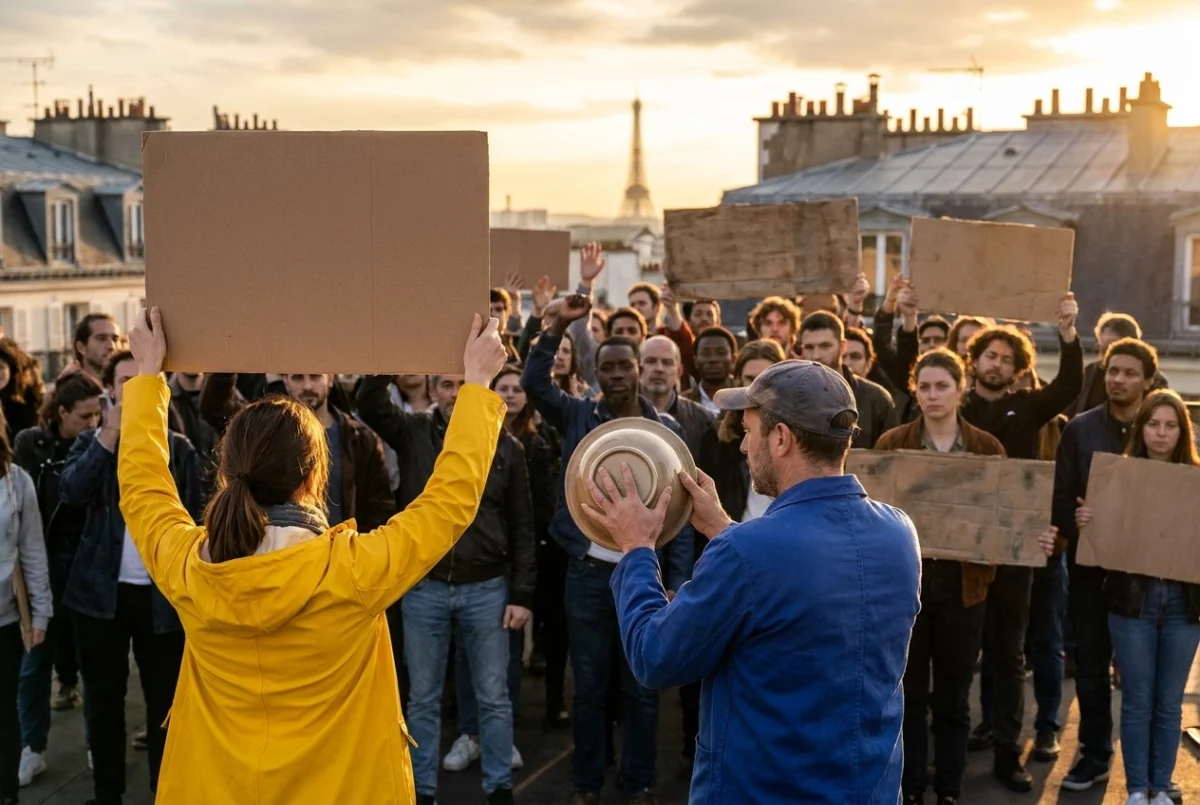
PARIS — For the sixth consecutive weekend, major European cities echoed with the chants, drums, and footsteps of tens of thousands of citizens demanding relief from an unrelenting economic squeeze. In France alone, an estimated 150,000 demonstrators took to the streets nationwide on Saturday, with approximately 21,500 gathering in the heart of Paris.
While the capital’s march proceeded largely without incident under the watchful eye of heavy police deployments, the broader movement reflects a deeply unsettled populace. What began in mid-October as localized student grievances regarding school conditions has rapidly transformed into a sprawling, continent-wide reckoning over soaring inflation, stagnant wages, housing unaffordability, and the erosion of public services.
As central banks grapple with monetary policy, governments scramble to offer fiscal concessions, and younger generations face a future of diminished economic mobility, the cost-of-living crisis has officially moved from a financial metric to a profound political and social flashpoint.
Main Facts: The Anatomy of Saturday’s Mobilization
The mobilization on Saturday underscored the sheer scale of public frustration. According to figures released by the Paris police prefecture, roughly 21,500 people marched through the French capital. Across the nation, approximately 150,000 participants voiced their anger over what organizers describe as an unbearable cost-of-living squeeze.
Demonstrators came from all walks of life, though the demographic makeup notably skewed young. Students, entry-level workers, and young families marched side-by-side, carrying banners demanding immediate intervention to lower the costs of energy, food, and housing. "We can no longer afford to live," echoed repeatedly through the crowds, encapsulating the sentiment of households crushed between escalating consumer prices and lagging wage growth.
While the Paris demonstration remained peaceful—with no immediate confirmations of mass arrests or injuries—the same could not be said for all corners of Europe. The French capital’s relative calm contrasted sharply with developments in Germany, where thousands gathered for largely orderly demonstrations before localized violence erupted in major urban centers including Frankfurt, Berlin, Cologne, and Hamburg. Meanwhile, in Spain, thousands took to the streets to protest housing costs and skyrocketing essentials, culminating in the nation’s first general strike over the issue in 14 years.
Chronology of the Crisis: From School Grievances to Continental Unrest
To understand how Europe arrived at this boiling point, it is necessary to retrace the timeline of the current wave of civil unrest.
- Mid-October: The movement trace its origins to localized demonstrations in France, where students and educators took to the streets to protest deteriorating school conditions, budget cuts, and institutional neglect.
- Late October: Recognizing a shared sense of economic precarity, these localized education protests rapidly absorbed broader societal grievances. The movement expanded to encompass runaway inflation, the soaring cost of housing, and declining public services. As demonstrations grew volatile in certain regions, President Emmanuel Macron announced a sweeping crackdown on public gatherings, banning unauthorized protests and deploying roughly 70,000 security personnel nationwide.
- November: The unrest metastasized beyond France’s borders. Spurred by synchronized spikes in global energy prices and food costs, similar demonstrations took root in Germany, Spain, and other European nations. Governments found themselves forced to balance public safety with the political necessity of addressing systemic financial distress.
- December: As winter set in, the European Central Bank (ECB) implemented a half-point interest rate hike—a slight deceleration from its previous three-quarter-point jumps, but a clear signal that the economy was flirting with recession. Despite government-offered concessions, weekend protests persisted.
- Present Day: Entering its sixth consecutive weekend, the movement has institutionalized into a recurring weekly expression of public discontent. While turnout in Paris dipped slightly following targeted government aid packages, the structural grievances remain entirely unresolved.
Supporting Data: The Global Economic Pressure Cooker
The raw anger in the streets is backed by hard economic data pointing to a systemic mismatch between household income and the cost of basic survival.
Official reports indicate that consumer prices and energy costs have skyrocketed globally, while wage growth has consistently failed to keep pace. The economic strain is not isolated to Europe. In the United States, data from the Bureau of Labor Statistics revealed that average weekly earnings dropped from $397.90 at the start of the Biden-Harris administration to $382.54, even as the Consumer Price Index registered a staggering 20.3 percent surge in prices, rendering the baseline cost of living exceptionally high for average workers.
Similar anxieties are reflected in international polling. A comprehensive July survey of 3,000 individuals conducted by the Financial Wellbeing Index found that 29 percent of Canadians harbored intense fears that they would be entirely unable to meet basic living expenses, such as food and energy bills.

Historical Parallels and Structural Drivers
Economists point to a confluence of monetary policy missteps, persistent supply-chain disruptions, and fractured energy markets as the primary catalysts for current inflation. Many draw parallels to historical economic shocks, such as the 1973 energy crisis, noting that the pillars of postwar prosperity frequently crumble when geopolitical tensions collide with resource dependencies. In response to past inflationary spirals—such as in 1975—central banks historically relied on aggressive interest rate hikes, pushing prime rates significantly higher to cool the economy, a playbook modern central banks are attempting to replicate today.
However, modern pressures extend beyond macroeconomics into corporate conduct and currency stability. Investigations into U.S. markets reveal that major corporations have paid nearly $100 billion in fines and settlements since 2000 to resolve allegations of covert price-fixing and antitrust violations—practices that artificially inflated consumer prices.
Furthermore, historical case studies, such as Jordan’s cost-of-living index between 1980 and 1995, demonstrate how currency devaluation and the abrupt removal of government subsidies can cause living costs to multiply exponentially in a matter of years. Reflecting these systemic fears, many modern protesters have carried signs demanding "honest money" and an end to aggressive fiat currency printing, criticizing central banks for what they view as systemic currency debasement. Analysts warn that even those households that entered this economic unraveling with a financial cushion remain vulnerable to the compounding pressures of high inflation and slowing economic growth.
Official Responses: Concessions, Crackdowns, and Political Fallout
Governments across Europe have found themselves walking a precarious tightrope between fiscal relief and authoritarian containment.
In France, the administration of Prime Minister Sébastien Lecornu has acknowledged past failings in addressing public unrest, particularly following scenes of severe public disorder that marked the earlier weeks of the movement. In an effort to defuse tensions, the government introduced targeted financial support measures and household concessions. According to financial analysts at Bloomberg, these measures likely contributed to the slightly lower turnout observed in Paris compared to previous weeks.
Yet, these concessions have been roundly criticized by opposition lawmakers as "too little, too late," with political rivals demanding more robust, systemic relief. The political fallout has been severe. President Emmanuel Macron initially attributed the riots, looting, and violence that marred early demonstrations to seditious far-left agitators and vandals, while maintaining that peaceful, union-led protests would be permitted.
The security crisis reached a boiling point when France’s interior minister at the time, Laurent Nuñez, made the stunning admission that authorities had temporarily lost control of the streets in several major cities during a weekend of intense rioting. Though Nuñez offered his resignation following the worst of the violence, President Macron declined it.
To regain control, the government deployed approximately 70,000 security personnel nationwide in late October and enacted aggressive bans on gatherings deemed illegitimate. The unrest prompted international concern, leading the U.S. Embassy in France to issue formal security alerts urging travelers to exercise extreme caution and avoid large public demonstrations.
Implications: What to Watch as the Movement Evolves
As the cost-of-living protests enter a critical phase, the long-term implications for European stability and global governance are profound.
- The Persistence of Grassroots Mobilization: Organizers have made it clear that weekend demonstrations will continue indefinitely if household costs remain stubbornly high and government measures fail to bridge the gap between wages and inflation. Even if peak turnout fluctuates week-to-week based on weather or the introduction of temporary state aid, the underlying infrastructure of the movement remains intact.
- Generational Alienation: Economists and sociologists note that the crisis has deeply alienated younger generations. What began as a dispute over education funding has morphed into a broader realization among youth that the traditional promises of social mobility, homeownership, and financial security are slipping out of reach within Europe’s sluggish economic climate.
- Investor Anxiety and Political Risk: Financial markets are watching these developments with mounting unease. Persistent social unrest poses a direct threat to political stability in core Eurozone economies, potentially forcing governments into reactive fiscal spending that could further complicate national debt trajectories.
What to Watch Next: All eyes will now turn to upcoming legislative sessions and central bank announcements. The central question remains whether additional state interventions can successfully alleviate household financial pressures, or if Europe is bracing for a protracted era of socioeconomic friction driven by a permanently altered economic landscape.