The modern world is defined by a paradox: we enjoy an unprecedented standard of living while existing on a razor’s edge of systemic fragility. Most citizens operate under the comfortable assumption that because history has been characterized by iterative problem-solving, future crises will be mitigated with similar ease. However, a growing body of systemic risk analysis suggests that this belief is a dangerous illusion. We are not merely facing a potential economic downturn; we are potentially witnessing the early stages of a cascading civilizational breakdown.
The Architecture of Our Fragility
The global economy is built upon a "just-in-time" philosophy that has prioritized extreme efficiency over structural redundancy. While this has lowered consumer costs, it has simultaneously stripped the system of its capacity to absorb shocks.
The Chokepoint Vulnerability
The disruption of the Strait of Hormuz serves as the primary case study for this systemic vulnerability. Analysts note that the interruption of such a narrow, vital corridor would not merely affect regional trade; it would propagate outward into a general crisis of civilization. The Strait is a literal artery for the global energy supply. Should the flow of oil and natural gas be throttled, the immediate result would not be a mere inconvenience but a total paralysis of the shipping and logistics networks that sustain every continent.
William Ophuls, in his seminal work Immoderate Greatness, identifies this as a "money illusion." This phenomenon disconnects our artificial, fiat-based economy from the physical, ecological reality of our resource dependencies. When the illusion shatters, the collapse will not revert us to the 1800s—a time of agrarian self-sufficiency—but rather to a state of total infrastructure failure, where the tools of modern survival have been forgotten or rendered obsolete by automation.
Chronology of a Cascade: How Systems Fail
The transition from a functioning society to a state of emergency is rarely instantaneous. It follows a predictable, albeit catastrophic, trajectory.
- The Energy Shock: It begins at the chokepoints. A geopolitical conflict or logistical breakdown in a region like the Persian Gulf halts the flow of hydrocarbons.
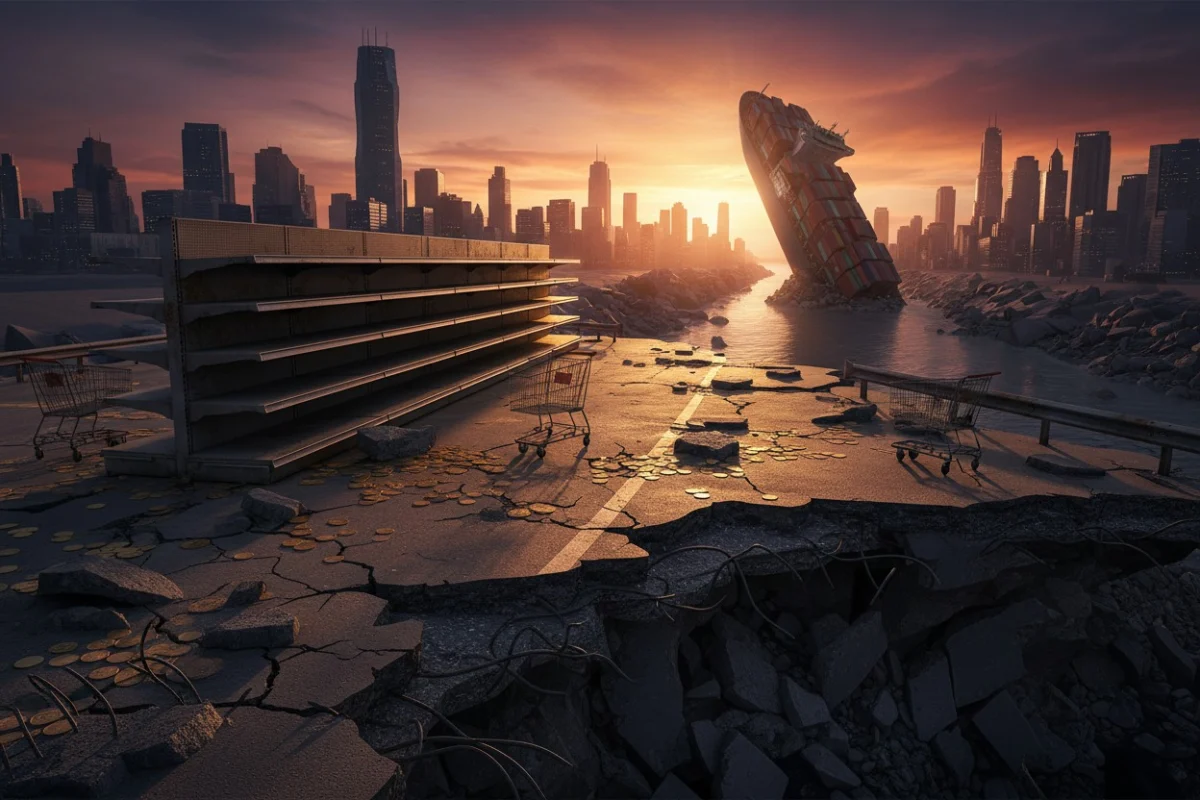
- The Logistics Paralysis: As fuel prices spike and supply chains stall, the "just-in-time" inventory systems of global retailers collapse. Within 72 hours, urban centers begin to experience inventory depletion.
- The Haber-Bosch Disruption: Because half of the global population is sustained by synthetic fertilizers produced via the Haber-Bosch process—which relies heavily on natural gas—an energy crisis quickly morphs into a global food crisis.
- The Social Threshold: As basic necessities become scarce, the social contract begins to dissolve. The first visible signals, according to observers like Matt Bracken, include the rapid looting of big-box retailers and grocery stores in major metropolitan areas.
- The Systemic Breakdown: Once the food supply chain is severed and the ability to distribute power is lost, the situation transitions from a "crisis" to a "collapse." Without maintenance, complex systems like water pumps, electrical grids, and automated steel mills fail, leaving a population that largely lacks the primitive skills required to repair them.
Supporting Data: The Math of Catastrophe
The reliance on industrial agriculture is perhaps our most precarious dependency. The Haber-Bosch process is essentially a way of "turning natural gas into food." When that link is broken, the result is not just a shortage, but an existential threat to billions.
Redundancy vs. Efficiency
David Holmgren, author of Future Scenarios, argues that a truly robust civilization requires significant fallback strategies. Instead, we have optimized our globalized system to the point where there is zero margin for error. Researchers, including David DuByne, suggest that we are currently seeing a convergence of civilizational cycles—a "global cataclysmic shift"—that renders the current decline unstoppable.
The "MuseLetter 309" presents a sobering analysis of what it calls a "good civilizational death." A manageable decline would be slow, localized, and deliberate. In contrast, our current trajectory is defined by extreme speed. Because we have eliminated all slack in our supply chains to maximize quarterly profits, the speed of our decline will be exponential rather than linear. The metaphorical tsunami is already forming, and the water has begun to recede from the shore.

The Official Response and the Vacuum of Leadership
To date, official government responses have remained largely focused on short-term market stabilization rather than systemic redesign. There is a palpable disconnect between the rhetoric of "economic recovery" and the reality of physical resource depletion.
Critics point out that governments have failed to devote resources to serious redesign strategies. Instead of building resilient, localized food and energy systems, the prevailing policy has been to prop up the existing, fragile machinery of dependence. This inaction has created a dangerous vacuum where the burden of preparation has shifted from the state to the individual.
Implications: The New Era of Self-Reliance
The implications of this trajectory are profound. If the global power structure fails to adapt, the world may enter a "warlord era," characterized by localized control of resources, the breakdown of currency, and the erosion of the nation-state.
The Shift Toward Hard Assets
As the trust in fiat currency wanes, the necessity for tangible, non-counterfeitable stores of value becomes paramount. Experts such as Andy Schectman, president of Miles Franklin, argue that physical gold and silver are the only viable hedges against the total collapse of the monetary system. When electronic ledgers go offline and digital banking grids are compromised, these metals become the only universally recognized, honest currency.
The Imperative of Skill Acquisition
The window to prepare is closing. For the modern individual, self-reliance is no longer a hobby; it is a prerequisite for survival. This involves:
- Decentralized Infrastructure: Learning to maintain independent water pumps, installing and managing solar-powered battery arrays, and understanding electrical wiring.
- Food Security: Transitioning from passive consumers to active producers. This includes stockpiling storable food and developing the ability to grow, preserve, and secure one’s own nutritional supply.
- Communication Resilience: Securing backup communications that operate outside the traditional internet and surveillance grids.
Conclusion: The Choice to Act
The evidence presented by systems theorists and geopolitical analysts is not intended as fearmongering, but as a logical projection of the dependencies we have constructed. We have built a machine that requires constant, perfect operation to sustain eight billion people. When that machine encounters an unavoidable obstruction—whether it be the closure of the Strait of Hormuz or a cascade of fertilizer shortages—the resulting fallout will be global in scope.
The path forward requires a sober acknowledgment of these realities. By moving away from the surveillance-based economy and toward decentralized, self-reliant living, individuals can insulate themselves from the worst of the coming volatility. The time to acquire these skills and secure these resources is now, while the lights are still burning, the shelves are still being stocked, and the currency still retains its purchasing power. The collapse is not a theory; it is a timeline, and it is already underway.