
The stairs are rarely the problem, but they are the messenger. Somewhere around the halfway point, the breath hitches, a knee registers a sharp, unwelcome protest, and a quiet, analytical part of your brain begins calculating the years of atrophy. It has been a long time—perhaps a lapsed gym membership gathering dust since your second child was born, or a fitness app deleted in frustration after the second week of a failed attempt at a 5k.
You are well aware that you should move more. Your primary care physician has mentioned it; your lower back has nagged you about it. Yet, every time you contemplate starting, the mental image is visceral and discouraging: a treadmill that feels like a machine of humiliation, the searing ache of neglected joints, and the suffocating sensation of breathlessness at the three-minute mark that confirms your darkest suspicion—that you have waited too long.
So, you do nothing. Another month slips by, and the deconditioning you fear gains another month of momentum. This is the authentic, unvarnished shape of starting an exercise regimen at 50 after two decades of sedentary living. It is not a question of "which workout" to choose; it is the pervasive, gating fear that your body has already closed the door, and that any attempt to push it open will only result in physical failure.
The reality, however, is quite different. The door is not locked; you are simply standing too far back to see it.
The Myth of the "Too Late" Threshold
Is 50 the finish line for physical vitality? The answer is a resounding no. The paralyzing fear hidden behind the question, "How do I start exercising at 50?" is usually a deeper, more existential worry: "Is it even worth the effort?"
According to federal health guidelines, physical activity is not a privilege of the young. Health organizations emphasize that individuals can begin or restart physical activity at any age. For most healthy adults, a gradual, low-intensity entry into movement does not even require medical clearance. The "too late" narrative is a psychological construct rooted in a fear of decline, not a physiological fact. Being deconditioned at 50 is not a verdict; it is merely a starting line.
Understanding the Fear of Public Failure
The resistance to starting often stems from a fear of exposure. You are not necessarily afraid of the exercise itself; you are afraid of starting at a level that highlights exactly how far you have slipped, potentially in front of others who are fitter and younger. After twenty years of relative inactivity, this fear is rational. However, it points you toward the wrong starting line. Entering a gym and attempting a high-intensity workout was never meant to be your first step; it is a milestone you reach somewhere around step forty.
The Biological Reality
Research continues to dismantle the timeline of decline that so many midlife adults fear. In one notable study, researchers trained adults who began the program 59% weaker than their younger counterparts. After just six months of twice-weekly resistance training, that strength gap narrowed to 38%, and the genetic markers of muscle aging actually reversed toward a more youthful profile. Your muscle tissue does not "know" your age; it knows whether it has been utilized within the last week. This is why building muscle in your 40s and 50s is not a lost cause, but a cornerstone of longevity.
Why the Midlife Restart Feels Different
Starting a fitness journey at 50 feels harder than it did at 30 because of two compounding factors: your body recovers more slowly, and years of sedentary habits have lowered your baseline. When you hit a wall at three minutes of exercise, you interpret it as proof that you are "broken."
You are not broken; you are simply deconditioned. Deconditioning is a physiological state, not a life sentence, and states change with consistent input. Most fitness advice is written for a 25-year-old who took a year off. It is not written for someone whose last meaningful exercise took place during the Clinton administration. When an article suggests you "start light" and defines "light" as a 30-minute jog, the mismatch is catastrophic. This is why so many midlife restarts collapse in the first seven days—the floor was set at someone else’s height.
The "Bottom-Up" Advantage
The sedentary body possesses a unique, often overlooked feature: it improves rapidly at the bottom. Those with the lowest baseline fitness see the most dramatic initial gains because there is significant room for physiological adaptation. A six-month study of previously sedentary women found that the most significant health improvements were recorded among those who started with the lowest fitness scores and the highest body weight. The further back you are starting, the more profound your initial wins.
The "Floor Method": Building Consistency Through Safety
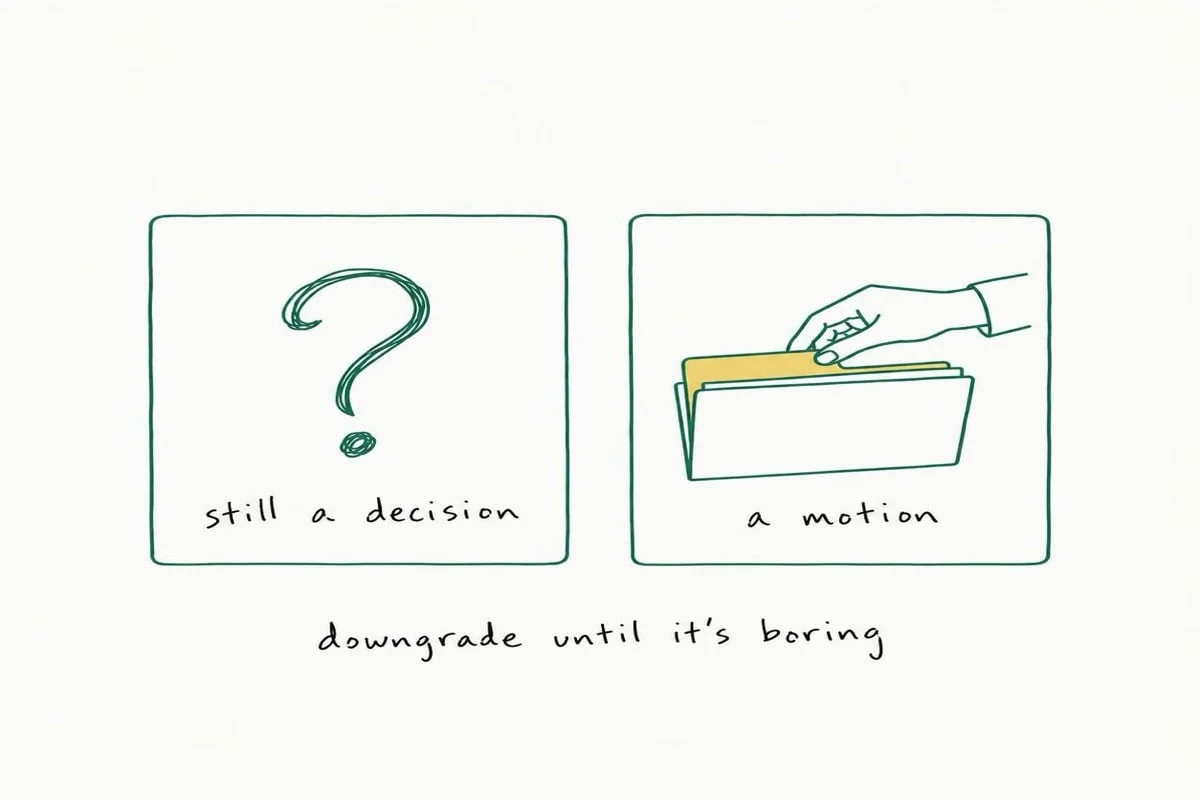
The secret to a successful midlife restart is not found in suffering. You do not earn fitness through pain. Instead, you build a "movement floor"—a level of activity so manageable that you can hit it even on your worst day.

The Philosophy of the Floor
The "floor method" is about creating a version of exercise that survives a bad night’s sleep, a flare-up of back pain, or a chaotic Tuesday. If your "floor" is a 10-minute walk, and you are exhausted, you walk for two minutes. You don’t quit; you just hit the floor. Suffering does not restart a sedentary body; repetition does.
The "no pain, no gain" mentality is a relic of your twenties that actively hinders you now. In your fifties, pain is not a badge of progress; it is the fastest route back to the couch. A punishing first week guarantees there will not be a second.
The Keystone Habit: Walking
Walking is the ultimate keystone habit. It requires no equipment, carries minimal injury risk, and quietly improves mood, appetite, and sleep quality. In one program, 74.5% of previously sedentary participants reached age-appropriate walking endurance, with a 92% attendance rate. The lesson is clear: a "suboptimal" program that you actually complete is infinitely more effective than a "perfect" program you abandon after three days.
Chronology: The 12-Week Progression
A well-tested 12-week protocol for the midlife beginner follows a "3-3-3" logic—a phased progression that builds upon itself without overwhelming the central nervous system.
- Weeks 1–4 (The Foundation): Focus on consistency. A 15-minute walk on three days a week. The goal is not intensity; the goal is to anchor the habit to a daily cue (e.g., after dinner or morning coffee).
- Weeks 5–8 (The Consolidation): Increase duration to 30 minutes on three days a week. By now, the cardiovascular system will begin to adapt, and the "winded" feeling will naturally recede.
- Weeks 9–12 (The Expansion): Maintain the 30-minute walks and begin introducing gentle strength work twice a week.
What Success Looks Like
By week six, the same 10-minute walk that once left you breathless will feel effortless. By week nine, the negotiation with your own willpower will largely disappear—it will simply become part of your identity. At this stage, you introduce bodyweight exercises: sit-to-stands from a chair, wall push-ups, and light carries. These are the levers that rebuild the muscle mass lost to decades of sitting.
Supporting Data and Medical Perspectives
The Joint Health Paradox
One of the most common hesitations for the 50+ demographic is the concern for joint health. However, clinical evidence suggests the opposite of what most people assume. In a landmark trial involving patients with knee osteoarthritis, low-to-moderate intensity exercise—specifically walking and resistance training—was found to reduce pain and disability more effectively than standard anti-inflammatory medications. Movement lubricates joints and strengthens the supporting musculature; inactivity, conversely, accelerates the degradation of joint health.
The Role of Multicomponent Training
As you advance past the first 12 weeks, integrating "multicomponent" training—a mix of aerobic activity, resistance training, and balance work—is vital. Research indicates that this specific trifecta can cut the risk of fall-related injuries by approximately 32% in older adults.
Essential Medical Cautions
While exercise is universally beneficial, those with specific conditions—such as peripheral neuropathy or chronic nerve issues—should proceed under the guidance of a clinician. In such cases, the "floor" remains a valid concept, but the activities chosen should be low-impact and balance-supported, such as recumbent cycling or aquatic therapy. The goal is to avoid injury, not to test your pain tolerance.
Implications: A New Trajectory
The implications of restarting at 50 extend far beyond the gym. Movement is a domain that feeds into all others. As your physical capacity increases, you will likely find that your professional energy levels improve, your sleep becomes more restorative, and your overall emotional resilience grows.
If you view this as a "fitness goal," it will likely fail. If you view it as a structural rebuild of your daily life, it will succeed. You have spent decades teaching your body that movement is optional. It only takes one quiet, unimpressive, consistent walk to begin teaching it something new.
The hardest part of starting at 50 is not the physical demand. It is the challenge of starting smaller than your pride wants you to. But remember: your body doesn’t need you to be a hero today. It just needs you to start. The rest is simply a matter of time and repetition.