Marcus, 49, can pinpoint the exact year the trade stopped paying dividends. He is seventeen years into a high-stakes sales career, a journey defined by 60-hour weeks, a smartphone that never rested, and a permanent state of professional vigilance. For nearly two decades, he operated on the premise that visible strain was the currency of ambition. But lately, the math has soured. The raises that once justified his exhaustion have plateaued, and the physical recovery time required after a grueling week has doubled.
Marcus is not alone. He represents a massive, overlooked demographic: the mid-career professional who bought into the “hustle culture” of the 2010s and is now realizing that the exchange rate for their time has fundamentally shifted. This is not a story about burnout in the traditional sense; it is a story about the economics of aging in a labor market that is still trying to sell 25-year-old expectations to 50-year-old realities.
The Architecture of Hustle: A Chronology of an Ideology
To understand why so many high-achievers feel trapped, we must recognize that "hustle culture" is an ideology rooted in the control of time, not the measurement of output. While the word "hustle" traces its etymology to the 1680s Dutch hutselen—to shake or toss—it took on its modern, aggressive American commercial sheen by the late 19th century.
However, the specific iteration that dominated the last decade was forged in the digital crucible between 2014 and 2019.
- 2014: The "Rise and Grind" ethos transitioned from a niche entrepreneurial aspiration to a mass-market digital ritual.
- 2018: The ideology reached peak institutionalization with the publication of Daymond John’s Rise and Grind, effectively codifying the "outwork and outhustle" mantra into the professional canon.
- Late 2018 – 2019: The backlash was swift. During the 2018 Web Summit, Reddit cofounder Alexis Ohanian famously dubbed the movement "hustle porn," labeling it a toxic, dangerous obsession with performative suffering. Shortly thereafter, the New York Times brought the term "hustle culture" into the mainstream, cementing its status as a defining cultural tension of the decade.
Despite this critique, experts like David Spencer, head of the economics division at the University of Leeds, argue that this was never a mere fad. Rather, it was a systemic effort by institutions to venerate overwork as a way to obscure the increasingly unappealing nature of modern labor. As sociologist Tressie McMillan Cottom noted, the 2010s saw a massive transfer of risk from institutions to individuals, masked by the seductive language of "personal ambition."
The Inconvenient Truth: The Trade Worked (Until It Didn’t)
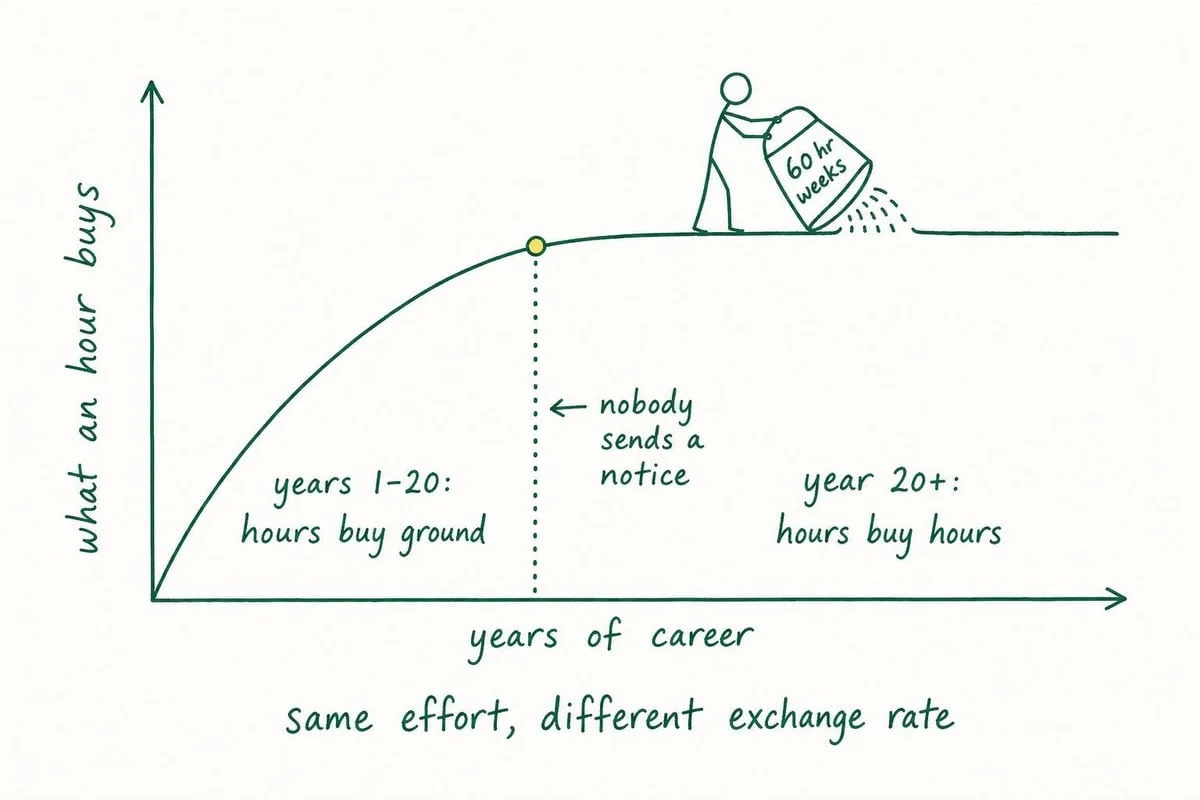
Most critiques of hustle culture fail because they dismiss the initial success of the model. For the first 20 years of a career, the "hustle" often delivers on its promises. Global wage data confirms that earnings profiles typically rise for the first two decades of experience before flattening. In the United States, a worker with 20 years of experience typically commands a salary 75% higher than their starting point.
When you were 29, picking up the extra account or catching a Sunday flight wasn’t a delusion; it was a calculated investment at the bottom of a steep growth curve. It was a rational bet. The crisis occurs because no one sends a formal notice when that curve flattens. The returns on an additional hour of labor drop precipitously once you cross the 20-year mark, yet the habit of working 60 hours remains deeply ingrained.
Supporting Data: The Triple-Clock Penalty
The decline in the value of an "extra hour" is governed by three distinct clocks, all of which accelerate as a professional enters their late forties:
1. The Output Clock
Research from Stanford economist John Pencavel demonstrates that the relationship between hours and output is non-linear. Below 49 hours, productivity scales proportionally. Beyond 50 hours, the return diminishes rapidly. By the time a worker reaches 60 hours, the additional input provides almost zero marginal utility. Modern studies on knowledge work and call center performance confirm this: increasing hours by 1% often results in less than 1% growth in output. Essentially, the professional becomes "busy" rather than "productive," suffering from a worsening exchange rate.

2. The Earnings Clock
Administrative tax data reveals that the probability of significant earnings growth begins to shrink steadily between the ages of 25 and 45. For the vast majority of workers, peak median earnings are reached in the mid-forties and then hold flat. Unless one is a graduate-degree holder with a specific professional trajectory, the "hustle" is no longer buying a higher salary; it is merely buying the maintenance of a status quo.
3. The Health Clock
This is the most critical and ignored factor. A massive study by the WHO and ILO found that working 55 or more hours per week carries a 35% higher risk of stroke and a significantly elevated risk of heart disease compared to a standard 35-40 hour week. These costs are often deferred for decades, meaning the "bill" for working 60 hours at 32 is being collected at 49.
The Internalized Compulsion: Why Leaving Is Hard
The most profound realization for the mid-career professional is that while the culture is external, the compulsion is internal. Occupational psychologists distinguish between "working excessively" (a behavior) and "working compulsively" (a cognitive state).
Many professionals who transition to lower-stress roles find themselves "inventing work" to fill the void. This is the hallmark of toxic productivity: the inability to exist in the gap after the external pressure lifts. Dana, a 52-year-old executive who recently switched firms, described the quiet of a 9-to-5 as "slipping." Her struggle was not with the company’s demands, but with her own reflexive need to prove her worth through constant output.
Implications: The Four-Move Exit
Leaving hustle culture is not about submitting a resignation letter; it is about re-engineering one’s relationship with time. Based on psychological meta-analyses, the transition involves four evidence-based moves:
- The Hard End: Do not try to shorten the entire week at once. Pick one day—say, Thursday—and enforce a "hard stop" at a predetermined time. This forces the brain to practice detachment, which is proven to be a vital input for next-day performance.
- Activity Selection: Choose evening activities for their capacity to induce detachment, not for their "productivity." A walk that involves rehearsing tomorrow’s meeting is not recovery; it is just work in a different location.
- Recovery as Input: Stop treating downtime as a reward for surviving the sprint. View recovery as a necessary component of the work itself, similar to how an athlete views sleep or nutrition.
- Defined "Enough": Before the week begins, define exactly what success looks like by Friday. Everything else is optional. This prevents the "inexhaustible" nature of hustle culture from dictating your schedule.
The Path Forward: A New Professional Identity
The data suggests that the fear of "losing ground" at 50 is largely unfounded. Longitudinal studies show that late-career earnings declines are primarily driven by the choice to reduce hours, not by a market-wide devaluation of the older worker’s hourly rate.
Furthermore, the workplace itself is changing. Recent data from Pew Research indicates that while 84% of workers over 50 still feel the need to do "more than expected," younger cohorts are increasingly prioritizing balance. The professional over 50 is often holding onto a line that has already shifted, a position that is both physically and economically expensive.
Marcus’s journey proves that this shift is possible without professional suicide. By moving his hours rather than cutting them, and by defining his "enough" in advance, he maintained his competitive edge while regaining his life. He is still a high achiever, but he has stopped paying 1891 prices in a 2026 world. The goal for the mid-career professional is not to downshift into irrelevance, but to move from a life of compulsive production to one of high-leverage intentionality.
Ultimately, the most productive move you can make is to realize that the trade has changed—and you are finally free to stop overpaying.