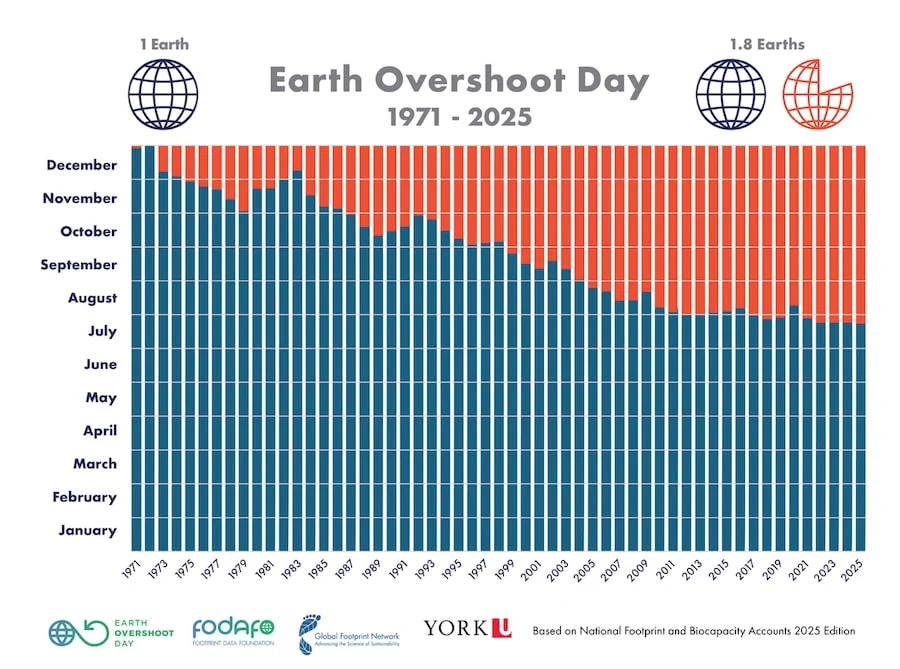
In a sobering reminder of the planet’s finite capacity to sustain human activity, July 24, 2025, has been marked as the earliest Earth Overshoot Day since the Global Footprint Network (GFN) began tracking resource consumption in 2006. This date represents the precise moment in the calendar year when humanity’s demand for natural resources—including food, timber, fiber, and carbon sequestration—exceeds what Earth’s ecosystems can regenerate over the entire 12-month period.
By mid-year, humanity had already exhausted the annual "budget" provided by nature, effectively entering a state of ecological deficit. For the remainder of 2025, the global population is operating on "borrowed time," consuming capital stocks—such as the depletion of fish populations, the destruction of forests, and the accumulation of carbon dioxide in the atmosphere—rather than living off the interest of the planet’s natural renewal cycles.
A Chronology of Consumption: How We Reached the Brink
To understand the gravity of the current situation, one must look at the historical trajectory of human consumption. While the concept of Earth Overshoot Day was formalized in 2006 by political economist Andrew Simms in partnership with the Global Footprint Network, researchers have since applied modern data modeling to retrospective years to track the trend line of human impact.
The mid-20th century marked a pivot point in human history. In 1972, humanity was still living within its ecological means, with the "Overshoot Day" falling on December 31. This suggests that as recently as five decades ago, the global consumption of resources was largely in balance with the planet’s biocapacity.
However, the late 1970s signaled a shift. By 1979, the date had crept back to November 3. Throughout the 1980s, despite some fluctuations, the trajectory showed an unmistakable downward slide. By 1989, the date had reached October 12. As the global economy industrialized further and population growth surged, the pace of resource extraction accelerated. By the turn of the millennium in 1999, Overshoot Day arrived on September 25.
When the GFN first began reporting the data in 2006, the date was August 22. The arrival of the "July threshold" in 2018 marked a significant psychological and environmental milestone. Aside from a temporary reprieve in 2020—caused largely by the global economic slowdown associated with the COVID-19 pandemic—the date has consistently hovered in late July. The 2025 record of July 24 edges out the previous record of July 25, set in 2022 and 2023, confirming that despite global climate pledges, the structural reliance on over-consumption remains deeply entrenched.

Supporting Data: The 1.8 Planet Reality
The core metric behind Earth Overshoot Day is the comparison between the Earth’s "biocapacity" (the amount of productive area available to generate resources and absorb waste) and the "Ecological Footprint" (the amount of productive area required to support human consumption).
Currently, humanity is utilizing nature at a rate 1.8 times faster than the Earth’s ecosystems can regenerate. This implies that to sustain our current global lifestyle, we would require the resources of 1.8 Earths. If the entire world population lived like the average resident of the United States, that requirement would jump to nearly five planets.
This deficit is not merely an abstract accounting error; it manifests in tangible ecological degradation:
- Carbon Overload: A massive portion of our footprint is attributed to carbon emissions. We are emitting far more CO2 than the world’s forests and oceans can sequester, leading to a cumulative warming effect.
- Resource Depletion: Freshwater tables are dropping, topsoil is eroding at an unsustainable rate, and global fisheries are being harvested faster than they can replenish.
- Planetary Boundaries: According to recent environmental science, humanity has now exceeded seven of the nine identified "planetary boundaries"—the threshold levels of human impact that, if crossed, could cause irreversible damage to the stability of the Earth system.
Official Perspectives: The Cost of Inertia
The scientific community and environmental advocates have responded to the 2025 data with a mixture of alarm and a call for radical systemic change. Lewis Akenji, a board member of the Global Footprint Network, emphasized the cumulative nature of the crisis.
"We are stretching the limits of how much ecological damage we can get away with," Akenji noted in the official 2025 announcement. "It is now a quarter into the 21st century and we owe the planet at least 22 years of ecological regeneration, even if we stop any further damage now."
Akenji’s statement highlights a critical misunderstanding in public policy: the belief that returning to "zero growth" in consumption is sufficient. In reality, because we have been in an ecological deficit for decades, the planet is in a state of debt. To restore the Earth, we must achieve net-positive regeneration, not just net-zero impact.

Mathis Wackernagel, the co-founder of the Global Footprint Network, framed the choice as an existential binary. "Because of the nature of physics, overshoot cannot last," Wackernagel stated. "It will end either by deliberate design or dumped-on disaster. It should not be too hard to choose which one is preferable, particularly in light of so many possible choices."
The Power of Possibility: Pathways to Correction
The Global Footprint Network’s "Power of Possibility" campaign argues that reversing this trend is technically and economically feasible, provided there is the necessary political will. The campaign outlines specific, high-impact levers that could shift the date back toward December:
- Energy Transition: Shifting the global energy mix to 75% renewable electricity would push the date back by 26 days. This is perhaps the most significant single action that could be taken, given the weight of the carbon footprint in our total ecological impact.
- Carbon Policy: A global effort to cut carbon emissions by 50% would shift the date by approximately three months, effectively moving Overshoot Day from July to October.
- Food Systems: Reducing global food waste by 50%—a goal already targeted by several UN Sustainable Development Goals—would gain the planet 13 days of breathing room.
- Structural Reform: Implementing a "Green New Deal" at a global scale, involving massive investments in sustainable infrastructure, circular economy practices, and regenerative agriculture, could shift the date by an estimated 42 days.
Implications: The Looming Choice
The implications of failing to act are profound. As we continue to operate in an ecological deficit, the resilience of the systems we depend on—food security, water stability, and climate moderation—is rapidly deteriorating.
The "dumped-on disaster" that Wackernagel warns of is already visible in the form of extreme weather events, biodiversity loss, and resource-driven migration. Each year that Overshoot Day arrives earlier, we tighten the constraints on future generations, leaving them with fewer resources and a more volatile climate.
However, the "deliberate design" path remains open. The technologies required for this transition—solar and wind energy, regenerative farming techniques, and circular manufacturing—are already available. The challenge is no longer one of innovation, but of implementation at a pace that matches the speed of our destruction.
As we look toward the remainder of 2025, the date of July 24 serves as a mirror. It reflects a society that has prioritized short-term extraction over long-term stability. Changing that date in 2026 and beyond will require a fundamental shift in how we value nature, how we measure economic success, and how we define the parameters of progress. The choice, as the experts suggest, is ours to make.