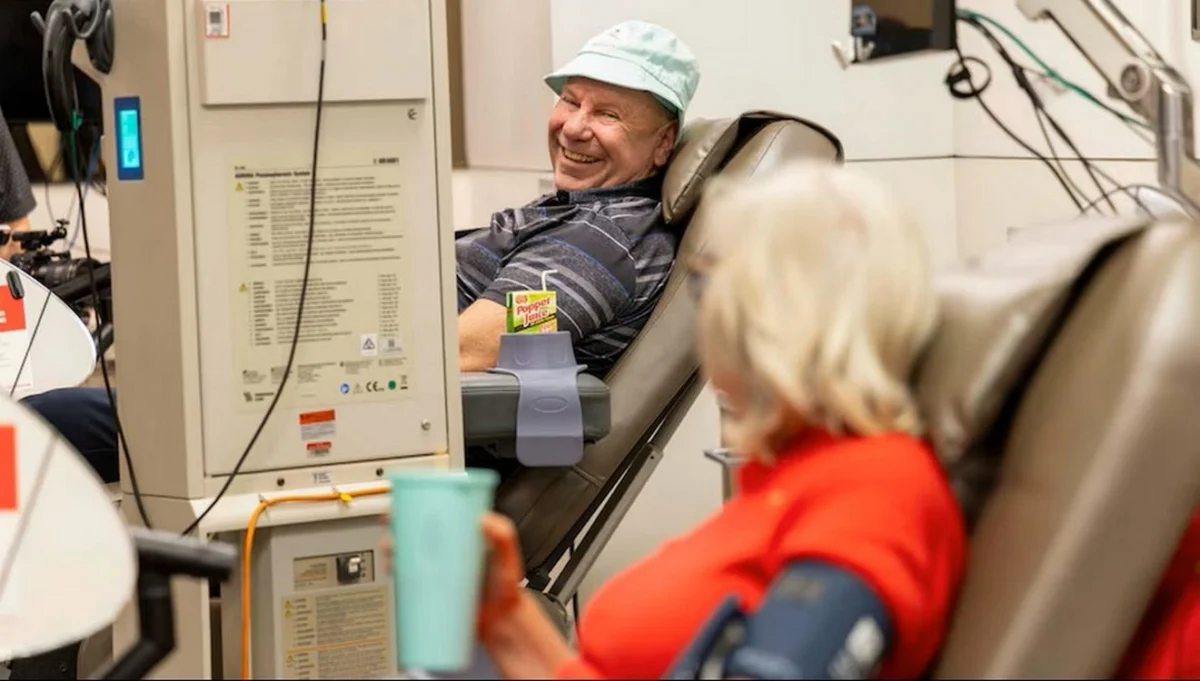
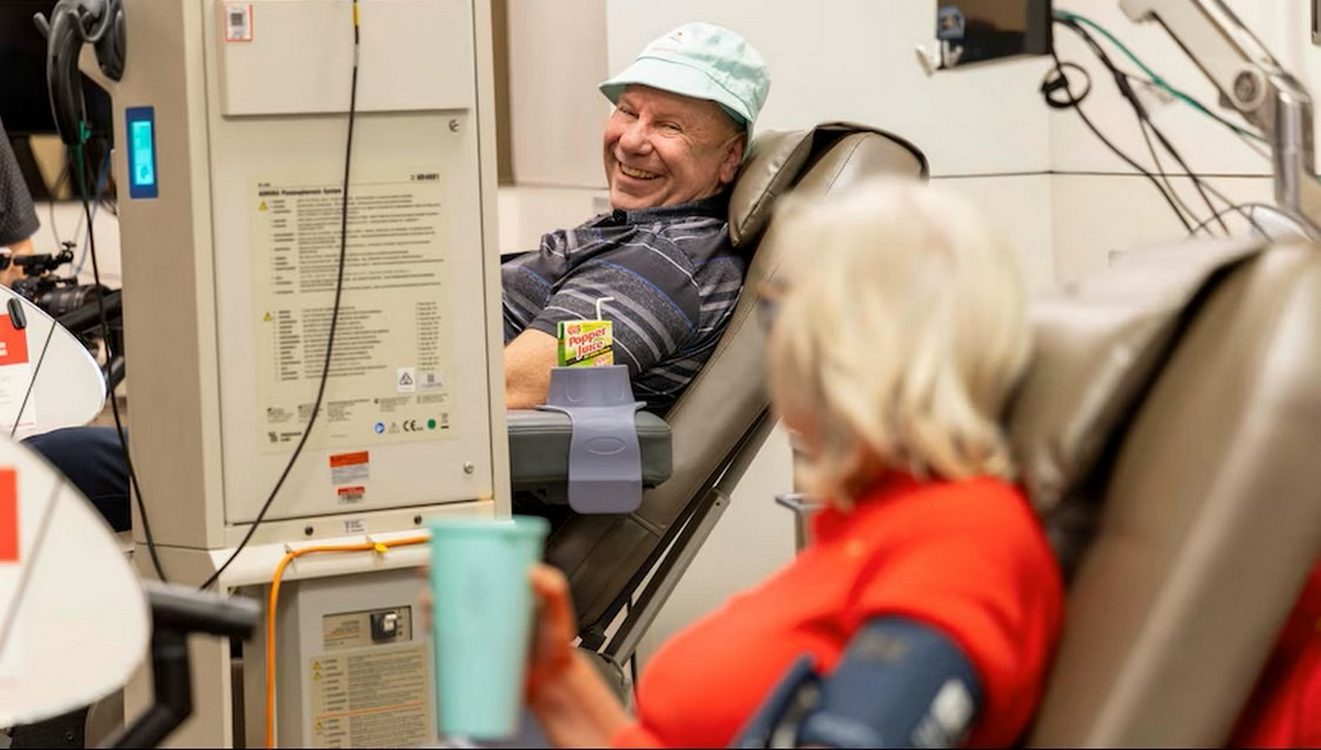
CANBERRA, AUSTRALIA — In a remarkable convergence of public service, personal adventure, and medical altruism, 59-year-old Melbourne police officer Trevor Bergman has achieved what no other individual is known to have accomplished. Sipping a juice box and sharing a lighthearted joke with staff—a universal ritual for post-donation recovery—Bergman completed his cross-country hemo-marathon in Canberra, officially checking off the final location on a uniquely ambitious map: all 85 Australian Red Cross Lifeblood donation centers across the entire continent.
Over the course of his extraordinary journey, Bergman rolled up his sleeves 545 times. His blood is not merely valuable; it is biologically scarce. Bergman is one of only an estimated 150 people in all of Australia known to carry the specialized anti-D antibody, a vital component utilized to protect unborn children from hemolytic disease.
From the sun-baked expanses of Western Australia to the tropical humidity of Darwin, and all along the sprawling eastern seaboard, Bergman’s donations have quietly supported patients in virtually every corner of the “Land Down Under.” His final, milestone donation in the nation’s capital was elevated by the presence of Australia’s representative to the Crown, Governor-General Sam Mostyn, who sat beside him to donate blood in tandem, honoring a feat that has captured the nation’s heart.
Main Facts: The Lifesaving Biology of Trevor Bergman
To understand the magnitude of Bergman’s achievement, one must understand the microscopic landscape of his blood. Bergman carries the anti-D antibody, a rare and precious physiological trait. In medical terms, anti-D immunoglobulin is critical for preventing hemolytic disease of the newborn (HDWN).
This devastating condition occurs during pregnancy when an expectant mother is Rh-negative and her developing fetus is Rh-positive. If the mother’s immune system recognizes the baby’s blood cells as foreign, it can mount an immune response, producing antibodies that attack the infant’s red blood cells. This can lead to severe anemia, brain damage, heart failure, or even be fatal to the newborn.
By utilizing plasma derived from donors like Bergman who possess the anti-D antibody, doctors can administer injections to Rh-negative mothers. These injections neutralize the threat before the mother’s immune system can sensitize and attack, effectively safeguarding the health and lives of thousands of newborns.
With only about 150 individuals in a nation of over 26 million people identified as carriers of this specific antibody, Bergman belongs to an elite, indispensable class of biological donors. His contributions are not just helpful; they are irreplaceable building blocks in Australia’s perinatal healthcare infrastructure.
Chronology: From a Casual Holiday Thought to a National Odyssey
The seeds of this continent-spanning endeavor were planted far from home, born out of a simple travel observation.
The Spark in the West
While vacationing in Perth, Western Australia—thousands of miles away from his home base in Melbourne—Bergman happened to walk past a local blood bank. Rather than walking by, he stepped inside to roll up his sleeve.
"When I went past the blood bank there and donated there, I just thought, ‘Well, I’m on holiday here, what a good way to see Australia,’" Bergman recounted in an interview with Australian Broadcasting Corporation (ABC) News AU.
What began as a spontaneous, civic-minded detour during a holiday gradually evolved into a grand strategy. Bergman realized that his regular donation schedule could be synchronized with explorations of the Australian landscape. Over the subsequent months and years, his personal travel itinerary became entirely dictated by the locations of Australian Red Cross Lifeblood centers.
Navigating the Map
Bergman’s mission transformed into a methodical tour of Australia’s vast geography. He mapped his life around the chair, the needle, and the collection bag.
- The East Coast: He methodically worked his way up the populated eastern corridor, stopping in regional hubs and major metropolitan centers alike.
- The Red Centre and the Top End: He ventured across the Nullarbor Plain to Western Australia, pushed north into the tropical climate of Darwin, and visited clinics tucked away in remote regional outposts.
- The Scenic Detours: "I’ve been able to go all the way up the east center, all the way over to Western Australia, up to Darwin—places that I probably never would have gotten to see," Bergman reflected.
The Inevitable Bump in the Road
Even the most dedicated marathoner encounters hurdles. Among his dozens of memories across 85 cities, Bergman noted that his most memorable—and humbling—visit occurred in the coastal city of Albany, Western Australia.
Upon arriving at the local center, eager to maintain his streak, staff members evaluated his health and gently turned him away. Bergman had arrived with "a sniffle." Reminded that even the most zealous donors must protect the safety of the blood supply by remaining completely healthy, Bergman had to pause, recover, and return later to fulfill his mission.
The Grand Finale in Canberra
The journey reached its literal and symbolic culmination in Canberra, the nation’s capital. To mark the completion of all 85 centers, Bergman was joined at the Australian Red Cross Lifeblood center by Sam Mostyn, Australia’s Governor-General and representative to the Crown. In a powerful display of solidarity, Mostyn sat in the adjacent chair, donating blood alongside the veteran police officer to commemorate his 545th donation and the closing of his nationwide loop.
Supporting Data: The Staggering Scale of Australian Blood Needs
While Trevor Bergman’s journey is exceptional for its geographic breadth and frequency, the underlying statistics surrounding blood collection in Australia highlight why everyday donors are so vital.
According to data compiled by Australian Red Cross Lifeblood:
- One in Three: Statistically, 1 in 3 Australians will require donated blood or blood products at some point in their lifetime. Whether through accidental trauma, major surgeries, cancer treatments, or childbirth complications, the demand is continuous and inescapable.
- Every Single Day: Australia requires over 33,000 donations every single week to meet the demands of hospitals and emergency rooms nationwide.
- The Perishable Nature of Blood: Whole blood has a remarkably short shelf life—typically around 42 days—while platelets last a mere 7 days. Because blood cannot be manufactured artificially on a commercial scale, the supply chain relies on a perpetual, unbroken chain of human generosity.
Bergman’s 545 donations represent an astonishing level of personal commitment. While a standard whole blood donor is generally limited to giving every 12 weeks, plasma and specialized antibody donors like Bergman can often donate more frequently under strict medical supervision. Over his lifetime of service, both as a police officer upholding the law and a donor preserving life, Bergman has quietly sustained an output that has touched countless Australian families.
Official Responses and Public Acclaim
The completion of Bergman’s journey drew praise from high-ranking officials, healthcare advocates, and ordinary citizens alike, transforming a quiet act of medical charity into a moment of national celebration.
The Governor-General’s Commendation
The participation of Governor-General Sam Mostyn in Canberra was more than just a photo opportunity; it was an institutional endorsement of civic duty. By donating blood side-by-side with Bergman, Mostyn underscored the profound impact that ordinary citizens can have on the national fabric.
"Trevor represents the very best of the Australian spirit—dedication, quiet perseverance, and a deep, abiding care for his fellow countrymen," representatives noted of the collaborative event. The presence of the Crown’s representative signaled that Bergman’s marathon was recognized at the highest levels of Australian governance as an act of extraordinary public service.
Australian Red Cross Lifeblood’s Gratitude
For the nurses, phlebotomists, and administrators who operate Australia’s 85 donation centers, Bergman is something of a legendary figure. Staff members across the country grew accustomed to his visits, welcoming him with the standard post-donation amenities—cups of water, fruit juice boxes, and light snacks—while marveling at his unique travel log.
Lifeblood representatives emphasized that while few people can replicate visiting all 85 centers, every single Australian who walks through their doors plays a role in a national ecosystem of care. Bergman’s story, they noted, serves as an invaluable public awareness campaign for anti-D donations, a category of blood product that desperately needs more eligible candidates to step forward.
Implications: Inspiration, Rare Blood Awareness, and the Road Ahead
Trevor Bergman’s remarkable hemo-marathon leaves a legacy that extends far beyond the personal satisfaction of completing a unique travel bucket list.
Boosting Awareness for Rare Blood Types
One of the most significant implications of Bergman’s media-documented journey is the spotlight it shines on rare blood components like anti-D. Many individuals go through life entirely unaware of their blood’s specific antibody makeup. By sharing the story of how anti-D protects newborns from hemolytic disease, public health advocates hope to inspire other eligible Australians to get tested and register as specialized donors.
The Intersection of Tourism and Altruism
Bergman inadvertently pioneered a new genre of domestic tourism: purpose-driven travel. By using blood donation as his compass, he discovered hidden gems, regional communities, and landscapes that standard holidaymakers frequently overlook. His journey demonstrated that civic engagement does not have to pause when we leave our hometowns; rather, it can serve as a bridge to connect with new communities across the country.
A Lasting Legacy in Blue and Red
As a career police officer, Bergman has spent decades protecting the public safety of Victorians. By extending that ethos of protection into the medical sphere—safeguarding pregnant mothers and vulnerable newborns across all six states and two mainland territories—he has lived a dual life of service.
Now, with all 85 centers checked off his list, 545 donations logged, and a final juice box finished in the nation’s capital, Trevor Bergman can look back on a map defined not by borders, but by boundless empathy. His journey stands as a stirring reminder that one person, armed with a rare biological gift and an unwavering sense of purpose, truly can touch every corner of a nation.