You are currently standing at a crossroads. Perhaps it is a high-stakes job offer that requires an answer by Friday, a mortgage commitment that stretches your financial limits, or a side hustle you have been propping up for two years despite diminishing returns. You look to the "Best Books on Decision Making" lists that dominate the literary landscape, and you find a recurring, frustrating pattern: a stack of academic titles headed by Daniel Kahneman, followed by nine others that offer philosophical depth but little actionable guidance for your immediate crisis.
The problem with most reading lists is that they are sorted by sales rank or author pedigree, not by the specific nature of your dilemma. When you are in the thick of a choice, you don’t need a comprehensive history of behavioral economics; you need a tool. This guide reevaluates the genre, discarding the "nature documentaries" of the mind in favor of functional, drill-based strategies that actually change your decision-making outcomes.
The Methodology: How We Graded the Classics
To curate this list, we moved away from established literary rubrics and focused on three pragmatic questions:
- Does this book provide a concrete, repeatable drill?
- Is there evidence that the strategy can improve decision accuracy?
- Does the author distinguish between theoretical insight and practical application?
The first question carries the most weight. In the realm of decision science, "practice" is the gold standard. Research from geopolitical forecasting tournaments—sponsored by the U.S. intelligence community—revealed that a training module lasting under an hour improved accuracy by 6 to 11 percent. These studies suggest that structured drills, not passive reading, are the true engine of improved judgment. If you finish a book without running a drill, you haven’t improved your decision-making; you’ve simply been entertained by your own cognitive processes.
The Seven Essential Titles for Decision Makers
1. Decisive: How to Make Better Choices (Chip and Dan Heath)
The Heaths argue that we often decide within a frame drawn by others. We ask, "Should I take this job?" rather than, "What are the three best ways I could spend the next two years?" This narrowing of vision is a common corporate trap. Their WRAP sequence—Widen your options, Reality-test your assumptions, Attain distance, and Prepare to be wrong—is designed to dismantle this bias.
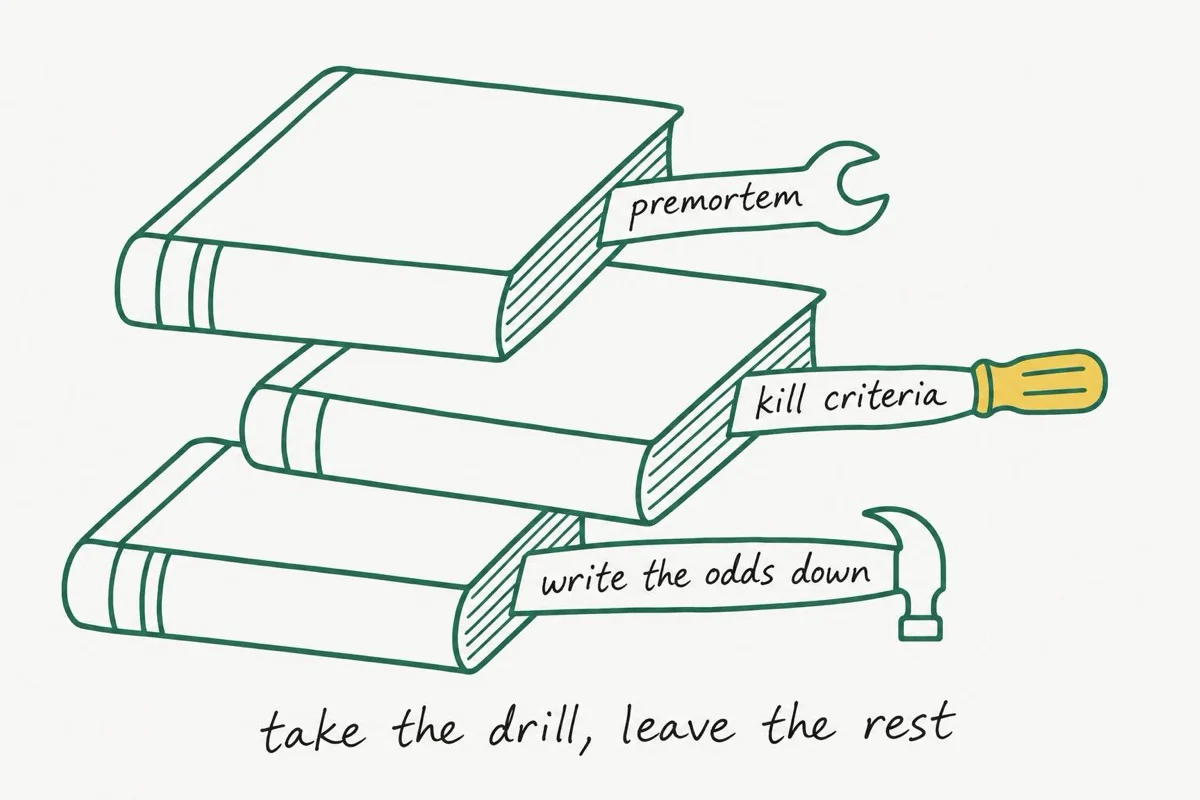
- The Essential Drill: The Premortem. Assume the decision has already failed, then write down the reasons why. Gary Klein’s research indicates that this form of prospective hindsight increases our ability to identify future failure points by roughly 30 percent.
2. Quit: The Power of Knowing When to Walk Away (Annie Duke)
While most books focus on choosing, Duke focuses on stopping—a skill few people schedule. The power of this book lies in setting "exit conditions" while your emotions are neutral. By deciding, for example, that you will shutter a business if it hasn’t cleared $2,000 by March 31, you remove the emotional burden of "losing" when the deadline arrives.
- The Essential Drill: Write your kill criteria in advance, including a specific date and a specific metric.
3. Thinking in Bets (Annie Duke)
Duke’s work is vital for those who suffer from "resulting"—the tendency to judge a decision based on its outcome rather than the quality of the process. If you take a job and the company folds, you might assume you made a bad choice. In reality, you may have made a sound choice based on the information you had at the time.
- The Essential Drill: Create a decision log. Write down your reasoning before the outcome is known to prevent hindsight bias from rewriting your history.
4. Thinking, Fast and Slow (Daniel Kahneman)
This is the seminal text that introduced the world to the "fast" (automatic) and "slow" (effortful) systems of the brain. It is the gold standard for understanding anchoring, loss aversion, and overconfidence.
- The Essential Drill: Treat instant certainty as a signal to slow down. When you feel an immediate, intuitive urge to decide, force a deliberate pause to engage your "System 2" thinking.
5. Noise: A Flaw in Human Judgment (Daniel Kahneman, Olivier Sibony, Cass Sunstein)
While bias pushes judgment in one direction, noise is the scatter. The authors demonstrate how the same expert—or two different experts—will reach wildly different conclusions based on arbitrary factors like the time of day or the order of information.
- The Essential Drill: Decision hygiene. If you are working in a group, ensure that every individual writes their judgment independently before any discussion occurs to prevent the "swallowing" of views by the loudest voice.
6. Smart Choices (Hammond, Keeney, and Raiffa)
This is perhaps the most procedural book on the list. It ignores the fluff and focuses on objectives, alternatives, consequences, and trade-offs.

- The Essential Drill: Build a consequences table. It forces you to map out exactly which objectives you are trading off, often exposing an option that is inferior in every category.
7. Superforecasting (Philip Tetlock)
Hard choices often hide a forecast: "Will this role exist in three years?" or "Will this neighborhood hold its value?" Tetlock’s research shows that the best forecasters are those who break questions into smaller pieces and update their beliefs in small increments.
- The Essential Drill: Write down a specific probability for an outcome and a "resolution date." Scoring yourself on your own predictions is the most painful—and effective—way to learn.
Supporting Data and The "Warning Labels"
It is crucial to acknowledge that some of the research underpinning this genre is shifting. For example, a much-cited study regarding "dishonesty" and the placement of signatures on forms was retracted in 2021. Furthermore, while Thinking, Fast and Slow remains a masterpiece, Kahneman himself has acknowledged that he placed too much faith in underpowered social-priming studies in one of the book’s chapters.
When building a personal policy for decision-making, always check the validity of a "striking behavioral finding." If a piece of advice sounds too clever to be true, it often is. We recommend viewing these books as a toolkit for your personal board of directors, not as infallible gospels.
The Table: Matching the Book to the Problem
| Book | Best For | The Drill |
|---|---|---|
| Decisive | Immediate, high-stakes choice | Premortem |
| Quit | Ending a failing endeavor | Kill criteria with a date |
| Thinking in Bets | Post-decision regret | Decision log |
| Thinking, Fast and Slow | Self-awareness | Pause for System 2 |
| Noise | Group dynamics | Independent written judgment |
| Smart Choices | Procedural mapping | Consequences table |
| Superforecasting | Long-term predictions | Probability and resolution dates |
Implications: Why You Should Start with a Drill
The most important takeaway for any reader is this: Do not read for content; read for application.
If you are currently facing a dilemma, do not order a stack of these books. Order one. Before you even crack the cover, take twenty minutes tonight to perform a "premortem" on your current dilemma. Write your question at the top of a page, invent a third option that feels slightly uncomfortable, and spend five minutes listing every possible reason your plan might fail.
If those twenty minutes provide clarity, you have found the right book. If they reveal that your problem is actually one of inaction or emotional attachment, you may need a different tool entirely.
Why the "Famous" Titles Sometimes Fail
You may notice the absence of Rolf Dobelli’s The Art of Thinking Clearly or Dan Ariely’s Predictably Irrational. These are excellent books for browsing—a glossary of cognitive biases—but they are not manuals for the "Tuesday Afternoon Problem." Knowing the name of "survivorship bias" does not help you decide between two job offers. Use these books as reference material, but do not mistake them for decision-making procedures.
Final Advice: The "Freezing" Threshold
If you find yourself truly "frozen"—unable to move despite having all the logic in the world—you are likely dealing with an emotional or value-based conflict, not an analytical one. In these cases, the books above will serve as a distraction. When the stakes are high enough to cause paralysis, the answer rarely lies in a spreadsheet or a probability, but in your own core values.
Remember: Books are cheap, but the cost of a poor, lingering decision is immense. Choose the tool that fits your current reality, execute the drill, and move forward.