In an era defined by economic volatility, rising housing costs, and the complex pressures of “adulting,” many mid-career professionals find themselves at a crossroads. For Brian and Michael, a couple based in central Connecticut, the milestone of their 10-year anniversary has prompted a serious re-evaluation of their financial trajectory. Despite steady employment and a combined household income of approximately $167,544, the couple faces the common modern struggle of balancing debt reduction, retirement security, and the dream of homeownership.
Their story—featured in the long-running "Reader Case Study" series—serves as a microcosm for the financial anxieties faced by many 30-somethings today: a desire for stability, a fear of being "left behind," and the struggle to turn professional success into long-term wealth.

Main Facts: The Financial Snapshot
Brian (34) and Michael (34) represent a dual-income household with stable, public-sector-adjacent employment. Brian works as a quality assurance manager for a state-run hospital, while Michael coordinates projects for a state behavioral health agency, supplemented by advocacy work.
Despite their healthy gross income, their net take-home pay is significantly impacted by benefits, taxes, and retirement contributions, leaving them with roughly $109,455 in net annual income. Their current monthly expenses hover around $8,035, which includes $2,000 in rent and $2,000 in dedicated debt payments. Their primary assets include a combined $91,250 in various retirement accounts and savings, while their liabilities consist of approximately $28,259 in high-interest consumer debt.

A Chronology of Transition
The couple’s current financial anxiety is largely rooted in a tumultuous 2022-2023. For eight years, they resided in a 600-square-foot studio apartment, allowing them to maintain a low cost of living. However, the necessity of moving in a high-inflation rental market, combined with unexpected veterinary bills for their two kittens, disrupted their planned timeline for entering the housing market.
This period of instability catalyzed their "case study" submission. Having successfully navigated the move, they are now shifting their focus from survival mode to strategic growth. They are looking for a roadmap to eliminate their remaining $28,000 in credit card debt and to transition from "renters by necessity" to "homeowners by choice."

Supporting Data: Expense Analysis and Debt
A critical element of their financial profile is the discrepancy between their income and their current "burn rate." With a net income of $109,455 and annual expenditures of $96,414, the couple theoretically maintains a surplus. However, that surplus is currently being absorbed by debt repayment and lifestyle creep.
The Debt Breakdown:
- Brian’s Visa (SCU): $16,057 at 0% (transitioning to 17.99% in November).
- Michael’s Visa Platinum: $9,700 at 10.99%.
- Brian’s Visa (Navy Federal): $2,503 at 0.99% (transitioning to 17.74% in November).
The urgency of this debt is defined by the looming interest rate hikes. Financial experts suggest that without a rigorous, accelerated payoff plan, the interest costs on these cards could quickly undermine their ability to save for a down payment or retirement.
Official Recommendations: A Strategic Pivot
The feedback provided by financial consultant Liz Frugalwoods highlights a crucial psychological shift: moving from a state of "shame" to a state of "strategic discipline."
The "No-Spend" Detox
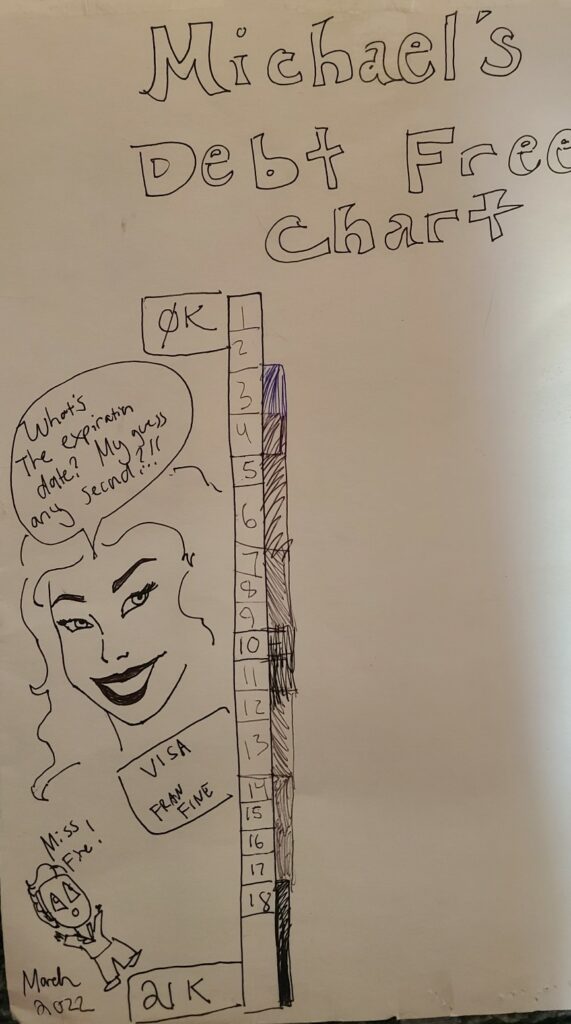
The most significant recommendation for Brian and Michael is an immediate, temporary "spending detox." By categorizing expenses into Fixed, Reducible, and Discretionary, the couple can identify "low-hanging fruit" to redirect toward debt. Specifically, eliminating discretionary spending—such as $200 in monthly eating out and $200 in home goods—could theoretically free up over $1,500 monthly. When combined with their existing $2,000 debt payment, they could be debt-free in approximately six months.
Retirement Optimization
Brian and Michael possess a "triple crown" of retirement assets: a 403b, a 457b, and a pension. The advice provided emphasizes that they should not consider homeownership until these retirement vehicles are being utilized effectively.
- The 457b Advantage: Because 457b plans allow penalty-free withdrawals upon leaving an employer, this should be a primary focus for Brian.
- The Roll-Over Strategy: Brian’s old 401k remains an under-optimized asset. Rolling this into an IRA provides greater control over investment choices and fee structures.
The Education Question
Regarding Brian’s desire to pursue a graduate degree, the recommendation is blunt: unless there is a guaranteed, documented path to a significantly higher salary, the time and financial capital required for a degree are better spent on debt reduction and retirement investing. In the current economic climate, education must be viewed as an investment with a measurable ROI.

Implications: The Path Toward Long-Term Stability
The case study of Brian and Michael illustrates that financial health is not merely about net worth; it is about the alignment of spending with long-term values.
1. The Emergency Fund Buffer
The couple currently holds $9,000 in cash, which covers roughly one month of expenses. A foundational pillar of their future security is building this to a 3-6 month reserve. This fund acts as a "debt-preventer," ensuring that when life—be it car repairs or medical bills—happens, they do not have to rely on credit cards.

2. Redefining "Adulting"
Brian’s feeling of being "behind" his peers is a common symptom of the "comparison trap." However, the data suggests otherwise. With a combined income of over $160k and a solid start in retirement savings, they are well-positioned. The transition from the "feast and famine" cycle of debt to a sustainable, mid-range lifestyle is the final hurdle to achieving their goals.
3. The Future of Homeownership
Homeownership is a valid goal, but it must be a byproduct of a solid foundation, not the starting point. By prioritizing debt elimination, increasing retirement contributions, and stabilizing their emergency fund, Brian and Michael can enter the real estate market from a position of power rather than necessity.

Conclusion
Brian and Michael’s journey is far from over, but it is firmly on the right track. By shifting their focus from the shame of past spending to the empowerment of future planning, they are laying the groundwork for a secure, comfortable, and independent future. As they approach their 10-year anniversary, the greatest gift they can give themselves is the structural discipline to ensure their next decade is defined by growth rather than the cycle of debt. The road to financial freedom is rarely a straight line, but with consistent tracking and prioritized spending, their goals—from homeownership to a legacy of stability—are well within reach.