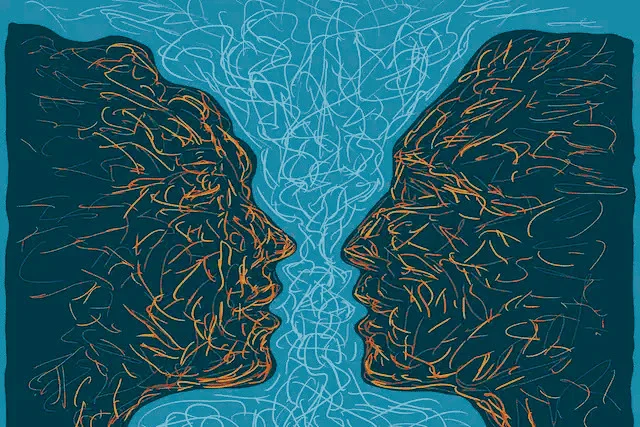
"Until you make the unconscious conscious, it will direct your life, and you will call it fate." — Carl Jung
The cycles of family history are often invisible, operating beneath the surface of our daily interactions like a subterranean river. We frequently inherit not just our physical traits, but our parents’ coping mechanisms, their unhealed wounds, and their specific "fire"—that volatile mix of passion, anger, and protective instinct. When we fail to examine these legacies, we risk repeating the very patterns we once vowed to escape. However, as one writer explores, the journey from unconscious repetition to conscious resilience is not about rejecting our heritage entirely, but about refining the fire we were born with.
The Echoes of the Past: Identifying the Pattern
The journey of self-discovery often begins with a startling realization: we are becoming the very people we feared as children. The author, reflecting on a poignant social media exchange, recalls a user who described themselves as "my mother’s revenge—the voice she didn’t have and the boundary she couldn’t set."
For many, this sentiment hits a nerve. It is a recognition that our parents’ behaviors—the snapping, the shouting, the unpredictable outbursts—were often the symptoms of their own unresolved traumas. Growing up in such an environment, children learn to walk on eggshells, constantly monitoring the emotional temperature of their caregivers to avoid being the target of that displaced fire.
The author notes that in 2021, she publicly confronted her own childhood experience: being raised by a mother who, overwhelmed by the pressures of single-parenting and her own traumatic upbringing—which included an abusive, alcoholic father—frequently lost her temper. Like many children in similar dynamics, the author learned to be hyper-vigilant, calculating her words and actions to maintain a fragile peace.
Chronology: From Hyper-Vigilance to Conscious Parenting
To understand the transformation from inherited trauma to emotional regulation, one must look at the timeline of personal evolution.
The Teenage Years: The Untamed Fire
During her adolescence, the author’s "fire" was not suppressed; it was channeled into competitive environments, such as captaining her swim team. While this intensity was seen as a strength, it was, in reality, a form of volatility. When overwhelmed, she lacked the internal framework to manage her intensity, often oscillating between explosive reactions and intense self-monitoring.
The Parenting Pivot: Recognizing the Red Flag
Becoming a parent herself forced a confrontation with the past. She began to notice the "chuntering"—that familiar, low-level simmering of frustration she recognized from her mother. The realization that her own children were beginning to "monitor her state" served as a critical wake-up call.
In a proactive effort to break the cycle, she implemented a feedback system: a chart on the fridge where her children could mark whether they felt she had communicated respectfully. This was not an attempt at perfection, but a commitment to repair. It marked a shift from unconscious reactivity to intentional awareness.
The Middle Years: The Danger of Suppression
For a period, the author believed the solution was to "swallow the fire." Fearful of repeating the loud, volatile environment of her childhood, she became conflict-averse, prioritizing peace over authentic communication. While this period was necessary to avoid the toxicity of her mother’s outbursts, she eventually realized that suppression is not the same as regulation. True emotional intelligence, she discovered, lies in the ability to express frustration without attacking, and to set boundaries without creating a battlefield.
Supporting Data: The Science of Generational Dynamics
While the author’s story is deeply personal, it aligns with psychological research regarding the transmission of trauma. The "intergenerational transmission of trauma" is a well-documented phenomenon where the psychological effects of a traumatic event are passed down from survivors to their children.
Experts in developmental psychology often highlight "Attachment Theory" as a key factor in this cycle. When a parent has not resolved their own childhood wounds, they may struggle to provide the "secure base" necessary for a child’s emotional development. This often leads to a cycle of "fear-based parenting," where the parent’s own anxiety or anger dictates the household’s emotional climate.
The author’s "fridge chart" exercise is, in essence, a form of "conscious parenting"—a movement that encourages parents to move away from rigid, authoritarian control toward a model of partnership, empathy, and emotional accountability.
Official Perspectives: The Psychology of "Breaking the Cycle"
Clinical psychologists often emphasize that "breaking the cycle" does not mean becoming the opposite of our parents. In fact, reacting in the extreme opposite direction can sometimes be just as unhealthy.
The core of psychological healing, according to Jungian analysis, is the integration of the "shadow"—the parts of our personality and history we would rather disown. By acknowledging that the fire we inherited has a story—a story of our parents’ own survival—we can separate the wound from the wisdom.
"The goal is not to eradicate the intensity," notes one family therapist. "The goal is to move from a state of ‘reacting’ to ‘responding.’ Reactivity is a reflex; response is a choice. That choice is where the cycle breaks."
Implications: Redefining Resilience
The implications of this realization are profound. It suggests that our family histories are not blueprints for our future, but rather raw material that we can reshape.
The Difference Between Protection and Resilience
The author posits that her mother’s primary goal was protection. Living in a world where she had seen her own mother abandoned and abused, her mother’s fire was a defensive mechanism: "Don’t let yourself be taken in; don’t give anyone the opportunity to hurt you."
The author’s transformation, however, has been toward resilience. She has come to understand that she does not need to live in a state of perpetual defense. The shift is subtle but life-altering:
- The Mother’s Creed: "That won’t be me." (Defensive/Avoidance)
- The Author’s Creed: "Even if it is me, I will be okay." (Resilient/Acceptance)
The Revenge Against Silence
Ultimately, the author redefines the concept of "revenge." Being one’s "mother’s revenge" no longer means a spiteful repetition of the past. Instead, it becomes a rebellion against the silence. It is a commitment to speaking the truth, acknowledging the pain of the past, and refusing to let it remain a secret that dictates the future.
Conclusion: A New Legacy
A family tree often records the surface facts of life: names, dates, and lineage. But it fails to record the "emotional inheritance"—the grief, the compromises, and the survival strategies that define the internal life of a family.
By choosing to understand what we have inherited, we gain the agency to decide what we will carry forward. We may inherit the fire, but we are the architects of the hearth. As we move forward, the question remains for each of us: What part of your family history was never yours to carry, and what part of it is a piece of wisdom you are proud to keep?
In the end, we are not defined by the cycles we were born into, but by the conscious decisions we make to change them. We are the authors of the next chapter, and the fire that once burned our ancestors can, in our hands, become the light that guides the way for those who come after us.