In a significant shift that underscores the delicate balance between software development and user sentiment, Day One—the industry-leading digital journaling platform—has officially announced the return of "Day One Labs" to its Silver tier subscribers. This move marks a reversal of a policy change implemented earlier this year, acknowledging the vital role that user-led testing plays in the evolution of the application.
By re-opening the "experimental sandbox" to a wider base of its user community, Day One is betting that the most effective way to refine future features is to place them directly into the hands of those who engage with the platform on a daily basis.
The Core Development: What Has Changed?
Effective immediately, users subscribed to the Day One Silver plan can once again access Labs. This feature, which serves as a testing ground for experimental tools and unpolished concepts, is now available at no additional cost for users running version 2026.17 or later.
The Labs platform serves as an iterative workshop where ideas are introduced in their "pre-finished" states. By allowing users to interact with these tools, the development team gains real-world insights into how features perform outside of a controlled lab environment. This ensures that when a feature eventually graduates from an experimental status to a core component of the app, it is already battle-tested and refined based on genuine user behavior.
A Chronology of the Labs Tiering Controversy
The journey of Day One Labs has been marked by a series of strategic pivots that highlight the challenges of managing a tiered subscription model.
- Initial Conception: Historically, Labs was positioned as a feature of the Premium subscription, allowing loyal power users to get a first look at experimental tools.
- The March Shift: In March 2026, as Day One restructured its subscription offerings into Silver and Gold tiers, the company moved Labs exclusively to the Gold tier. This transition resulted in immediate friction; many Silver subscribers, who had spent months providing feedback and shaping features, found themselves locked out of the very ecosystem they had helped build.
- The Public Response: The community response was swift and candid. Users expressed frustration not just at the loss of a perk, but at the perceived disconnect between the company’s "collaborative" ethos and the decision to gate-keep the testing environment behind a higher price point.
- The Reversal: Recognizing the validity of these concerns, Day One’s leadership confirmed that the decision was a mistake. By bringing Labs back to the Silver tier, the company is attempting to repair the relationship with its user base and restore the feedback loop that drives its product roadmap.
Supporting Data: Why User-Led Feedback Matters
The importance of this move cannot be overstated in the context of user experience (UX) design. Data from the company suggests that when a few hundred users test a feature, developers can determine if the core mechanism functions correctly. However, when that testing pool expands to thousands of active daily journalists, the company gains qualitative data on whether a feature actually belongs in a user’s life—or if it is merely a clever piece of code that adds unnecessary clutter.
Day One’s model is predicated on the idea that no two journals are alike. Because every user interacts with the app differently, the "edge cases" of usage are often where the most significant product breakthroughs occur. Allowing Silver subscribers access to these features ensures a broader demographic of usage, preventing the development cycle from becoming an echo chamber of only the most expensive-tier users.
Official Responses and Strategic Philosophy
In a statement addressing the change, Day One’s product team emphasized that Labs is not a "perk" in the traditional sense; rather, it is a critical component of the manufacturing process. "We didn’t build Labs as a preview," the company noted. "It is part of how Day One gets made."
The company has also been transparent regarding the "life cycle" of a feature. Not every experiment will remain in the app indefinitely. Some will graduate to the general, stable build, some may be moved to the Gold tier, and others may be discontinued entirely. To manage these expectations, Day One has implemented a "Three-Touch" communication policy:
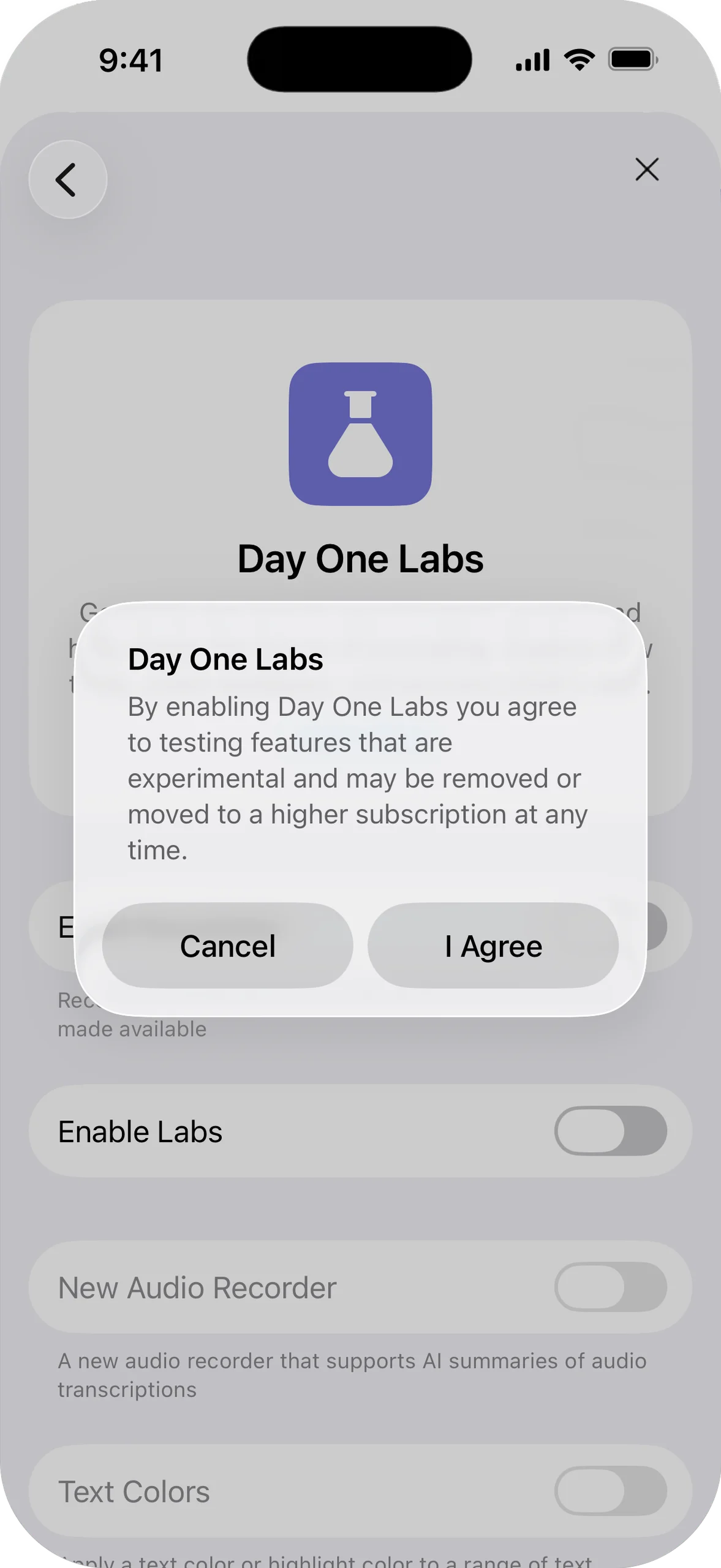
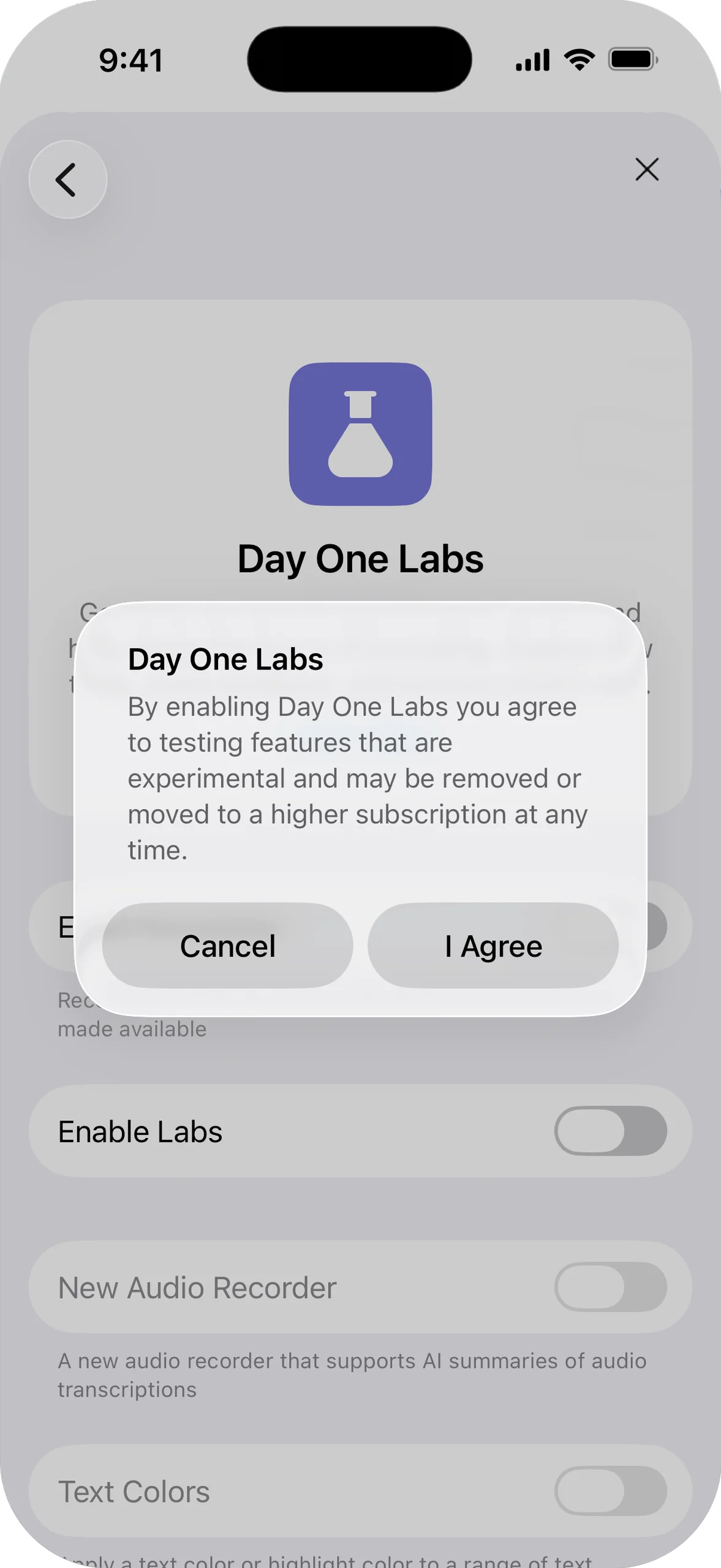
- At Initiation: When a user enables Labs, they must confirm an understanding that features are experimental and subject to change or tier-gating.
- During Usage: Every experimental feature is clearly marked with a "Labs" badge, ensuring users are never under the illusion that they are using a stable, final product.
- Prior to Graduation: Before any feature moves, changes, or becomes exclusive, the company commits to notifying users well in advance, ensuring there are no surprises regarding subscription requirements.
A Note on AI and Privacy
A key element of the current Labs offering is the inclusion of AI-driven tools, which have been a point of contention for many privacy-conscious users. The current Labs suite includes a "New Audio Recorder" with AI-generated summaries and "AI Format Transcription," which improves the readability of spoken journal entries.
Day One has reaffirmed its commitment to privacy:
- Consent-First: No AI features are active by default. They must be toggled on by the user.
- Data Integrity: The company maintains that no data processed in Labs is stored on their servers for training purposes.
- Segmentation: The "AI Features" toggle found in general settings, which governs broader tools like Daily Chat, remains separate from the Labs-specific AI tools. This allows users to opt into experimental audio transcription without necessarily enabling the broader suite of AI tools found in the Gold tier.
Implications for the Future of Journaling
The return of Labs to the Silver tier signals a broader trend in the software-as-a-service (SaaS) industry: the transition from "black box" development to transparent, community-driven iteration. For the user, this means the app is more responsive to their specific needs. For the developer, it means a more robust product that is less likely to face user backlash when features are eventually finalized.
However, the move also sets a high bar for accountability. By inviting thousands of users into the "workshop," Day One is effectively opening its doors to constant, potentially harsh, public scrutiny. The "Share feedback" mechanism, which routes user comments directly to the development team, will now serve as a barometer for the company’s health.
How to Access and Participate
For users looking to re-engage with the experimental side of Day One, the process is straightforward but requires the latest software updates:
- Update: Ensure the application is updated to version 2026.17 or later.
- Navigate:
- iOS/iPadOS: Tap the profile icon, select Settings, then Labs.
- macOS: Access Settings via the menu bar and select the Labs tab.
- Web: Click the gear icon and select Labs from the menu.
- Enable: Toggle "Enable Labs" to active.
- Feedback: The company encourages users to use the feedback button at the bottom of the screen to report bugs, confusing UX, or feature requests.
Ultimately, the restoration of Labs is a strategic "reset." It acknowledges that while businesses need to create distinct value for different subscription tiers, the creative spirit of a product like Day One is best served when the community—regardless of their financial tier—is given a seat at the table. Whether this approach leads to a more stable, user-centric application remains to be seen, but for now, the barrier between the builder and the user has been lowered, allowing the community to once again help write the next chapter of the platform’s history.