By [Your Name/News Outlet Name]
A persistent, low hum. It’s a feeling many individuals in their 40s and beyond describe not as a jarring crisis, but as a subtle erosion of direction. The external markers of success – a stable career, paid bills, a full calendar – remain intact, yet a quiet question surfaces: "What is all of this actually for?" This pervasive sense of drift, experts say, is the hallmark of a midlife search for purpose, a journey far more nuanced and enduring than dramatic reinventions often portrayed.
This phenomenon, often misconstrued as a full-blown midlife crisis characterized by impulsive decisions and drastic life changes, is in reality a far more common and internal experience. It’s a signal that the foundational goals of earlier decades – career establishment, family building, proving oneself – have largely been met or outgrown. As individuals navigate this phase, the psychological imperative shifts from acquisition to contribution, a concept known as "generativity" in developmental psychology. When this innate drive for generativity lacks an outlet, it can manifest as stagnation, a feeling that life has stalled despite outward appearances of normalcy.
The prevailing narrative often paints midlife purpose-seeking as a quest for a singular, life-altering revelation. However, contemporary research and psychological understanding suggest a more grounded and sustainable approach: purpose isn’t typically "found" in a dramatic epiphany; it is meticulously "rebuilt" by realigning the core domains of adult life.
The Quiet Erosion: Why Purpose Fades in Midlife
The foundations of purpose built in one’s 20s and 30s often center on tangible achievements: climbing the career ladder, raising young children, and establishing financial security. As these objectives are met, the external scaffolding that once provided clear direction begins to feel hollow. Psychologist Erik Erikson’s theory of psychosocial development highlights generativity versus stagnation as the central task of midlife. The inherent human desire to contribute to the next generation, to mentor, and to build something lasting beyond oneself intensifies around age 40. When this drive is unfulfilled, it can lead to a profound sense of flatness and a feeling of being stuck, even in a seemingly successful life.
This flatness is not a sign of personal failure or laziness. Rather, it’s a signal that the motivational engines that powered the first half of life – achievement, acquisition, and outward validation – are naturally shifting. Stanford researcher Laura Carstensen’s work on socioemotional selectivity theory explains this phenomenon: as individuals perceive their time horizons shortening, their motivation pivots from open-ended future goals to present emotional meaningfulness, prioritizing relationships and contribution. The "achievement-and-acquisition" engine, which propelled earlier successes, begins to deliver diminishing returns in terms of meaning.
The struggle to reconcile this shift can be disorienting. Individuals may attempt to reignite the old engines through new job titles, bigger goals, or enhanced productivity systems, only to find temporary relief before the familiar hum of purposelessness returns. This suggests that more of the same, particularly when it focuses on outward achievement, is unlikely to address a fundamental meaning deficit.
Compounding this disorientation is the complex tapestry of midlife responsibilities. Juggling work, health concerns, financial planning, and the evolving needs of aging parents and children can make the question of purpose feel like yet another overwhelming item on an already overflowing to-do list. This often leads to its postponement, waiting for a "quieter season" that may never arrive.
Rebuilding Purpose: A Deliberate Reconstruction, Not a Dramatic Reinvention
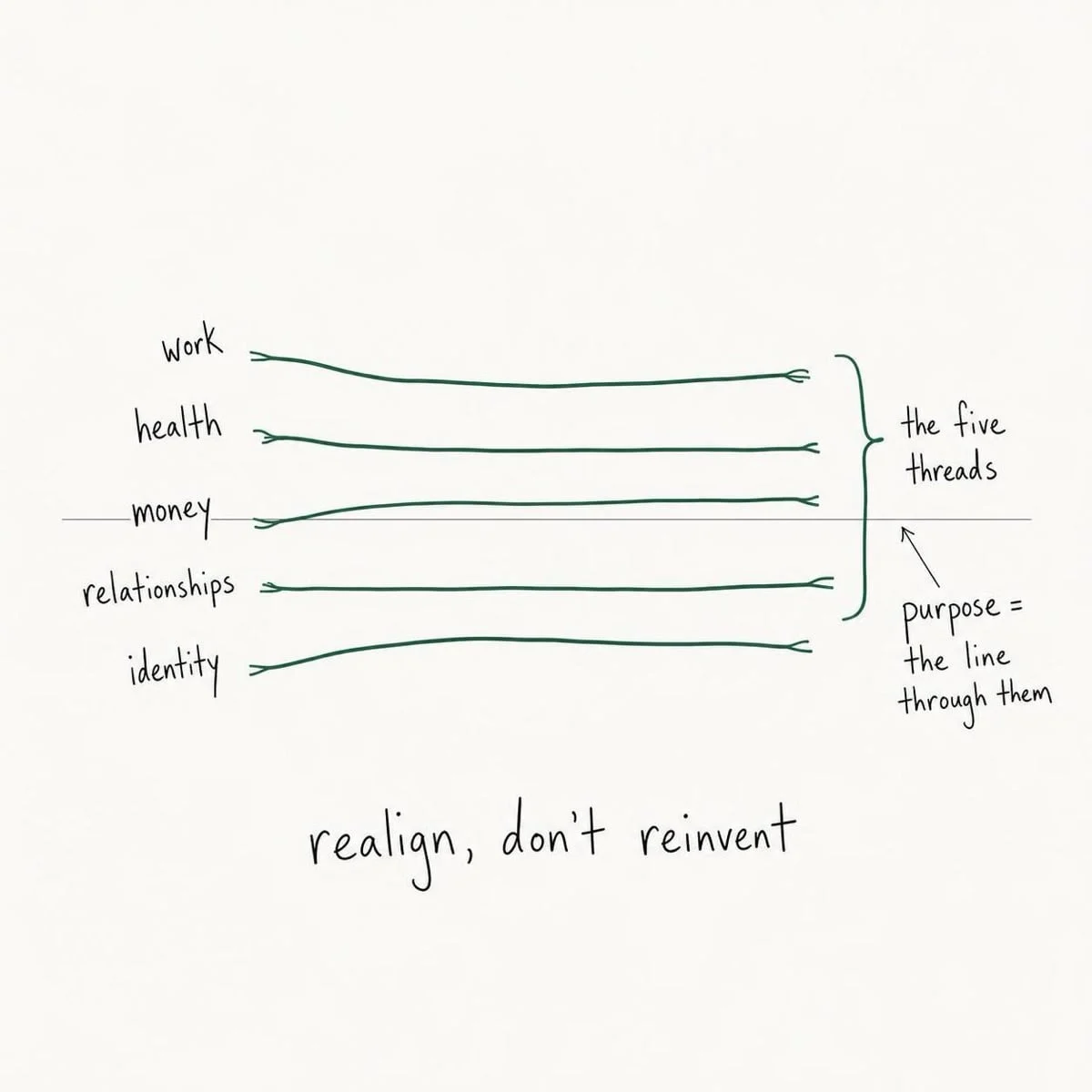
The paradigm shift in understanding midlife purpose lies in reframing it not as a hidden treasure to be discovered, but as a structure to be meticulously rebuilt. This reconstruction involves realigning the five fundamental domains of adult life: work, health, money, relationships, and identity. When these domains operate in disparate directions, a sense of purposelessness can emerge, even if each area is individually functional. Purpose becomes apparent when these threads begin to converge and reinforce one another.
This perspective challenges the conventional advice to "find your passion" or "discover your why," which often directs individuals inward in passive pursuit of a singular revelation. Meaning, as conceptualized by researchers like Roy Baumeister, is not an inherent discovery but an active construction. It is built through a combination of a sense of purpose (direction), values (ethical compass), efficacy (belief in one’s impact), and self-worth. The operative word here is "built," implying an active process of creation and integration.
Therefore, finding purpose in midlife is less about archaeological excavation of a buried self and more about the deliberate work of carpentry – realigning existing components. The career, relationships, and personal well-being remain vital, but their ability to mutually reinforce each other may have diminished. By addressing these domains systematically, the feeling of lost meaning can be understood as scattered, not absent. This underscores why a true midlife "reset" is rarely a clean-slate reinvention, but rather a thoughtful re-sequencing of existing elements. The profound relief in this reframing is the understanding that one does not need to possess a fully defined purpose to begin the process; direction often emerges as a consequence of the realignment itself.
The Step-by-Step Approach to Purpose After 40
The most effective strategy for finding purpose after 40 is a sequenced rebuild, not a grand, impulsive leap. This involves identifying the single domain that feels most misaligned, realigning it through consistent, small actions, and allowing the renewed sense of meaning to fuel subsequent steps. Research on generativity consistently shows that midlife adults who actively engage in contributing to others exhibit enhanced cognitive function and lower rates of depression in later years. This suggests that purpose is cultivated through action, not solely through introspection.
Four key strategies can facilitate this process without leading to burnout:
1. Naming the Drift Before Chasing the Fix
Many individuals bypass the crucial initial step of identifying the root cause of their dissatisfaction, jumping directly to broad questions like "What should I do with my life?" A more effective approach begins with a narrower focus: which of the five core domains is currently pulling most strongly against the others? Is it a job that provides financial security but lacks personal meaning? Are relationships suffering due to an overemphasis on career advancement? Has one’s identity become frozen in a role from a previous life stage, such as being "the parent of young children" or "the rising star" in a now-established career?
Purpose erodes wherever a disconnect emerges between one’s lived reality and stated values. Pinpointing this gap is the essential first step. The answer to the question of "what is my purpose" often lies hidden within the answer to "what feels off."
2. Aiming at Contribution, Not Mere Passion
The popular exhortation to "follow your passion" often falls short for individuals over 40 because passion is an output, a result of engagement, rather than an input or a starting point. What consistently generates a profound sense of meaning is the awareness that one matters to others. Extensive research, including Laura Carstensen’s work, indicates that purpose is significantly strengthened when it is intrinsically linked to people and contribution, rather than solely to personal achievement.
This principle underpins the concept of the "second mountain" in life, where the first half is often dedicated to climbing for oneself, while the second half is built around something larger. This could manifest as mentoring, cultivating a craft, engaging in community building, or nurturing a significant relationship. The impact of mentoring a junior colleague, coaching a youth sports team, or actively rebuilding a neglected friendship often far outweighs the influence of a mere vision board. For those whose social connections have thinned, the simple act of rebuilding a social circle can itself be a profound act of purpose-building.

3. Employing Small, Anchored Actions, Not a Grand Pivot
A critical safeguard against burnout is the judicious use of small, consistent actions. A complete midlife career change is not a prerequisite for finding purpose, and attempting such a drastic shift prematurely, without a clear direction, can lead to financial instability and increased distress. Purpose is best rebuilt through incremental, repeated behaviors that are intentionally linked to existing routines.
Research examining daily experiences consistently reveals that specific, small behaviors and events, rather than sweeping resolutions, are the primary drivers of a felt sense of meaning. This could involve engaging in one meaningful conversation per week, dedicating fifteen minutes to a long-abandoned creative pursuit, or establishing a regular phone call with a family member. These small actions accumulate over time, and crucially, they allow individuals to maintain their financial stability and overall security while they rediscover their footing. If a larger change ultimately proves to be the right path, it can be pursued from a place of clarity and confidence, rather than panic.
4. Protecting the Physical Vessel of Meaning
Purpose and physical health are not independent endeavors; they are deeply interconnected. Individuals who report a strong sense of purpose are significantly less likely to become physically inactive and are also less prone to developing sleep disturbances. Conversely, maintaining one’s physical well-being makes it easier to access and act upon a sense of purpose. This reciprocal relationship explains why habits that increase longevity often correlate with a robust sense of meaning. It is challenging to rebuild purpose when operating on insufficient sleep or with a body that has been neglected. Maintaining physical fitness, even recognizing that building muscle remains possible in one’s 40s and beyond, is an integral part of the same overarching project, not a distraction from it.
The order of these steps is often more critical than the speed at which they are executed. Rebuilding one thread at a time, in a deliberate sequence and at a sustainable pace, is far more effective than a frantic reinvention. Calm, consistent discipline consistently outperforms rushed, panicked change.
The Practical Manifestation of Purpose at 50 and Beyond
In practice, the process of finding purpose after 40 often appears unremarkable from an external perspective. There are typically no dramatic career changes or sudden epiphanies. Instead, it involves identifying a single drifting thread, realigning it with a small, repeatable action, and then moving on to the next.
Consider the case of Ravi, a 51-year-old regional sales director. Despite a comfortable income, a stable marriage, and children in high school, Ravi experienced a pervasive sense of flatness. He was waiting for a grand calling to arrive, a moment that never materialized. Instead, he shifted his focus to identifying the drift. The most misaligned thread wasn’t his job, but his identity and contribution: after two decades of selling, he had invested little in building up others.
He began with a small, actionable step: one mentoring lunch per month with a junior sales representative, scheduled for the first Friday of each month. This action involved no title changes, no career risks, and no significant financial outlay. Within two months, these mentoring lunches became the highlight of his week, injecting renewed energy that spilled into other areas of his life. He began walking three mornings a week, tending to his health thread, demonstrating how purpose often inspires a desire to care for the physical vessel that carries it. This pattern is well-documented: purpose fuels proactive health behaviors.
Six months into this process, Ravi’s mentoring had evolved into leading an informal training program. He hadn’t discovered a "new" purpose; he had realigned aspects of his existing life until the scattered elements of meaning began to converge. Notably, he didn’t directly address his financial situation, though improved financial habits and stability often follow as the panic driving impulsive spending subsides.
Contrast this with Priya, a 47-year-old who quit her marketing job abruptly to "find herself." She depleted a year’s savings and returned to marketing feeling even more lost. Both individuals experienced the same fundamental hunger for meaning. The crucial difference lay in their approach: Ravi rebuilt methodically, while Priya detonated. The journey toward a meaningful life in midlife is often best navigated with a map that emphasizes gradual realignment rather than abrupt demolition.
Addressing the Lingering Question: "But I Still Don’t Know My Purpose"
It is perfectly acceptable not to have a definitive answer to "what is my purpose" at this stage. The trap lies in waiting for absolute certainty before taking action. Purpose is not a static destination to be reached through passive contemplation; it is a dynamic process that unfolds through movement. Meaning researchers distinguish between the "presence of meaning" and the "search for meaning." The search becomes productive when it is coupled with small, purposeful actions, rather than being dominated by passive rumination. The answer emerges from engaging in these small actions, observing what provides renewed energy, and following that thread.
The fear that it might be "too late" to find purpose is also a common misconception. Developmental psychology indicates that the capacity for resolving identity and purpose remains open throughout the lifespan. Individuals frequently achieve clarity through later-life experiences, such as career shifts, deeper community engagement, or new caregiving roles. It is never too late, and the current phase of life is precisely when purpose is often most robustly built.
The Path Forward: One Thread at a Time
Instead of attempting to answer the overwhelming question, "What is my life’s purpose?" this week, focus on a smaller, more manageable objective. Identify the single domain—work, health, money, relationships, or identity—that currently feels most out of alignment. Articulate the gap between what you profess to value in that domain and how your daily actions reflect those values. Then, commit to one small, specific action within that domain and practice it consistently for two weeks before evaluating its impact.
This is the foundational step: not a radical reinvention, but a single thread realigned, repeated until it establishes a new pattern. The intricate journey of finding purpose in midlife is not about a singular, life-defining decision. It is a cumulative process of a hundred small realignments, and the opportunity to make the first of these exists right now, in the coming hour. Purpose does not announce itself; it is actively constructed through consistent action, one realigned thread at a time.
Frequently Asked Questions
How do you find your purpose in midlife?
Instead of searching for a singular, overarching answer, focus on rebuilding. Examine the five core domains of adult life—work, health, money, relationships, and identity—and identify the one that is most misaligned with your values. Realign this domain through small, consistent actions, rather than attempting a dramatic pivot. Purpose emerges as a noticeable through-line once these various threads begin to point in the same direction. This sense of purpose typically appears after the realignment process has begun, not before.
What are the common stages of navigating midlife shifts?
While a dramatic "midlife crisis" is less common than a quiet loss of meaning, models describing midlife shifts often include: initial denial or unawareness of dissatisfaction, followed by feelings of anger or restlessness. This can lead to a period of reflection, comparing the present with the past, which may then give way to feelings of depression or flatness. Withdrawal and a sense of disengagement can follow, ultimately leading to acceptance and a process of rebuilding. It’s important to view these as a flexible framework, not a rigid prescription, as individual experiences vary significantly. The core work remains identifying the drift and systematically realigning one’s life.
What are the indicators of a lack of purpose?
A lack of purpose often manifests as a subtle "drift" rather than an overt breakdown. This can include a pervasive feeling of flatness, going through the motions of daily life, and questioning the ultimate significance of one’s endeavors. Motivation may be blunted, and days can feel like they lack cumulative meaning. Furthermore, since strong purpose is linked to improved sleep and physical activity, its absence can negatively impact these aspects of well-being.
What resolves a midlife sense of purposelessness?
The resolution of midlife purposelessness typically stems from active contribution and realignment, not from material purchases or escapist actions. The feeling of flatness dissipates when daily life aligns with personal values, and energy is directed towards something beyond oneself. This can involve mentoring others, honing a craft, nurturing relationships, or caring for loved ones. Small, consistent actions repeated over time are more impactful than grand gestures and help maintain stability while a new sense of direction takes shape.