Your alarm clock rings at 6:10 a.m. By 6:12, you are physically upright, shuffling toward the kitchen. By 6:15, you find yourself staring blankly into the open refrigerator, unable to remember why you opened the door or even recall your own phone number. You read the same text message three times, the words failing to form coherent thoughts. It isn’t until roughly 6:40 a.m. that the mental fog begins to lift, and you finally feel like a functioning human being—which, coincidentally, is exactly when you need to be walking out the door.
For millions, this daily ritual of disorientation is misdiagnosed as a personal failure or a sleep disorder. In reality, you are likely experiencing sleep inertia, a scientifically measured physiological state that is as ordinary as breathing. The frustration stems from a fundamental misunderstanding of the process: we treat these first twenty minutes as a problem to be solved with willpower, when in truth, they are a biological inevitability that should be managed, not conquered.
The Science of Sleep Inertia: A Measured Reality
Sleep inertia is defined as the transitional state between sleep and wakefulness, characterized by impaired cognitive performance, reduced alertness, and physical grogginess. According to research published by Hilditch and McHill (2019), this is not a character flaw or a symptom of poor discipline; it is a clinical phenomenon. Even the most well-rested individuals experience a drop in mental acuity the moment their eyes open.
The "standard" attempts to mitigate this state—moving your alarm across the room, splashing ice-cold water on your face, or chugging an extra-large coffee—rarely change the texture of those twenty minutes. This is because these interventions happen after the fact. The research suggests that the severity of your morning fog is determined long before your alarm clock triggers its first chime.
The Chronology of the Morning: Why the Fixes Fail
To understand why your current routine feels ineffective, we must look at the timeline of your sleep. The "honest answer" to why you feel like a zombie is split into two parts: the disappointing reality and the useful strategy.
1. The Sleep Debt Factor
The most significant driver of morning impairment is your accumulated sleep debt. If you are consistently sleep-deprived, the brain struggles to transition into wakefulness. A prolonged stretch of wakefulness before sleep can exacerbate this. Unlike other factors, sleep debt is one of the few variables you can influence—though only by changing your behavior the night before.
2. The Circadian Trough
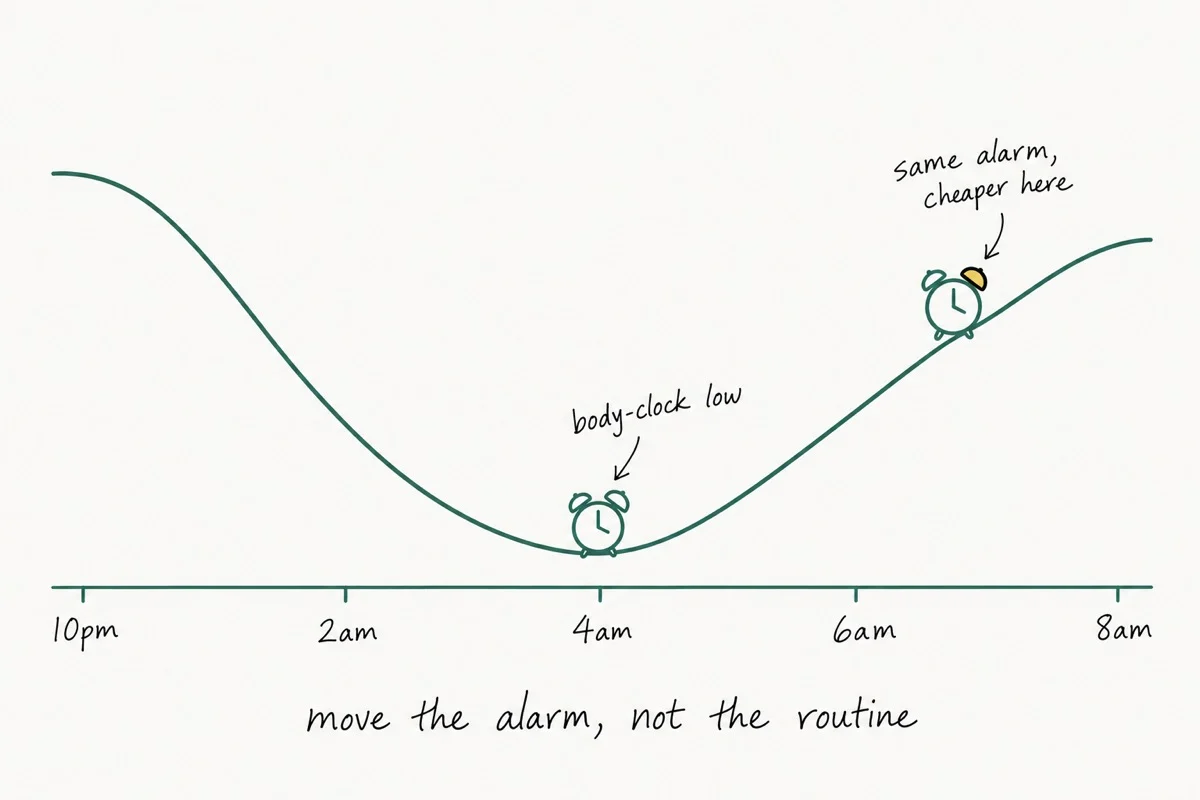
Your body operates on an internal clock, and waking up during the "circadian trough"—your body’s biological low point—guarantees a harder start. For a standard 11:00 p.m. to 7:00 a.m. sleeper, this trough typically occurs between 3:00 a.m. and 5:00 a.m. If your alarm is set to go off while your body is still anchored in this biological low, the resulting inertia will be significantly more severe than if you were to wake up thirty minutes later, as your body naturally shifts toward alertness.
3. The Stage of Sleep
Waking up from deep, slow-wave sleep is notoriously difficult. While many smartphone apps claim to track your sleep cycles and wake you during a "light" phase, clinical evidence remains skeptical. The interaction between sleep pressure, timing, and stage-depth is complex, and relying on an app to navigate these variables is often less effective than simply protecting your overall sleep opportunity.
Supporting Data: Evidence-Based Remedies
When we analyze the effectiveness of common morning rituals, a clear hierarchy of evidence emerges.

Tier 1: The High-Impact Pre-Wake Adjustments
- Protecting Sleep Opportunity: The most effective "cure" is boring: get more sleep. If your sleep is fragmented, addressing the quality of your rest is a prerequisite for improving your mornings.
- Shifting the Alarm: Moving your alarm to align with your natural wake-up rhythm is the single cheapest and most effective change you can make. If you are a "night owl" forced into an early schedule, this is a conflict of chronotype, not a deficit of willpower.
Tier 2: Moderately Effective Tools (The "Wait-Time" Strategy)
- Caffeine: Caffeine is effective, but only if you understand its pharmacokinetics. Research indicates that caffeine takes roughly 30 to 40 minutes to reach peak blood levels. Drinking it the moment you wake up provides no immediate relief. Treat your first cup as the start of a twenty-minute waiting period, not an instant reset button.
- Light Exposure: Exposure to light, particularly through light-emitting glasses or an artificial dawn simulator, can improve self-rated feelings of alertness. While it may not significantly boost your psychomotor speed, it can make the morning "feel" less painful, which is a valid goal in itself.
Tier 3: The "Weak" Remedies
Common advice—such as cold showers, heavy breakfasts, or early-morning exercise—frequently falls into the lowest tier of evidence. These habits may have health benefits, but they are not reliable cures for sleep inertia. Trying to "shock" your system awake often leads to frustration when the fog fails to lift, reinforcing a cycle of perceived failure.
Official Responses and Clinical Perspectives
When should this state move from a "morning problem" to a "medical concern"? Clinical literature, such as the studies by Trotti (2017), highlights that severe, prolonged difficulty waking—sometimes colloquially referred to as "sleep drunkenness"—can be a symptom of idiopathic hypersomnia. Furthermore, persistent, unrefreshing sleep is a classic marker of obstructive sleep apnea.
Medical experts advise that if you find yourself consistently unable to function for extended periods, or if your morning fog poses a safety risk, you should consult a professional. Be prepared to provide data: how long you are unusable, the frequency of these episodes, and the gap between your natural sleep timing and your required wake-up time.
Implications: Designing a "Dumb" Morning
Since you cannot "think" your way out of sleep inertia, the most productive strategy is to design a morning that requires zero executive function.
The "No-Decision" Protocol
Garrett, a professional who previously struggled with early morning productivity, eventually shifted his strategy. He moved all high-level decision-making—responding to complex emails, analyzing contractor quotes, or planning his day—to his commute, which occurs an hour after he wakes.
His first twenty minutes are now reserved for "dumb" tasks:
- Fixed Routine: Dressing in clothes laid out the night before.
- Low-Cognitive Load: Preparing a coffee before the need for alertness becomes critical.
- Environmental Cues: Opening curtains to let in natural light immediately.
By removing the pressure to be productive during the "fog," the morning ceases to be a series of failures. You are not meant to be sharp at 6:12 a.m.; you are only meant to be functional enough to execute a pre-determined plan.
Conclusion: Accept the Cost
The most important takeaway from current sleep research is this: stop auditioning new "hacks" for the morning and start looking at the inputs you control the night before. Whether it is adding thirty minutes to your sleep window or moving your alarm to a time that respects your body’s circadian rhythm, the solution is proactive, not reactive.
Accept the first twenty minutes of your day as a sunk cost. Do not fill them with tasks that require nuance or high-stakes judgment. By automating your morning and respecting your biology, you can reclaim your day from the fog, not by fighting it, but by simply letting it pass on its own terms.