We have all been there: staring at a life-altering crossroads—a job offer with a Friday deadline, a mortgage application that pushes your finances to the limit, or a failing side hustle you’ve been propping up for years. You turn to the "Best Decision-Making Books" lists, only to be met with the same academic heavyweights. You read the theory, you nod at the insights, and yet, when Monday morning arrives, you are no closer to choosing.
The problem with most reading lists is that they prioritize sales rank over utility. They treat your brain like a laboratory and your life like a study in behavioral economics. But when you are in the thick of a high-stakes choice, you don’t need a nature documentary about your own cognitive biases; you need a tool.
This guide evaluates the most prominent titles in the field of decision science, not by their academic prestige, but by their "drillability"—the ability to pull a single, actionable exercise from their pages that can actually change your outcome this week.
The Evidence: Why Practice Outperforms Prose
To grade these books, we established a pragmatic rubric: Does this book offer a repeatable, structured drill? Can this drill be performed in under an hour? Does the book acknowledge where its advice ends and reality begins?
The emphasis on "drills" is intentional. Research suggests that reading alone is a passive act with limited impact on real-world outcomes. Conversely, structured training has measurable results. In a four-year geopolitical forecasting tournament, researchers found that a training module lasting under an hour improved forecasters’ accuracy—as measured by the Brier score—by 6 to 11 percent.
When you read a book without executing a drill, you are consuming entertainment. When you execute a drill, you are engaging in decision hygiene.
The Seven Essential Titles for Your Decision-Making Toolkit
1. Decisive: How to Make Better Choices in Life and Work (Chip & Dan Heath)
The Heaths argue that we often decide within a frame drawn by others. We ask, "Should I take this job or not?" instead of, "What are the three best ways I could spend the next two years?"
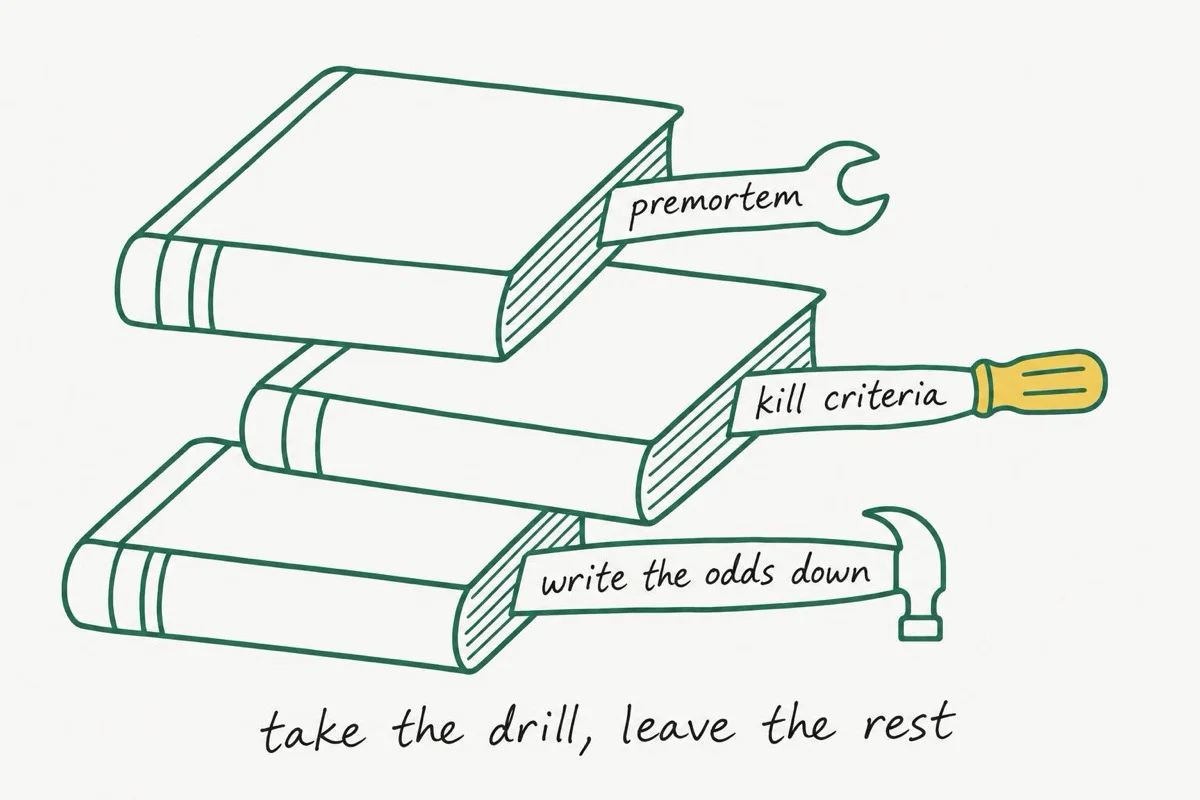
The Drill: Run a "premortem." Assume the decision you are leaning toward has already failed in the future. Spend ten minutes writing down exactly why it failed. Gary Klein, a pioneer in this field, found this simple act of "prospective hindsight" increases one’s ability to identify failure points by approximately 30 percent.
2. Quit: The Power of Knowing When to Walk Away (Annie Duke)
Most books focus on the "go" decision. Duke focuses on the "stop." The danger in quitting is that we wait until we are emotionally exhausted, making it impossible to judge the situation objectively.
The Drill: Establish "kill criteria" before you start. If your business doesn’t hit a specific revenue milestone by a specific date, you close it. By writing these rules when you are calm, you prevent your future, stressed self from negotiating with reality.
3. Thinking in Bets (Annie Duke)
The core insight here is "resulting"—the tendency to judge the quality of a decision by its outcome rather than the information available at the time.
The Drill: Keep a decision journal. Record the facts you had, the odds you estimated, and your reasoning before the outcome lands. This separates your process from the result, preventing you from learning the wrong lessons from a "lucky" bad decision or an "unlucky" good one.
4. Thinking, Fast and Slow (Daniel Kahneman)
This is the foundational text for the modern era, introducing the world to the "Fast" (intuitive) and "Slow" (deliberative) systems of the brain.

The Catch: While it is a masterpiece of intellectual history, it is not a manual. Furthermore, some of its earlier social-priming research has been contested. Treat it as a map of the mind’s traps, not a step-by-step guide. Use it to slow down when you feel an immediate, intuitive "certainty" about a choice.
5. Noise: A Flaw in Human Judgment (Daniel Kahneman, Olivier Sibony, Cass R. Sunstein)
If bias is a constant error in one direction, noise is the inconsistent scatter—like two different doctors giving two different diagnoses for the same symptoms.
The Drill: "Decision Hygiene." If you are making a group decision, force everyone to write their judgments down independently before any discussion occurs. This prevents the "swallowing" of individual opinions by the most dominant voice in the room.
6. Smart Choices: A Practical Guide to Making Better Decisions (Holloway, Hammond, Keeney)
This is the most procedural book on the list. It treats decision-making like a math problem involving objectives, alternatives, and trade-offs.
The Drill: The Consequences Table. List your objectives on one axis and your options on the other. Scoring these often reveals an option that is objectively inferior on every dimension, allowing you to discard it instantly.
7. Superforecasting: The Art and Science of Prediction (Philip Tetlock)
Hard choices are usually predictions in disguise. "Will this industry exist in ten years?" "Will this partner be a good match?"
The Drill: Convert your beliefs into numbers. Instead of saying "I think this will happen," say "I believe there is a 65% chance of this happening." Forcing yourself to quantify your confidence prevents the vagueness that allows us to justify poor decisions after the fact.
Two Titles We Advise Skipping (For Now)
We do not recommend The Art of Thinking Clearly by Rolf Dobelli or Predictably Irrational by Dan Ariely for those currently facing a specific, pressing choice.
- The Art of Thinking Clearly functions as a dictionary of biases. While excellent for browsing, it provides no framework for weighing two competing options.
- Predictably Irrational is a fascinating tour of human folly, but it lacks a "how-to" structure. You cannot use it to navigate a Tuesday morning dilemma. Furthermore, be wary of applying older behavioral science findings; always verify if the underlying data has been subject to recent academic retraction or peer-reviewed scrutiny.
Chronology of the Decision Process
To make a decision effectively, follow this chronological flow:
- Preparation (The "Noise" phase): Gather your data and options without discussing them with others. Write them down to avoid external influence.
- Expansion (The "Decisive" phase): Force yourself to generate at least one additional, "unlikely" option.
- Refinement (The "Smart Choices" phase): Build a table of consequences. Evaluate what you are trading off.
- Forecasting (The "Superforecasting" phase): Assign probabilities to your potential outcomes.
- Stress Testing (The "Decisive" phase): Run the premortem. Why does this choice fail?
- Commitment (The "Quit" phase): Set your exit criteria now. Decide at what point you will pull the plug if things go south.
Implications: The Cost of Indecision
The most significant takeaway is that the "best" book is the one you read with a specific, written-out problem in front of you.
When you feel yourself freezing on a big decision, recognize that the paralysis is often not about the choice itself, but about the identity shift or the emotional risk the choice implies. No book can make that trade-off for you. However, by moving from "thinking about the decision" to "running a drill on the decision," you shift your internal state from passive anxiety to active problem-solving.
Tonight, before you buy a book, take a piece of paper. Write your dilemma as a question. Force a third, weird option onto the page. Assume your preferred choice has failed, and spend five minutes listing why. If this twenty-minute exercise clarifies your thinking, you have already done more for your future than most readers do in a year. Books are cheap; your time and the consequences of your decisions are not. Choose the drill, not just the title.