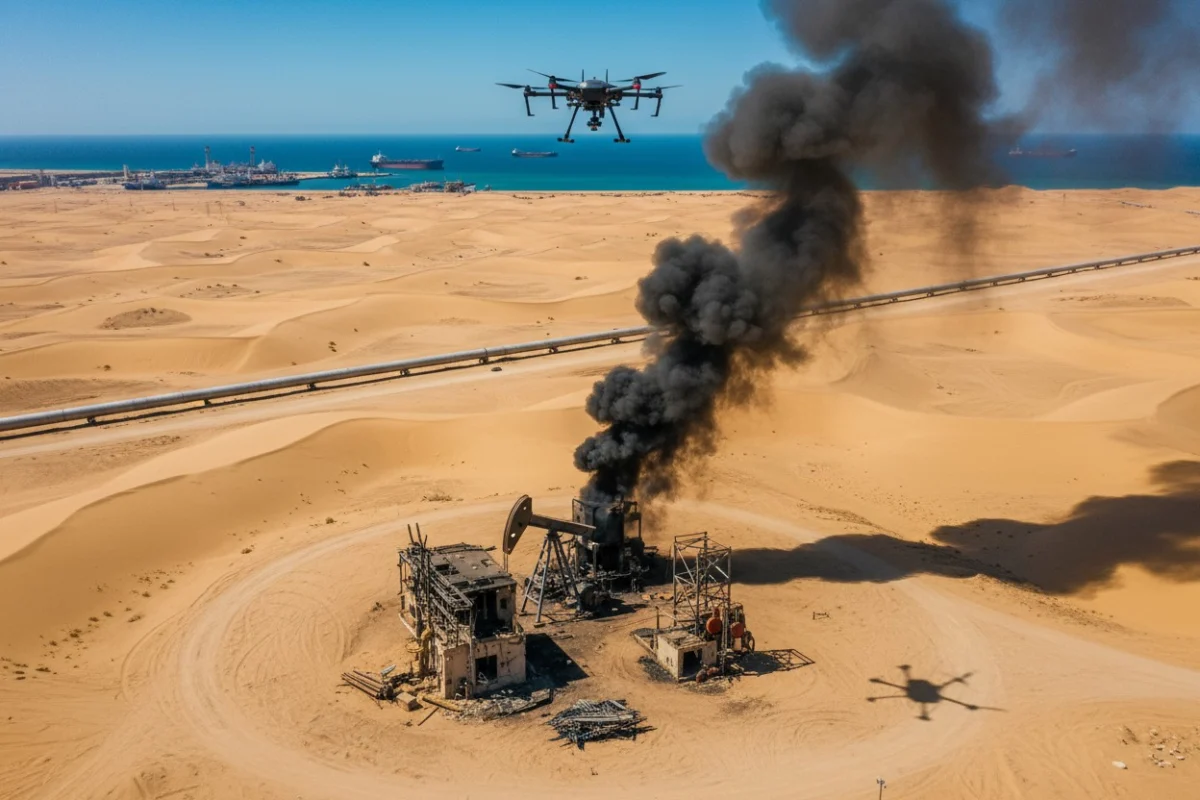
RIYADH/MEDINA — The geopolitical fault lines running across the Middle East experienced a sharp and dangerous tremor on Monday as Saudi Arabia’s strategic East-Hussein pipeline—commonly known as the East-West pipeline—came under direct attack near the holy city of Medina.
The strike against the kingdom’s primary "back door" export route marks a profound escalation in an already volatile regional conflict. Coming on the heels of repeated drone and missile strikes targeting the capital city of Riyadh and key oil installations, the assault directly challenges Saudi Arabia’s ability to maintain the flow of petroleum to international markets. With the critical Strait of Hormuz effectively choked off by ongoing maritime hostilities stemming from the wider U.S.-Israeli conflict with Iran, the targeting of the East-West pipeline threatens to squeeze global energy supplies from both ends, sending shockwaves through international markets and raising the specter of surging fuel costs for consumers worldwide.
Main Facts
The latest security breach occurred on Monday, when an aerial explosive device targeted
a segment of the East-West pipeline near Medina. According to the official Saudi Press Agency (SPA), which cited a senior energy ministry official, the strike ignited a "limited fire" that maintenance crews and emergency responders quickly brought under control. Crucially, the ministry emphasized that pipeline operations continued uninterrupted, averting an immediate supply shock.
However, the psychological and strategic impacts of the attack were immediate. The strike on the pipeline occurred barely twenty-four hours after Yemen’s Iran-backed Houthi movement claimed responsibility for a targeted attack on a prominent Saudi Aramco tower in Riyadh. The twin incidents plunged the Saudi capital back onto a war footing. Authorities triggered emergency protocols, briefly instructing residents to shelter indoors away from windows due to "a hostile aerial threat," while educational institutions scrambled to revert to remote learning just days after students had returned to physical classrooms.
The East-West pipeline spans approximately 1,200 kilometers, cutting horizontally across the Arabian Peninsula from the kingdom’s oil-rich Eastern Province to the Red Sea port of Yanbu. Designed to bypass the perilous maritime chokepoint of the Strait of Hormuz—through which roughly 20 percent of the world’s petroleum normally passes—the pipeline has transformed from a strategic backup into an absolute lifeline for global energy security.
With the Strait of Hormuz effectively immobilized by the ongoing U.S.-Israeli war on Iran, any successful disruption of the East-West conduit removes the world’s primary safety valve against systemic oil shortages. While no group immediately claimed formal responsibility for Monday’s specific pipeline strike, suspicion has fallen squarely on the Houthis, who have drastically escalated their cross-border campaign since a fragile, UN-brokered truce with Riyadh collapsed in July. Tehran-backed militias operating out of Iraq have also previously targeted the same infrastructure, underscoring the multi-front nature of the threat facing Saudi energy assets.
Chronology of Escalation
The attack on the Medina pipeline segment does not stand in isolation; rather, it represents the apex of a deteriorating security matrix that has unraveled rapidly over the past several months.
- July: The fragile, unwritten truce between Riyadh and the Houthi movement completely collapses, bringing an end to a period of relative calm along the Saudi-Yemen border and within the kingdom’s airspace.
- September: Iraq-based militias aligned with Tehran launch a drone attack directed at the East-West pipeline, forcing a temporary, precautionary shutdown of the vital infrastructure and providing a chilling preview of vulnerabilities along the Red Sea corridor.
- Early October: Over a compressed ten-day window, a barrage of Houthi projectiles repeatedly strikes Riyadh’s King Khalid International Airport. The sustained bombardment results in at least 17 deaths and over 300 injuries, prompting condemnation from international monitors and a vow of retaliation from the Saudi-led coalition.
- Late October: The Houthis publicly announce a successful strike targeting one of the East-West pipeline’s intermediate pumping stations, signaling their growing technical capability to reach deep into Saudi territory and threaten vital economic nodes.
- Sunday (Day Prior to Pipeline Strike): Houthi forces claim responsibility for a targeted strike on an Aramco tower in Riyadh, causing minor shrapnel damage and setting off air raid sirens across the capital. Riyadh residents are placed on high alert as air defense batteries engage incoming threats.
- Monday:
- The East-West pipeline is struck near Medina, triggering a localized fire that is swiftly extinguished by rapid-response teams.
- In the evening, Saudi education officials announce that all schools in Riyadh will transition back to remote learning as a precautionary measure against ongoing aerial threats.
- The Saudi-led coalition retaliates in Yemen, launching airstrikes that reportedly destroy three military facilities manufacturing missile components and fuel. Simultaneously, Houthi media outlets report devastating coalition strikes targeting oil and gas installations in and around the Yemeni capital of Sanaa.
- Tuesday: Air defense systems are once again pushed to their limits. Coalition spokesman Major-General Turki al-Maliki confirms the interception of two ballistic missiles targeting Riyadh and a third projectile aimed at the kingdom’s southern territory. Meanwhile, local reports from Yemen cite a rising civilian death toll from weekend and Monday airstrikes, with Almasirah television reporting 44 fatalities—including over 20 children—in a single Sanaa province village.
Supporting Data & Strategic Metrics
To fully understand the gravity of the assault on the Medina pipeline, analysts point to several sobering logistical and economic indicators:
- 20 Percent: The proportion of global petroleum consumption that historically transits through the Strait of Hormuz, the narrow waterway currently blockaded and rendered virtually impassable by the broader U.S.-Israeli conflict with Iran.
- 1,200 Kilometers: The length of the East-West Petroline, engineered to transport up to 5 million barrels of crude oil per day from Abqaiq in the east to Yanbu on the Red Sea, effectively bypassing the Persian Gulf theater.
- 17 Fatalities and 300+ Injuries: The casualty toll resulting from a concentrated ten-day barrage of Houthi strikes targeting King Khalid International Airport earlier in the autumn campaign.
- 44 Civilian Deaths: The reported death toll from recent Saudi-led coalition airstrikes in the Sanaa province, highlighting the devastating human cost borne by Yemeni civilians amid the military escalation.
- Millions of Consumers: The ultimate downstream demographic affected by the double-squeeze on oil export routes. With both the Hormuz maritime route and the Red Sea land bridge under persistent hostile fire, global oil inventories face severe contraction, driving up benchmark crude prices and directly impacting retail fuel costs at American and European gas stations.
Official Responses
The international and domestic reactions to the unfolding crisis reflect deep anxiety over regional stability and economic security.
Riyadh’s official stance has focused on reassuring international markets that the kingdom remains in firm control of its energy infrastructure. Following the Medina incident, the Saudi Ministry of Energy released a formal statement through the Saudi Press Agency emphasizing that while a fire occurred, it was contained immediately and operational flow through the pipeline remained completely unaffected. Ministry officials reiterated that Saudi Arabia possesses robust redundancy systems and emergency protocols capable of withstanding systematic sabotage attempts.
On the military front, the Saudi-led coalition has adopted an increasingly aggressive posture. Major-General Turki al-Maliki, the coalition spokesman, has repeatedly underscored the defensive necessity of retaliatory operations inside Yemen. Briefing the press on Tuesday following the interception of missiles over Riyadh and the southern regions, al-Maliki asserted that coalition forces will continue to dismantle the military infrastructure utilized by the Houthis to project power beyond Yemen’s borders, specifically targeting underground missile assembly plants and fuel depots.
Conversely, the Houthi leadership and its aligned media networks have framed the continuous drone and missile campaigns as a legitimate response to ongoing coalition air raids and the economic blockade of Yemen. Spokespersons for the movement have vowed to press forward with operations targeting vital Saudi economic and military installations until the coalition halts its interventions and lifts all restrictions on Yemeni ports and airspace.
Meanwhile, Western capitals—particularly Washington—find themselves in a delicate diplomatic bind. While U.S. officials have largely characterized the direct military phase of the anti-Iran campaign as winding down, the asymmetric fallout being delivered via Houthi proxies demonstrates that the security architecture of the Arabian Peninsula remains highly fractured. Energy analysts note that diplomatic channels have yielded little progress in persuading Tehran to rein in its regional proxies, leaving military defense as the primary recourse for Riyadh and its allies.
Implications for Global Markets and Consumers
The convergence of attacks on the East-West pipeline and the ongoing paralysis of the Strait of Hormuz has fundamentally altered the risk calculus for global energy markets. For decades, the primary anxiety of oil traders centered on maritime choke points in the Persian Gulf. Today, the vulnerability of overland infrastructure running thousands of miles across desert terrain has introduced a volatile new risk premium.
The strategic reality facing the global economy is stark. If the Persian Gulf "front door" remains bolted shut due to the U.S.-Iranian confrontation, and the Red Sea "back door" faces near-daily aerial bombardment from Houthi forces, the world’s margin for supply error evaporates. Even though Saudi state media insists that current operations at the Medina pipeline facility remain normal, the psychological impact of persistent attacks creates sustained upward pressure on Brent and West Texas Intermediate (WTI) crude benchmarks.
For the everyday consumer—particularly in the United States, Europe, and import-dependent Asian economies—this translates directly to elevated prices at the fuel pump and compounding inflationary pressures across industrial sectors. Transportation, agriculture, and manufacturing costs are inextricably tied to the cost of crude oil; any prolonged constriction of Saudi export capacity ripples through supply chains, dampening post-conflict economic recovery.
As the smoke clears from the Medina pipeline fire and residents in Riyadh navigate the jarring return to virtual classrooms, the underlying crisis shows no signs of abatement. The war that Washington and its partners declared "effectively over" on a conventional military level has bequeathed a chaotic legacy of asymmetric proxy warfare. For Saudi Arabia, the defense of its oil arteries has become a daily, high-stakes battle for survival. For the rest of the world, it is a stark reminder of how fragile global energy security remains in an era of cascading regional conflict.