You arrive at your desk on a Tuesday morning. Your task management app stares back at you with fourteen pending items. Eleven of them are marked "High Priority." Two of these demands arrived via a frantic email from your boss before your first cup of coffee; three are the result of a customer escalation chain; and one is that elusive strategy memo you have dutifully pushed from Monday to Monday for the past month.
Every single item on that list is objectively defensible. That is precisely why your current system is failing.
In the modern workplace, priority levels have become a casualty of linguistic inflation. We add fields for P1, P2, and P3, hoping for clarity, yet within a month, every request that holds a shred of political or operational weight is pre-stamped "P1." The labels look tidy, but you remain at 7:00 PM on a Thursday, staring at a screen, choosing which promise you are going to break.
The Anatomy of the Priority Crisis
Priority levels are intended to be a mechanism for triage—a fixed set of labels that rank work based on the damage it prevents and the velocity at which it must move. In the realm of IT Service Management (ITSM), this process is governed by a rigid matrix. You calculate impact (the scale of business loss) against urgency (the expected speed of resolution). The highest combination maps to "Priority 1: Critical."
This heritage is vital because incident response teams define their top-tier levels with surgical precision. A major network vendor, for instance, defines a P1 as a "major business outage affecting critical sites, multiple VPN users, or core applications." Notice the defining characteristic: it says nothing about who asked, how loudly they screamed, or how recently the request landed in an inbox.
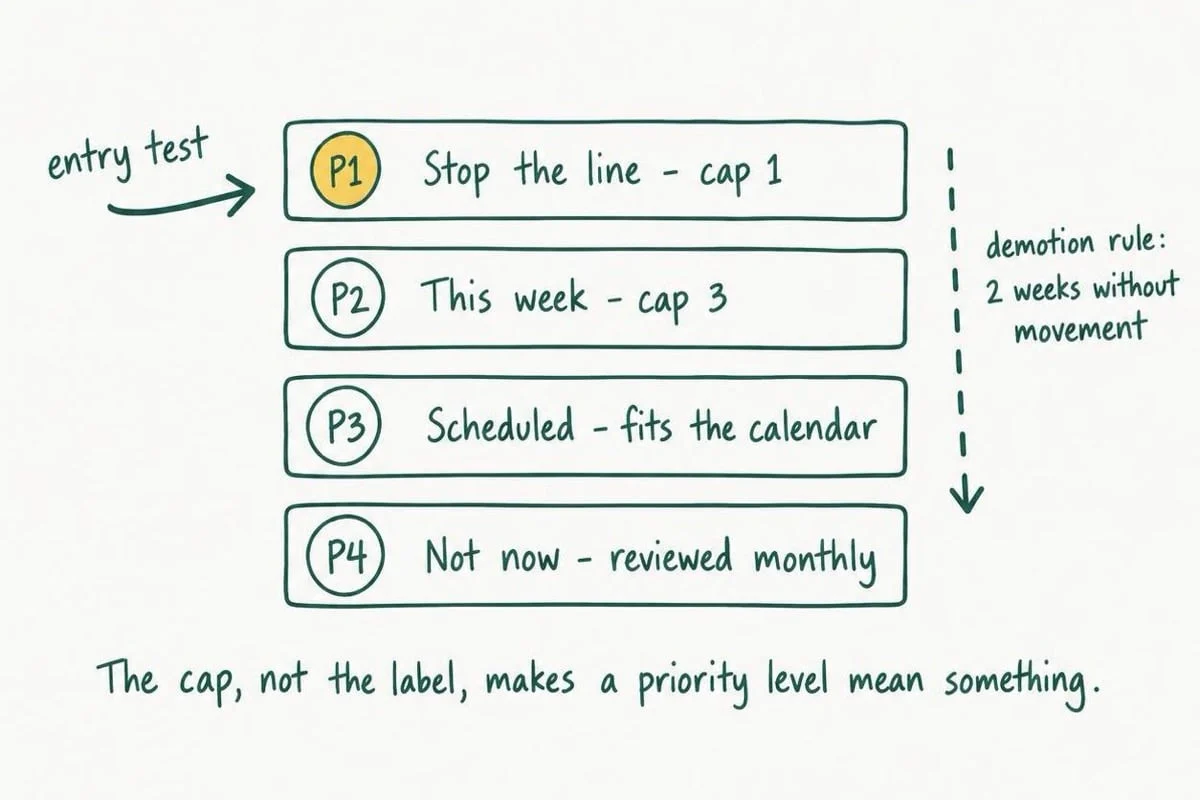
However, when this logic is ported to personal task lists, the "entry test" for these labels is almost always ignored. Without a standardized, objective definition for what constitutes a high-priority item, the scale collapses.
The Inflation of Urgency
Labels inflate for a simple, structural reason: they are free to assign, but your time is finite. When a "High Priority" tag costs nothing to apply, it will be spent freely. By the third week of using a system without guardrails, "P1" no longer denotes criticality. It denotes "recent," "loud," or "requested by someone senior." The system does not fail because people are abusive; it fails because there is no scarcity built into the architecture.
Research into the "mere urgency effect" suggests that human beings are psychologically wired to favor tasks with a looming deadline—even when those tasks provide an objectively lower payoff than the complex, important work that lacks an immediate "due date" flag. When you design a list where eleven items are marked "High," you are essentially setting a trap for your own brain, encouraging the completion of trivial, urgent tasks at the expense of long-term strategic value.
A Four-Level Framework: Forcing the Choice
To reclaim your schedule, you must move beyond the Eisenhower Matrix. While sorting tasks into four quadrants is a helpful exercise, it does not solve the problem of having eleven "Important" tasks and only one Tuesday.
The following framework, adapted from incident management, introduces two missing variables: a strict cap on volume and a defined cost of entry.
| Level | Definition | Entry Test (Objective) | Capacity Cap | The Cost |
|---|---|---|---|---|
| P1: Stop the Line | Prevents immediate damage | External block or daily deadline failure | 1 Item | Everything else shifts by 24 hours |
| P2: Weekly Promise | Dated commitments | Named person, internal deadline | 3 Items | No new entry without a removal |
| P3: Scheduled | Future-dated work | Calendar-blocked or defended date | Unlimited | Weekly review/promotion |
| P4: Not Now | Deferred/Backlog | "Would I trade a P2 slot?" | Unlimited | Monthly review/90-day purge |
The Mechanics of Capacity
The "Cap" column is the most radical element of this system. It relies on a version of Little’s Law—the principle that in any stable system, the number of items in progress is directly proportional to the time it takes to complete them. By limiting your P2 "Weekly Promises" to three items, you force a bottleneck. You cannot simply pile on more work; you must finish one commitment to create a slot for the next. This shifts the burden from "How do I do everything?" to "Which three promises matter most this week?"
The Chronology of a High-Performance Tuesday
To see how this functions in reality, consider the case of Marcus, an operations lead at a logistics firm.

09:00 AM: Marcus begins his day. His "P2" slots are occupied by a board memo due Thursday. His "P1" slot is empty.
09:12 AM: A warehouse integration failure occurs. Customers are blocked. This meets the P1 entry test: it is an active, external, and time-sensitive block. Marcus moves the board memo to Wednesday. Crucially, he communicates this shift to his CFO, Ellen. The broken promise is acknowledged, not ignored.
11:40 AM: Ellen requests a pricing analysis "as soon as possible." Because Marcus’s P1 slot is occupied by the integration, he presents a trade: "I can start this at 2:00 PM once the integration is closed, or I can start it now and the integration waits. Which is the priority?"
This is not "pushback" in the negative sense; it is a professional capacity statement. It shifts the burden of prioritization back to the stakeholder, allowing them to own the business outcome.
04:30 PM: Three new requests arrive. Because his P2 slots are full, Marcus assigns them to P3 with a scheduled date. He leaves the office having completed the critical fix and moved the memo—a productive day that avoids the "busy-work trap."
Strategic Implications and Official Responses
The most common objection to this rigid framework is the lack of autonomy: "My boss marks everything as a priority, and I have no say."
Professional productivity experts argue that even in hierarchical environments, this system serves as a diagnostic tool. When you ask a superior, "I can make this the new P1, but that means the project you assigned on Monday slips to Thursday; is that acceptable?" you are not arguing about labels. You are engaging in a resource-allocation conversation. Most leaders will respond with a strategic choice. Those who refuse to choose are inadvertently providing you with the data you need to manage your own workload boundaries.
The Role of Decision Fatigue
The psychological cost of constant re-prioritization is severe. Laboratory studies on task switching show that the time tax of switching between tasks increases with the complexity of the rules. By pre-defining your entry tests on a quiet Sunday, you remove the "tax" of deciding what to do at 4:00 PM on a Tuesday, when your cognitive load is at its peak.
Implementation: The First Fourteen Days
If you are looking to overhaul your workflow, follow this two-week roadmap:
- The Sunday Audit: Spend twenty minutes writing your entry tests and caps. Post this list on your monitor or save it as a note in your task app.
- The First Week: Simply track your P1 count. If you declare more than two P1s in a week, your entry test is too loose. Tighten the definition until using the label feels like a last resort.
- The Second Week: Monitor your P2 closure rate. If you are consistently opening more P2s than you are closing, your cap is not binding. You are treating the "Weekly Promise" as a wish list rather than a contract.
Final Assessment
Your task list is a mirror. If it is cluttered, bloated, and anxiety-inducing, it is because your system is currently saying "yes" to everything. By introducing caps, entry tests, and explicit trade-offs, you stop decorating your list and start managing your output.
Ultimately, these systems are not about doing more work; they are about ensuring that the work you do is the work that actually matters. If you find the reality of your capacity uncomfortable, you have achieved the most important step: you have moved from a state of denial to a state of data-driven reality. From there, you can finally begin to act.