In an era where personal health data is increasingly treated as a digital commodity, the security of menstrual and reproductive tracking apps has become a focal point of intense scrutiny. As the digital landscape shifts—compounded by complex legal environments surrounding reproductive healthcare—many users are finding that the "convenience" of popular period-tracking applications may come at a cost they are no longer willing to pay.
Recent audits, including a comprehensive review by the Mozilla Foundation, have cast a shadow over several industry giants. While many apps promise to simplify health management, they often store sensitive information on corporate servers, potentially exposing that data to third-party advertisers or, in extreme cases, legal discovery. Amidst this concern, one application has emerged as the gold standard for user privacy: Euki.
The Main Facts: Why Your Period Tracker Might Be a Liability
The fundamental issue with most period-tracking apps is their business model. Many operate on a cloud-based infrastructure, meaning that the moment you input data about your cycle, symptoms, or sexual health, that information leaves your device and travels to the developer’s servers.
Once your data is stored on a server, it is subject to the company’s privacy policy, which often includes clauses allowing for the anonymized sharing or selling of data to third-party marketers. More critically, in the wake of shifting reproductive rights legislation, there is a documented concern that this data could be subpoenaed by law enforcement. Unlike traditional medical records, which are shielded by strict HIPAA regulations in the United States, data held by consumer-facing apps often lacks the same rigorous legal protections.
Euki departs from this norm by adopting a "privacy-first" architecture. By keeping all data stored locally on the user’s phone, Euki ensures that the developer—and by extension, any potential third-party entity—never has access to the user’s personal health history.
Chronology: The Evolution of Digital Reproductive Privacy
The conversation surrounding the security of reproductive health data is not new, but it has gained significant momentum over the last decade.
- Pre-2020: Period tracking apps were largely viewed through the lens of convenience. Users prioritized features like UI design, notification reliability, and predictive accuracy over data storage protocols.
- 2022–2023: The overturning of Roe v. Wade served as a massive catalyst for change. As legal battles over reproductive rights intensified, privacy advocates raised alarms about how "digital footprints"—including search history, location data, and health app inputs—could be weaponized in a court of law.
- 2024–2025: High-profile audits of popular apps like Flo, Clue, and Stardust revealed significant shortcomings in how these platforms handled user privacy. These audits highlighted that even companies claiming to "encrypt" data often retained the keys to decrypt that information, making them vulnerable to government requests.
- July 2026: The Mozilla Foundation released its latest audit of six major period-tracking apps. While most fell short of industry-best privacy standards, Euki was highlighted as the only application to prioritize the user’s autonomy over data collection.
Supporting Data: The Privacy Audit Findings
The Mozilla Foundation’s investigation into the top six menstrual and ovulation tracking apps was exhaustive. The audit assessed apps based on encryption, data-sharing policies, and the ability of the user to control their own digital history.
The findings for the "big players" in the space were alarming. Several apps were found to share data with advertisers or to maintain databases that, while described as "secure," remained technically accessible to the companies themselves. In contrast, Euki’s architecture was found to be fundamentally different:

- Zero-Account Requirement: Unlike its competitors, Euki does not require an email address, phone number, or social media login. By removing the identity layer, the app prevents the creation of a persistent user profile.
- Local Storage: Data is housed exclusively on the user’s hardware. If a phone is lost or stolen, that data is inaccessible to the company, as it never existed on their servers.
- No In-App Purchases: The removal of a monetization layer via tracking or advertising reduces the incentive for the app to collect or analyze user data.
Official Responses and Developer Transparency
The developers behind Euki have taken a starkly different approach to transparency. While many tech firms use dense, impenetrable legal jargon in their privacy policies, Euki’s communication is designed to be accessible.
According to their technical disclosures, the app is free of charge and features no in-app purchases. This is a deliberate design choice meant to ensure that the user’s relationship with the app remains strictly transactional: the user provides input, and the app provides insights, with no middleman. When asked about potential data requests from law enforcement, the developers have consistently emphasized that they cannot comply with such requests because they do not possess the data. They essentially designed the system to be "subpoena-proof" by design.
The Practical Implications for Users
For the average person, switching to a privacy-focused app like Euki involves a trade-off. Users might lose some of the "social" features found in other apps—such as forums, community chats, or complex AI-driven trend predictions that require cloud-based data processing. However, for those who prioritize security, the trade-off is often deemed necessary.
Key Privacy Features of Euki:
- Dual-PIN Protection: The app allows users to set a primary PIN and a "fake" PIN. The fake PIN is a brilliant security feature; if a user is coerced into showing someone their app, entering the fake code displays a "technical difficulties" error screen, effectively hiding the actual health data.
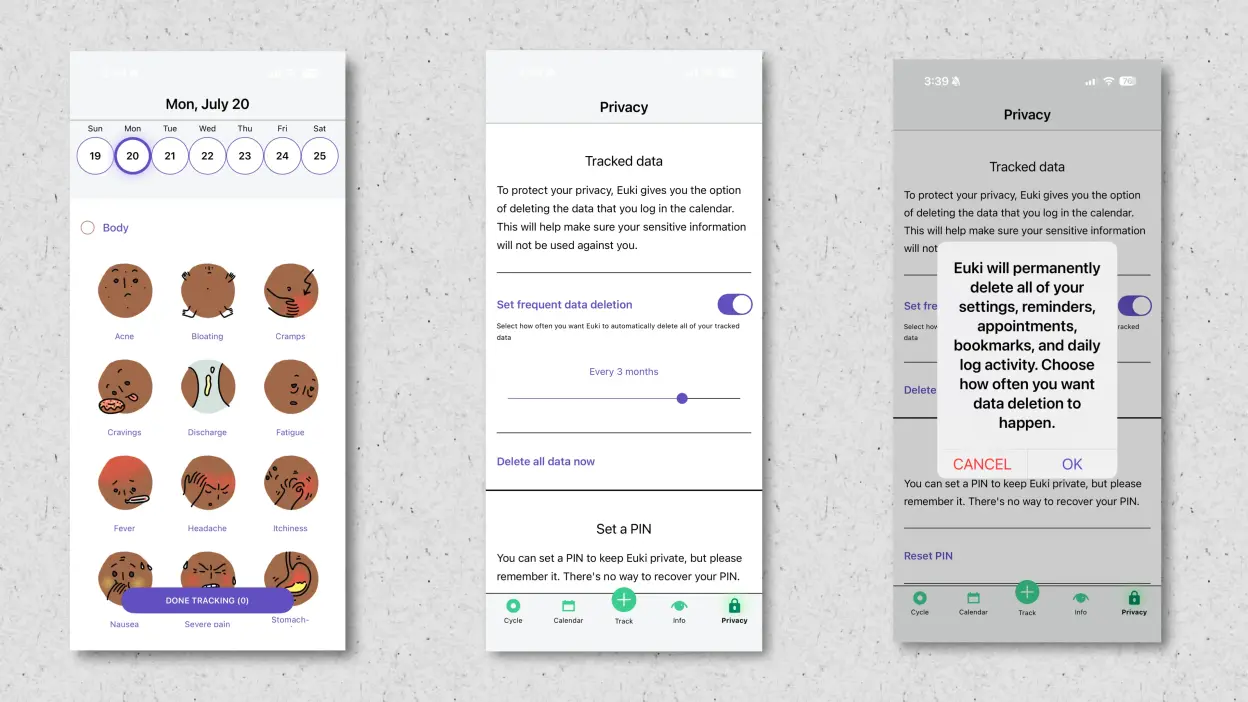
- Automated Data Wiping: Users can schedule regular deletions of their logs. This ensures that even if a device is seized, the digital trail is minimized.
- Versatile Tracking: Despite its focus on security, Euki does not sacrifice utility. It supports the tracking of bleeding, emotional states, physical symptoms, sexual activity, and even niche medical markers like IUD string checks or clinical appointments.
A Broader Shift in Digital Health
The rise of Euki signals a larger, necessary shift in how we interact with technology. For years, the "free" model of software—where the user is the product—has dominated the tech sector. Reproductive health, however, is a uniquely sensitive category where the standard rules of digital marketing cannot apply.
As the Mozilla Foundation and other advocacy groups continue to apply pressure, the industry is at a crossroads. Larger companies may eventually be forced to adopt local-storage models to regain user trust. Until that happens, independent, non-profit-aligned, or privacy-first applications like Euki provide a roadmap for how health-tech should function in a modern society.
For users currently using mainstream apps, the advice from cybersecurity experts is consistent: evaluate your risk profile. If your primary goal is to manage your health without leaving a trail of sensitive information that could potentially be accessed by third parties or legal entities, the transition to a local-first application is not just a technological upgrade—it is an essential act of digital self-defense.
As we look toward the remainder of 2026, the success of Euki serves as a case study: in the digital age, the most valuable feature a health app can offer is the promise that it knows absolutely nothing about you.