Your alarm rings at 6:10 AM. By 6:12, you are upright, stumbling into the kitchen by 6:15. Yet, despite being physically mobile, you find yourself staring blankly at the open refrigerator, unable to decide what to eat. You read the same text message three times, the meaning sliding off your brain like water off a duck’s back. It isn’t until 6:40 AM that the mental fog begins to lift and you finally feel like a sentient human being—which, coincidentally, is the exact moment you need to walk out the door.
For millions of people, this ritual is a source of profound frustration. We spend the rest of the day convinced we suffer from a chronic sleep disorder, or worse, a character flaw—a lack of willpower that prevents us from being "morning people." However, the scientific community has a name for this state: sleep inertia. It is not a moral failing; it is a measurable, biological phenomenon. And as recent research suggests, the remedy to this morning malaise is not found in a frantic, post-alarm routine, but in the decisions you make long before your eyes open.
Main Facts: Defining the Fog
Sleep inertia is defined as the transitional state of reduced alertness, impaired cognitive performance, and diminished physical capability that occurs immediately upon waking. According to research published by Hilditch and McHill (2019), this is not merely a feeling of "being tired." It is a quantifiable degradation of the brain’s executive functions.
Clinical literature, including work by Dr. Rachel Marie E. Trotti, characterizes this state as a period of significant disorientation. Crucially, sleep inertia is ordinary. It is a biological gear-shift that happens even to those who achieve high-quality sleep. The expectation that one should be "sharp" the second their eyes open is a modern societal construct that contradicts our biological reality.
The problem arises when we attempt to "fix" this state using popular hacks: moving the alarm across the room, dousing the face in ice water, or consuming caffeine the moment our feet hit the floor. While these tactics may provide a placebo effect or a sensory jolt, they do little to alter the underlying biological texture of those first twenty minutes. The evidence is clear: real relief is a result of proactive, not reactive, interventions.
Chronology: The Biology of Waking
To understand why the first 20 minutes are "unusable," we must look at the variables that dictate the severity of sleep inertia. These factors are set in motion hours before the alarm sounds.
1. The Sleep Debt Factor
Sleep deprivation acts as a force multiplier for sleep inertia. When you wake up having failed to secure an adequate "sleep opportunity" (the window of time intended for rest), your brain remains stuck in a low-functioning state significantly longer. A long period of wakefulness before eventually falling asleep can also complicate the next morning’s transition, creating a cycle of degradation that no amount of morning coffee can fully reverse.
2. The Circadian Trough
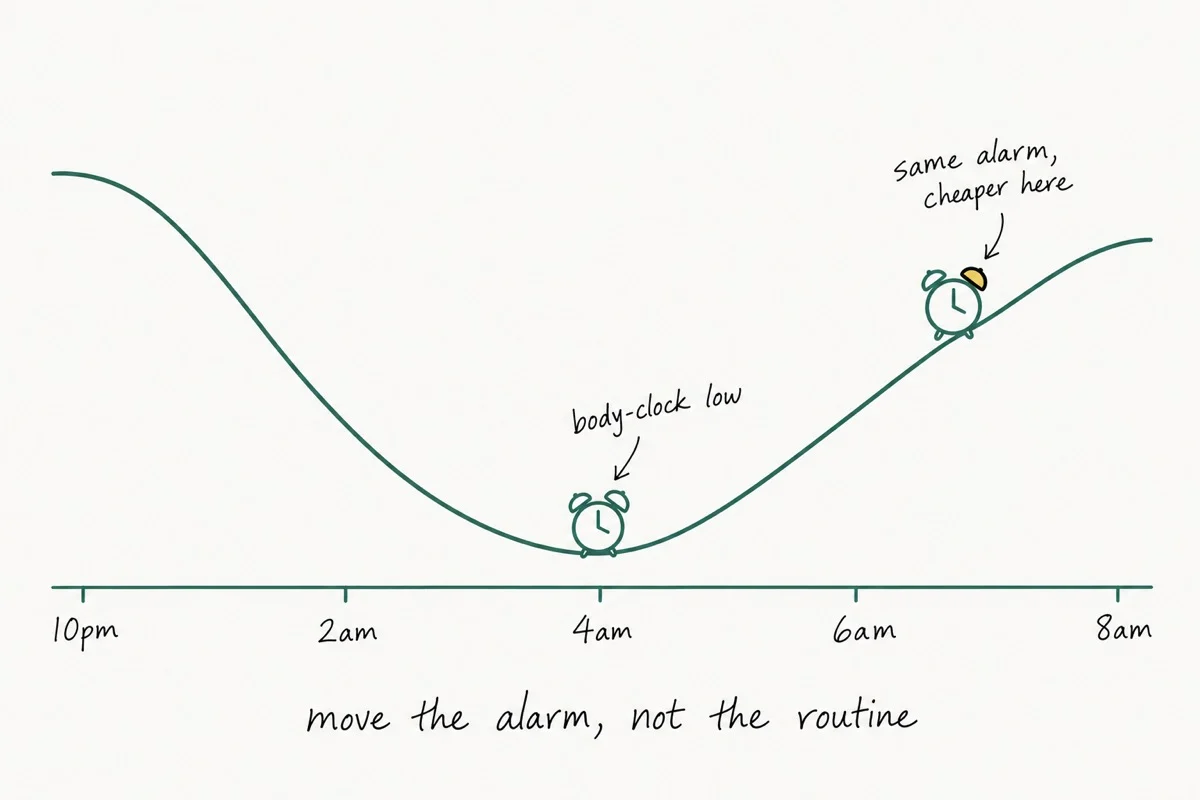
Your body operates on a rhythmic schedule known as the circadian rhythm. For a person maintaining a standard 11:00 PM to 7:00 AM sleep schedule, the "circadian trough"—the low point of biological alertness—typically occurs between 3:00 AM and 5:00 AM. However, these numbers are not universal; they are tethered to your specific chronotype. If your alarm is set to go off while your body is still in this biological low, the cost of waking is exponentially higher than if it were set just thirty minutes later.
3. The Stage of Sleep
The stage from which you are pulled matters. Waking from deep, slow-wave sleep is associated with more intense inertia. While some mobile applications promise to track your sleep cycles and wake you during "light sleep," the scientific community urges caution. Because sleep pressure and timing are so complex, these apps often lack the precision required to truly spare you the fog, and users should be skeptical of any technology that promises a "painless" wake-up based on stage-tracking alone.
Supporting Data: What Actually Works
When we analyze the effectiveness of various morning interventions, a hierarchy of evidence emerges.

High-Evidence Interventions (The Pre-Wake Stage)
- Protecting Sleep Opportunity: This is the most effective, albeit the least glamorous, solution. Increasing the duration and consistency of your sleep is the only way to fundamentally shorten the duration of post-wake grogginess.
- Strategic Alarm Placement: If you are chronically groggy, you may be in a timing conflict with your body clock. Moving your alarm 20–30 minutes later—even if it means shifting a non-essential task to later in the day—is more effective than any "wake-up hack."
Moderate-Evidence Interventions (The Immediate Wake Stage)
- Caffeine (The Timing Delay): Caffeine is effective, but it is misunderstood. Studies show that peak blood-caffeine levels are reached approximately 38–40 minutes after consumption. Whether you consume it as a drink or gum, the "jolt" is not instantaneous. To be effective, you must treat your first cup as the start of a 20-minute waiting period, not a magical reset button.
- Light Exposure: Light-emitting glasses or artificial dawn simulators can improve subjective feelings of alertness. Research suggests these tools make the morning "feel" better, even if they don’t necessarily improve objective psychomotor performance.
Low-Evidence Interventions (The "Hack" Tier)
- Cold Water and Exercise: While refreshing, there is limited clinical evidence that these acts terminate sleep inertia. They may offer a sensory distraction, but they do not clear the neural cobwebs of sleep inertia. The scientific consensus suggests these are "pleasant habits" rather than medical solutions.
Official Responses: Clinical Perspectives
When does "groggy" become a medical concern? Professionals distinguish between standard sleep inertia and more serious conditions like idiopathic hypersomnia or obstructive sleep apnea.
If you find that your inability to function persists for hours, or if you experience "sleep drunkenness" (extreme confusion upon waking), this is a matter for a clinician. Medical experts advise that you keep a log: note the duration of your morning fog, how often it occurs, and how it impacts your daily function. Presenting this data to a doctor is far more effective than self-diagnosing or attempting to "power through" with caffeine.
For those whose grogginess is driven by hormonal shifts—such as those navigating menopause—the solutions must be tailored to address underlying physiological changes, often requiring a multi-disciplinary approach involving sleep specialists and endocrinologists.
Implications: Designing a "Dumb" Morning
The most significant takeaway from the research is a shift in mindset: Stop trying to be productive during a time when your brain is biologically incapable of it.
If the first 20 minutes of your day are fundamentally impaired, the most strategic move is to ensure that those minutes require zero executive function.
- The "Dummy-Proof" Routine: Prepare everything the night before. Lay out your clothes, pack your bag, and set the coffee machine to start before you even walk into the kitchen. By removing the need to make decisions, you eliminate the risk of "bad decisions" (like sending an ill-advised email or forgetting your keys).
- Move the Decisions: Shift your high-stakes work, difficult conversations, and complex planning to a time when your brain is fully online—usually 60 to 90 minutes after waking.
- Acceptance: Recognize that the fog will pass. It is a biological inevitability, not a failure of character. By stopping the internal war against your own physiology, you save energy that can be better spent during the hours when you are actually at your peak.
Frequently Asked Questions
How long does sleep inertia last?
While many sources suggest a strict 20-minute window, it is more accurate to view it as a curve. Most people see significant recovery within 20 to 30 minutes, but for some, the effects can linger for up to two hours. If yours runs long, it is not a sign of a broken brain; it is simply your unique biological recovery rate.
Does hitting the snooze button make it worse?
The act of snoozing itself is less damaging than the consequences of the habit. If snoozing leads to a fragmented, low-quality sleep or shifts your wake-up time into an even worse circadian slot, it will certainly exacerbate your inertia.
Why are naps sometimes harder to wake up from?
Naps that last long enough to enter deep, slow-wave sleep are notorious for inducing severe sleep inertia. For a quick refresh, aim for shorter naps (10–20 minutes) to avoid the "sleep drunkenness" that occurs when you are ripped from deep rest.
Conclusion
The quest for a "perfect" morning routine often leads to an accumulation of ineffective, high-effort habits. The science suggests we should move in the opposite direction. By protecting your sleep, aligning your alarm with your body’s natural rhythm, and delegating your hardest tasks to a time when your brain is fully awake, you can transform your mornings. The first 20 minutes may not belong to you, but they don’t have to cost you anything, either.