We have all been there: staring at a shelf of half-filled notebooks, knowing that somewhere within those dense, ink-stained pages lies the answer to a pressing question. Perhaps it is the exact quote from a client meeting in March, the contact information for a highly recommended contractor, or a brilliant creative spark scribbled on a commuter train. You know the data exists; you simply cannot reach it.
For many, the paper notebook has become a "write-only" device. It is an excellent vessel for the immediate capture of ideas, but it becomes a static, impenetrable archive the moment you need to extract information. Most people attempt to solve this by purchasing more expensive stationery or starting a fresh notebook, but these actions rarely address the underlying structural failure. A Japanese-inspired organizational framework offers a solution to this retrieval crisis, requiring only a few seconds of maintenance per page.
The Structural Failure of Modern Note-Taking
To understand why our notebooks fail us, we must identify the primary conflict: chronology versus utility.
Paper notebooks are inherently linear. We write in the order events occur, but we almost always need to retrieve information in the order of its relevance. Because there is no native architecture connecting these two dimensions, the only search mechanism available to the user is the "thumb-flip." Once a notebook exceeds fifty pages, this method transitions from a search strategy into a form of aimless archaeology.
Why Common Fixes Fail
Many common organizational tactics fail because they attempt to force complex sorting during the "capture phase." This is the worst possible time for cognitive friction.
- Project-specific notebooks: You will invariably have the wrong one in your bag when inspiration strikes.
- Tabbed dividers: These assume you had the foresight to categorize your life in January.
- Colored pens and highlighters: These require complex decision-making while you are still trying to listen or process information.
- Digitizing daily: Manually transcribing notes into an app is essentially a second job—a discipline that almost always collapses during a high-stress week.
The golden rule of note-taking is that capture must remain "dumb and fast." If a system demands too much mental energy, the act of writing will eventually cease.
What is the Japanese Notebook System?
When researchers or productivity enthusiasts search for "Japanese notebook systems," they often find two disparate results: high-end, structured stationery products and an informal, folklore-adjacent edge-indexing technique.
The Product Ecosystem
Japanese stationery manufacturers have mastered the art of the fixed-format planner. Brands like Hobonichi (with their Techo line) and MIDORI (with the TRAVELER’S notebook) operate on a philosophy that Western planners often avoid: the format is fixed, and the user commits to it. These products are not merely tools; they are environments. They recognize that if the structure is consistent, the user’s brain adapts to that structure, reducing the need for constant redesign.
The Page-Edge Indexing Trick
The second part of the "system" is an edge-indexing method that lacks a clear, singular origin story. While some proponents suggest it is a centuries-old practice, it functions best as a modern, low-cost maintenance layer. In this system, you maintain a single, chronological stream, but you outsource the sorting to the physical edge of the paper and a dedicated index at the back of the book. By separating capture from retrieval, the two processes never compete for your attention.
Implementation: Building the System in 20 Minutes
You do not need to buy new supplies. This system works with your current notebook, a pen, and a single highlighter or marker.
1. The Foundation: Page Numbering
The most critical step—and the one most people skip—is numbering your pages. Spend twenty minutes numbering the bottom outer corners of your notebook. Without page numbers, an index is impossible. This is the "index-ability" factor that turns a pile of paper into a database.
2. The Four-Category Limit
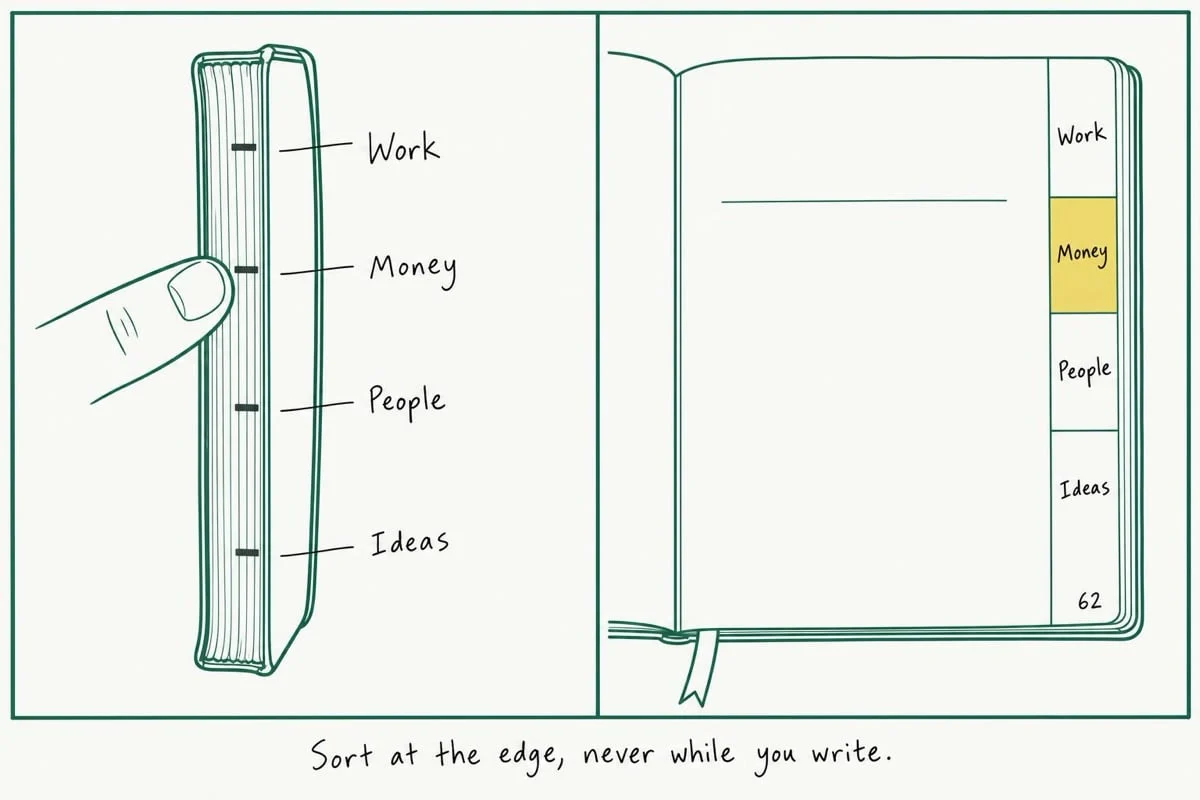
Select four, and only four, categories that encompass your life. Examples include: Work, Money/Admin, People, and Ideas. Do not exceed four categories. If you have more, you will hesitate during the capture phase, which kills the flow. If a fifth category feels essential, it likely deserves its own dedicated notebook.
3. The Edge Column
Leave a narrow, half-inch strip down the outer margin of every page. Divide this strip into four horizontal bands. When a page is primarily dedicated to one of your four categories, fill the corresponding band with your marker, bleeding the ink right off the edge of the paper. When the book is closed, you will see a visible, color-coded stripe on the edge of the pages. This allows you to find specific information without ever opening the book.

4. The Back-Page Index
Reserve the final two pages of your notebook for a formal index. For every page you fill, record:
- Date
- Three to six words describing the content
- Page number (e.g., Mar 4 – Hoffman call, pricing – p.62)
This takes four seconds and should be done the moment you finish a page.
5. The Friday Review
Spend five minutes on Friday afternoon scanning your entries. Circle any open tasks or unfinished projects. This "habit stacking"—attaching the review to the end of your final meeting—is the secret to ensuring the system survives past the first month.
Implications for Workflow: A Case Study
Consider a professional named "Paula." She manages multiple projects and personal household administration. On Monday, she takes notes in a meeting; she marks the "Work" band, writes an index line, and uses square boxes for action items. On Wednesday, she jots down a creative idea on the train; she marks the "Ideas" band. On Thursday, she records a plumbing quote in the only available space—the middle of her client notes.
In the old system, that plumbing quote would be lost to the abyss of chronological data. In this system, when the plumber calls back, Paula simply looks at the "Money" stripe on the edge of her book, sees the four dashes, and flips to the relevant page. The retrieval takes fifteen seconds.
Why Paper Still Matters
In an era of digital dominance, why use a notebook at all? The answer lies in capture friction. Digital tools are superior for searching, but they are disastrous for deep thinking. The act of unlocking a device, navigating to an app, and avoiding notification distractions introduces significant friction. Paper allows for immediate, uninhibited thought.
The professional strategy is a hybrid: use paper for primary capture and thinking. Only move information to digital storage if it meets one of three thresholds:
- It requires collaboration with others.
- It is tied to a hard, non-negotiable deadline.
- It is information you have needed to look up more than twice.
Official Perspectives and Expert Consensus
While the "Japanese System" is often marketed as a catch-all solution, productivity experts emphasize that it is not a cure-all for organizational apathy.
"The gear is not the constraint," notes productivity consultant Marcus Thorne. "People often believe that buying a $50 notebook will solve their inability to track tasks. In reality, the system is the index. If you don’t maintain the index, the quality of the paper is irrelevant."
Academic studies on handwriting and memory, while frequently cited, often remain inconclusive. However, the consensus among cognitive psychologists is that the act of handwriting forces a level of information processing that typing does not. By manually summarizing a page into an index line, you are performing a secondary, subconscious review of the material, which significantly aids in memory retention.
Conclusion: Starting Small
Do not attempt to overhaul your entire life tonight. Start with the notebook you already own. Number the pages from today forward. Create your index on the back two pages for only the last ten entries.
If a month passes and you find yourself successfully retrieving information, the system has paid for itself. If you never look back at your notes, you have learned something vital: you may not have a retrieval problem at all. The goal is not to have a "perfectly organized" shelf; it is to have a tool that actually serves your work, rather than a graveyard of abandoned intentions.