It is 9:15 a.m. You have opened your laptop with a clear understanding of the day’s requirements. By 9:50 a.m., however, the reality of the morning looks drastically different: you have read the same three emails twice, opened a spreadsheet only to close it immediately, and scanned the news headlines for the fourth time. You have accomplished nothing. The work itself is not technically difficult; you could explain the requirements to a colleague with ease. Yet, you remain perfectly still.
This state, colloquially referred to as "task paralysis" or an "overwhelm freeze," is a common experience in the modern workplace. It is rarely a result of laziness or a deficit in discipline. Instead, it is a structural failure of decision-making. When a task list grows, the cognitive load increases, eventually hitting a threshold where the brain simply stops processing.
The Chronology of a Frozen Day
The trajectory of a "frozen" day usually follows a predictable, downward spiral. It begins with the morning’s initial ambition, quickly followed by the creeping realization that the workload is insurmountable.
- 9:15 a.m. (The Intent): The workday begins with high-level awareness of pending tasks—a contract to review, a doctor’s appointment to schedule, a project deck to build, and a lingering email reply.
- 10:00 a.m. (The Friction): You attempt to address a task. You look at "Review Contract" and find your mind stalling. The brain registers a requirement for a decision, but no immediate path forward.
- 12:00 p.m. (The Avoidance Loop): Having failed to start the high-priority tasks, you pivot to low-stakes "busy work." The discomfort of procrastination begins to manifest as physical restlessness or, conversely, complete lethargy.
- 5:00 p.m. (The Debt): The day concludes with the heavy realization that nothing was moved. The tasks remain, now accompanied by the added weight of guilt and the erosion of self-efficacy, which makes the prospect of tomorrow even more daunting.
This is not a character flaw. It is a system error. When the "pile" of tasks exceeds the brain’s capacity to categorize them, the result is total stagnation.
Supporting Data: The Science of Cognitive Load
The reason for this freeze lies in the limitations of human working memory. Research from psychologist Nelson Cowan on working memory capacity provides a sobering look at our limitations. In adults, the "central limit" for holding information—or "chunks"—is roughly three to five items when rehearsal is blocked.
When you have eleven "open loops" on your plate, you are asking your brain to juggle more than it is biologically designed to handle. Discipline cannot override biological hardware. When you look at an item on your list and your brain returns "no first move," you are not procrastinating; you are experiencing a cognitive bottleneck.
Furthermore, research on "decision deferral" suggests that people are significantly more likely to abandon a task entirely when the alternatives are ambiguous or conflict-ridden. A 2024 review highlights that choice overload is conditional: it isn’t the number of tasks that paralyzes us, but the complexity of the decisions buried within those tasks. If you write "Fix Project" on a to-do list, you haven’t written a task—you’ve written a complex, unresolved question.
The Methodology: Downgrading to "Boring"
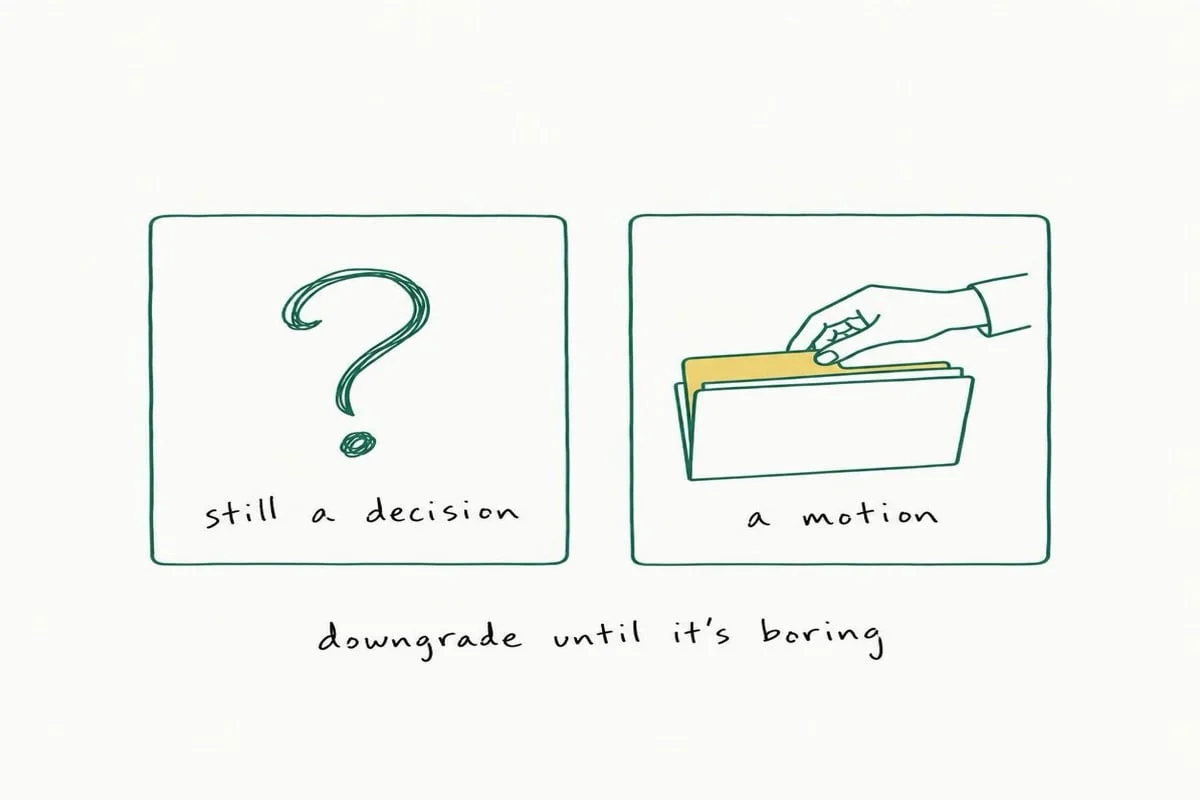
The prevailing advice—to break big tasks into smaller ones—is often counterproductive. "Write the report" becomes "outline the report," which then becomes "think about the report’s structure." All three of these are still decisions, not actions. You have simply created a series of smaller, yet still overwhelming, questions.
To escape the freeze, the objective must shift from "smaller" to "boring."
The "Stranger Test"
A task is successfully downgraded when a reasonably competent stranger could perform the action without asking you a single clarifying question.
- "Do my taxes" (Fails the test: requires endless decisions).
- "Open the folder marked 2025 and label all documents by date" (Passes the test: the thinking is finished; only the labor remains).
Boring is not a sign of low standards; it is a signal that the cognitive work has been completed, leaving only the physical execution.

The Three-Line Card
The implementation of this method involves a simple index card containing only three lines:
- When: The specific time the motion starts.
- Where: The specific location (e.g., "At my desk").
- The Motion: A single, physical act (e.g., "Open the contract and read section 4").
This structure leverages "implementation intentions." A meta-analysis of 94 studies involving over 8,000 participants found that individuals who created specific "if-then" plans had a significantly higher goal-attainment rate (d = 0.65) than those who merely held a goal in mind. By writing the card, you externalize the decision, freeing your working memory to focus on the immediate, tiny movement required to break the paralysis.
Implications for Workflow and Mental Health
It is crucial to differentiate between a temporary "overwhelm freeze" and persistent mental health challenges.
When to Seek Professional Support
The National Institute of Mental Health (NIMH) advises that if an individual experiences a persistent inability to concentrate, difficulty making simple decisions, or an inability to complete daily tasks for two weeks or more, it is time to consult a health professional.
Terms like "task paralysis" are helpful shorthand for the experience, but they are not clinical diagnoses. They do not account for underlying conditions such as ADHD, clinical depression, or generalized anxiety. A 2023 meta-analysis of behavioral activation—a therapy that focuses on scheduling concrete activities—found high efficacy in treating clinical depression, proving that while "action" is not a cure-all, it is a proven mechanism for improving mental health outcomes.
The Myth of the "System"
The most common objection to this approach is that it feels like "one more system to manage." However, the "Three-Line Card" is designed to be the opposite of a system. There is no streak to maintain, no app to sync, and no penalty for missing a day. It is a tactical tool for the moment you are already behind.
If you attempt to use this as a "hack" to trick yourself into two hours of work, it will fail. The motion is the entire commitment. By allowing yourself to stop once the specific, boring action is complete, you build trust with your own brain. You prove that a task does not have to be a multi-hour ordeal, but can instead be a series of manageable, low-stakes errands.
Conclusion: One Motion, Today
The goal of this approach is not to suddenly become a productivity machine. The goal is to stop a day from being "lost."
When you feel the freeze setting in, do not try to "plan the week." Do not reach for a new task-management application. Simply look at the item causing the most dread, identify the single decision you have been avoiding, and downgrade the work until it is so boring that a stranger could do it.
Write the card. Perform the motion. Stop.
In a world that demands constant output, the most radical thing you can do is simply move one thing forward. By mastering the art of the "next motion," you reclaim your day from the paralysis of over-analysis. You don’t need more discipline; you need more clarity, and that starts with the very next thing you do.