For millions of people in their 40s and 50s, the "midlife crisis" is not a cliché involving sports cars or impulsive career changes. It is a quiet, domestic erosion. You wake up one morning, look across the breakfast table, and realize that the person sitting there—or the version of yourself staring back in the mirror—no longer aligns with the life you are living.
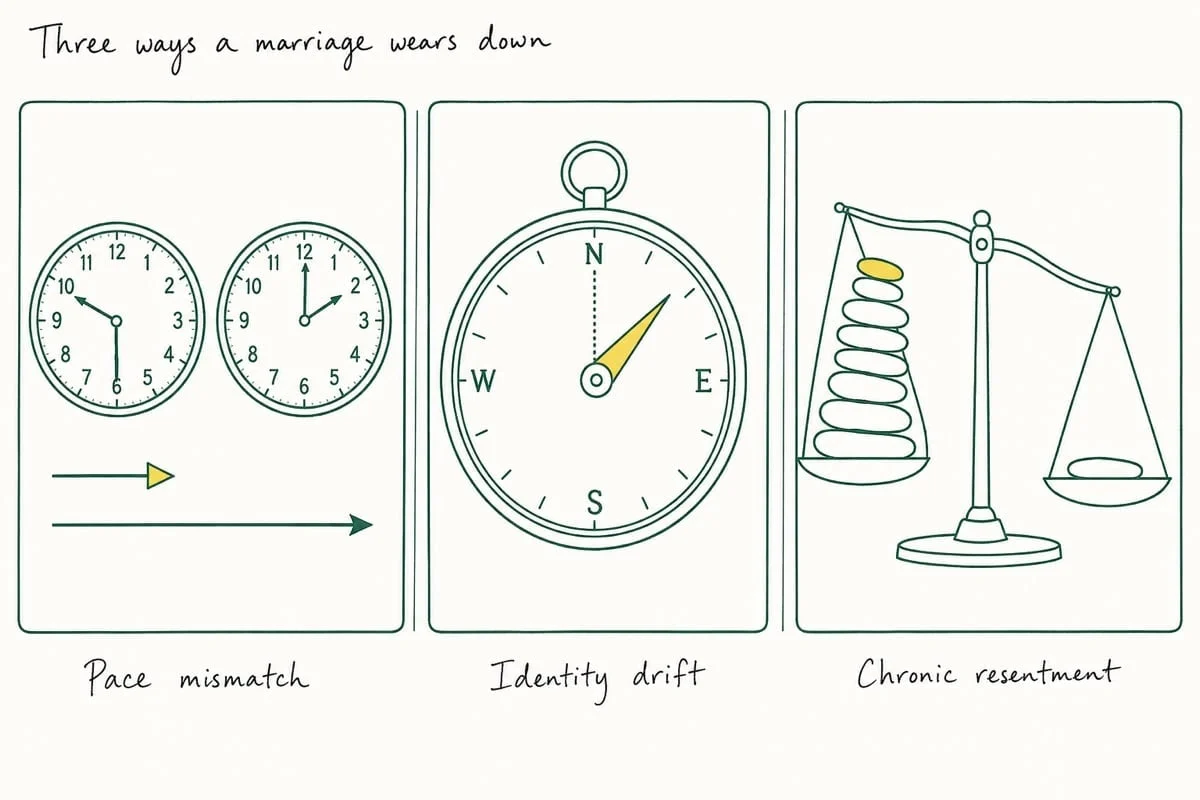
While pop culture often frames this as a binary choice—stay and suffer or leave and start over—relationship experts and clinical researchers suggest a third path: the Midlife Rebuild. An unhappy marriage at midlife is rarely the result of a single catastrophic event. It is almost always a structural failure caused by three compounding forces: pace mismatch, identity drift, and chronic resentment. Before deciding whether to dissolve a union, it is imperative to diagnose which of these pillars has collapsed.
Main Facts: The Anatomy of a Stalled Union
To navigate the complexity of a long-term marriage, one must first strip away the emotional static. When a marriage loses its luster, partners often point to the "death of romance" or "incompatibility." However, data suggests that these are symptoms, not root causes.
The three primary diagnostic markers of a midlife marital decline are:
- Pace Mismatch: One partner enters a season of rapid internal growth or change, while the other remains stagnant or on a different developmental timeline. This is a synchronization issue, not a character flaw.
- Identity Drift: The "self" you were twenty years ago is not the "self" you are today. In the process of building a stable, shared life, many individuals inadvertently erase their own interests, values, and autonomy.
- Chronic Resentment: The accumulation of thousands of "micro-betrayals"—unspoken grievances, compromised needs, and silent sacrifices—that eventually solidify into a wall of contempt.
If your marriage is failing, the goal is not merely to "save" it, but to determine if the foundation can support the people you have both become.
Chronology of a Disconnect: How We Got Here
The deterioration of a marriage at midlife typically follows a predictable, albeit slow, trajectory. It does not happen overnight; it is a twenty-year accumulation of habits.
- The Foundational Years (Years 0–7): The marriage is built on shared goals: career climbing, home purchasing, and early child-rearing. The "self" is often sacrificed for the "us" willingly.
- The Maintenance Phase (Years 7–15): The couple settles into a rhythm. Efficiency becomes the priority. Communication shifts from deep connection to logistical coordination (schedules, bills, household management).
- The Midlife Pivot (Years 15–25): The children grow older, or careers reach a plateau. The external pressures that held the couple together begin to fade, leaving a vacuum. This is when the "pace mismatch" becomes visible. One partner may feel an urgent need for novelty or self-discovery, while the other feels satisfied with the status quo.
- The Breaking Point: If the couple does not address these shifts, they reach a point of "chronic resentment." Small annoyances, once ignored to keep the peace, turn into a permanent state of emotional distance or open hostility.
Supporting Data: What the Research Says
Relationship science, most notably the work of Dr. John Gottman and Dr. Esther Perel, provides a roadmap for those currently in the "midlife fog."
The 5-to-1 Ratio
Gottman’s research into marital stability identified a specific metric: the 5-to-1 ratio. Stable, long-term couples engage in five positive interactions for every one negative interaction during conflict. When that ratio slips, the relationship enters the danger zone. The good news? This is a behavioral metric. It can be consciously rebuilt through small, daily deposits of appreciation and connection, even when the feeling of "being in love" is currently dormant.
The U-Curve of Happiness
Data on global life satisfaction reveals a "U-shaped" curve. Humans consistently report lower life satisfaction in their mid-40s to mid-50s, regardless of their marital status. This is a critical insight: Your unhappiness may be a biological and developmental stage, not a marital verdict. Blaming a spouse for the natural, universal dip in midlife satisfaction is a common error that leads to unnecessary divorces.
The Danger of Contempt
Gottman famously identified the "Four Horsemen" of the apocalypse: criticism, contempt, defensiveness, and stonewalling. Contempt—defined by mocking, eye-rolling, and an attitude of superiority—is the single strongest predictor of divorce. If your marriage has reached the stage of contempt, it requires immediate, professional intervention rather than self-help strategies.

Official Responses and Clinical Perspectives
Mental health professionals emphasize that a "rebuild" is not a life hack; it is an act of intentionality.
"The conditions that make for a stable, secure marriage—predictability, safety, and routine—are the very things that can cause an individual to feel stifled," notes researcher Esther Perel. The tension between the need for security and the need for autonomy is the central friction of midlife.
For those who feel they have "lost themselves," clinicians suggest that the marriage is often a "screen" upon which they project their own identity crisis. If you were to wake up tomorrow and find your marriage perfectly repaired, would you still feel empty? If the answer is yes, the primary work is internal. A marriage cannot be the sole vessel for your sense of purpose.
Implications: Moving Forward
If you are standing at this crossroads, the immediate step is not to file for divorce, nor is it to force a reconciliation that feels performative. The step is to stabilize and diagnose.
The 30-Minute Weekly Audit
The most effective tool for a midlife rebuild is the "30-minute conversation." Once a week, set aside thirty minutes where no logistics (kids, chores, bills) are discussed. The agenda is binary:
- What felt good this week? (Focus on connection).
- What felt off? (Focus on the source of the resentment or mismatch).
This practice serves as a "drain valve" for resentment. By naming the issues weekly, you prevent them from compounding into the contempt that destroys relationships.
The Five Possible Paths
Most people believe they have two options: stay or leave. In reality, there are five:
- The Conscious Rebuild: Both partners recognize the growth gap and commit to navigating it together.
- The Internal Pivot: You stay, but you shift your focus toward your own personal growth, relieving the marriage of the burden of "making you happy."
- The Strategic Pause: You agree to a 90-day moratorium on big decisions while you both stabilize your own mental and physical health.
- The In-House Separation: A formal agreement to live as roommates while redefining the terms of your domestic life.
- The Conscious Uncoupling: A peaceful, intentional separation once it is clear that the paths have diverged beyond repair.
A Note on Safety
It must be reiterated: if your marriage involves domestic violence, substance abuse, or an untreated mental health crisis, the "diagnostic" approach is insufficient. In these cases, you are not dealing with a "tempo issue" or "identity drift." You are dealing with an acute safety risk. In the United States, please reach out to the National Domestic Violence Hotline (1-800-799-7233) or the Suicide and Crisis Lifeline (988). These situations require external, clinical support, not self-directed reflection.
Conclusion: You Are Not Behind; You Are Rebuilding
The midlife transition is a profound, often painful, but necessary phase of the human lifecycle. If you feel unhappy, you are not necessarily failing; you are at the "rebuild" stage of a long-term project. The goal is to see your marriage as one of several systems in your life. By diagnosing the specific cause of your discord—be it pace, identity, or resentment—you gain the agency to move forward with clarity rather than panic.
Start small. Set the 30-minute conversation. Name the problem. And remember: the decision to stay or leave is a weight that only becomes manageable once you have finished the diagnostic work. You are not behind; you are simply beginning the most honest chapter of your adult life.