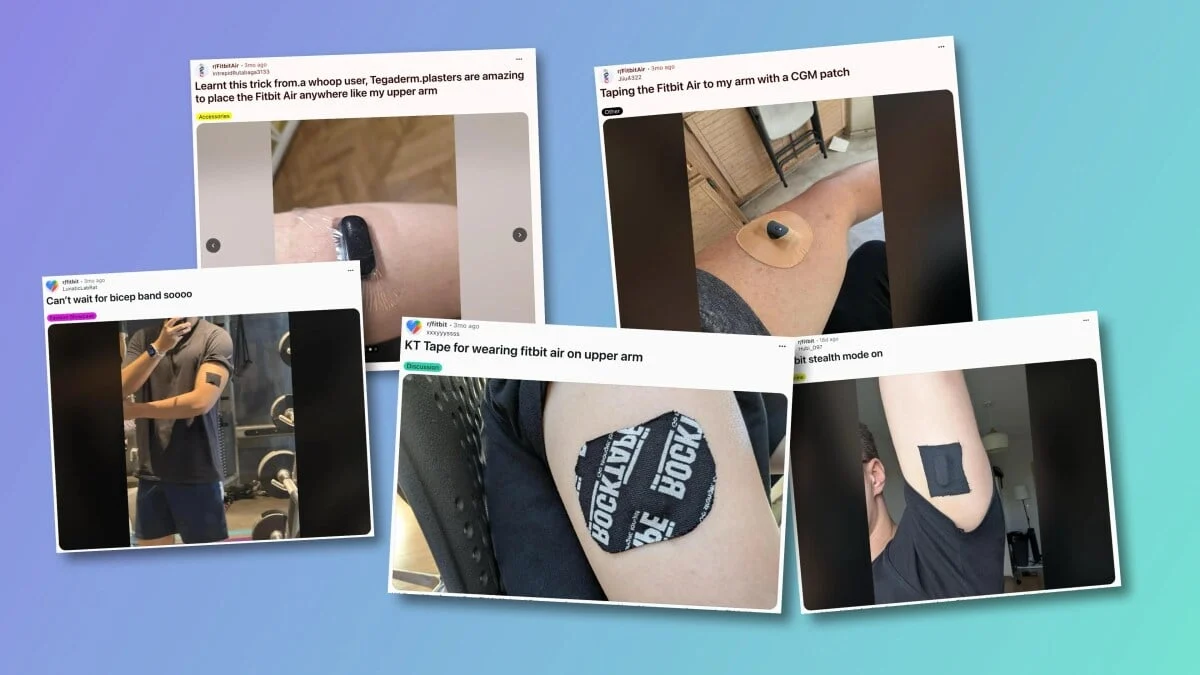
The ubiquity of the fitness tracker has traditionally been synonymous with the wrist. From the early days of pedometers to the sophisticated sensors in today’s smartwatches, the anatomy of activity tracking has been tethered to our pulse points. However, a growing subculture of fitness enthusiasts—most notably within the Fitbit Air community—is challenging the design conventions of wearable technology. By discarding factory-issued straps in favor of medical-grade adhesives, users are "taping" their trackers to their biceps, triceps, and even legs to achieve a more ergonomic, less intrusive tracking experience.
The Evolution of Wearable Ergonomics
The smart band’s primary appeal lies in its minimalism. Unlike a full-featured smartwatch, a tracker is intended to be a silent partner in health monitoring. Yet, the wrist is a high-traffic area. It is constantly subject to friction, potential impact during weightlifting, and the aesthetic clashing of multiple bands.
Companies like Whoop have already capitalized on this "any-wear" philosophy, offering bicep bands and apparel with integrated pockets for sensors. When tech giants like Google, the parent company of Fitbit, fail to offer official accessories for alternative placements, the user base inevitably takes the initiative. The "tape-on" trend is not merely a quirk; it is a grassroots reaction to a design limitation. Users are discovering that by removing the strap, they can eliminate the interference caused by wrist wraps, kettlebells, and heavy clothing sleeves, effectively turning their device into an invisible, "forget-it-is-there" health monitor.
Chronology of a DIY Movement
The shift toward alternative placement has been a slow-burn evolution within fitness forums and subreddits.
- Early Adoption (2018–2020): During this period, powerlifters and CrossFit enthusiasts began experimenting with shifting trackers to their forearms or biceps to avoid interference with barbell contact. Most initial attempts involved standard athletic tape, which often failed due to the high-intensity nature of the workouts.
- The "Whoop Influence" (2021–2023): As market leaders like Whoop popularized the bicep band, consumers began questioning why other trackers—such as the Fitbit Air—could not be worn similarly. Anecdotal reports of users taping devices to their legs or thighs for comfort began to circulate.
- The Overpatch Revolution (2024–Present): With the surge in popularity of Continuous Glucose Monitors (CGMs), a new product category—the "overpatch"—became widely available. These clear, breathable, and waterproof adhesives were designed to keep medical sensors in place for 14 days. Savvy fitness users quickly realized these patches were the "holy grail" for securing trackers to the skin, leading to the current wave of experimentation.
Supporting Data: The Science of Placement
Does relocating a sensor actually work? The physiological reality of heart rate monitoring is that sensors rely on photoplethysmography (PPG)—shining light into the skin to measure blood flow.
While the wrist is the standard, it is arguably one of the most difficult places to get a clean reading due to the proximity of bone and the relative sparsity of blood vessels compared to the upper arm. By moving the sensor to the back of the upper arm, many users report a tighter seal against the skin, which blocks out "ambient light noise"—a common cause of inaccurate readings during high-intensity exercise.
In controlled personal experiments, users have found that while heart rate data often matches standard wrist-based tracking, the Activity Detection algorithms frequently falter. Most trackers are pre-programmed to recognize the rhythmic arm swings associated with walking or running at the wrist. When the device is placed on the bicep, the motion signature changes significantly, leading to missed auto-detection of workouts. Consequently, proponents of this method emphasize that manual start/stop tracking is a necessity for those making the switch.
Assessing Adhesion: What Actually Works?
For the DIY enthusiast, the choice of adhesive is the difference between a successful workout and a lost device.
The Hierarchy of Adhesives
- KT Tape (Kinesiology Tape): While popular among athletes for muscle support, it is rarely sufficient for a standalone tracker. In high-sweat environments, the edges tend to fray and peel within 24 hours.
- Athletic/Medical Tape: These are generally non-breathable and prone to irritation. They often lack the tensile strength required to hold a device securely through a full range of motion.
- CGM Overpatches: These are the gold standard. Designed for medical use, they are hypoallergenic, waterproof, and engineered to endure two weeks of movement, showers, and friction. Because they cover a larger surface area than the device itself, they provide superior structural support.
Official Responses and Industry Silence
To date, major wearable manufacturers have remained largely silent on the practice of taping devices to the body. From a legal and quality-assurance perspective, this is understandable. Manufacturers calibrate their algorithms for specific body placements. Encouraging or endorsing "off-label" use of a device would create a support nightmare, as the company would be unable to guarantee the accuracy of data collected from non-validated locations.
However, the trend is forcing a conversation in the industry. As users demonstrate a clear preference for bicep-based tracking, companies are slowly beginning to offer proprietary bicep bands. This indicates that while they may not endorse the use of tape, they acknowledge the validity of the user’s desire for alternative placement.
Implications for the Future of Wearables
The "tape-on" movement represents a broader shift toward "invisible computing." As consumers become more sophisticated, they are less interested in the jewelry aspect of wearables and more interested in the raw data.
The Benefits
- Ergonomics: Total freedom for the wrist, which is crucial for combat sports, weightlifting, and gymnastics.
- Accuracy: Potential for improved heart rate readings due to less ambient light interference and a more consistent skin-to-sensor contact.
- Customization: The ability to wear the device anywhere on the body, from the upper arm to the thigh.
The Drawbacks
- The "Removal" Problem: The primary obstacle is the adhesive itself. Strong adhesives that survive two weeks of wear can be painful to remove. Users are advised to use warm water or baby oil to dissolve the residue, but it remains a tedious process.
- Algorithm Limitations: Without official support for "bicep mode," users must manage their own activity logs, as automated movement tracking remains largely ineffective in these positions.
- Cost: While a single overpatch is inexpensive, the cumulative cost of replacing them every week—or every few days—can add up, making this a premium modification rather than a cost-saving measure.
Conclusion: Is It Worth the Effort?
Taping a Fitbit to your arm is a classic example of "hacking" hardware to meet a specific human need. While it is not a perfect solution, it is a viable one for those who find the wrist-worn experience restrictive.
For the average user, the hassle of sourcing high-quality overpatches and the degradation of automated movement tracking may outweigh the benefits. However, for the high-performance athlete, the precision of a secure, bicep-mounted sensor is a compelling upgrade. As long as the industry continues to treat the wrist as the default, we can expect this DIY trend to persist—or better yet, to inspire the next generation of truly "any-wear" fitness technology. If you choose to embark on this experiment, remember the golden rule of the DIY community: always remove your adhesive in a warm shower, and keep a spare patch ready for the next cycle.