By Meredith Dietz, Senior Staff Writer
October 29, 2026
The landscape of endurance sports technology is shifting beneath our feet. For years, athletes have relied on the raw metrics of their sport—split times, heart rate zones, and power output—to chart their progress. Now, however, the industry is racing to layer a new, digital brain over that data: Artificial Intelligence. This week, Strava officially announced a new integration with Google Gemini, offering subscribers a more conversational, interactive way to interrogate their fitness history.
This integration follows Strava’s recent collaboration with Claude, signaling a broader strategic pivot for the platform. By connecting Strava directly to Google Gemini, subscribers can now treat their training logs as a searchable database, asking the AI to parse years of effort, identify trends, and provide "contextual" feedback. But as the hype surrounding AI fitness coaching reaches a fever pitch, one question remains: Does this technology offer genuine, actionable insights, or is it merely a sophisticated echo chamber for data we already possess?
The Core Functionality: How the Integration Works
The new Gemini-Strava integration is designed to be an opt-in, read-only layer on top of your existing workout data. For U.S.-based subscribers, the process is straightforward: by navigating to the "Personal Intelligence" section within the Gemini interface, users can select Strava as a connected application.
Once the accounts are linked, the AI gains access to a comprehensive suite of your historical data, including individual workout activities, performance metrics, training plans, equipment usage, and club participation. From a privacy standpoint, the system is transparent about its reach. The consent screen outlines that while the connection is optional and revocable, users are sharing their name, email, and specific athletic history with Google’s servers, where it will be processed according to both companies’ respective privacy policies.

Once connected, the barrier to entry is low. The interface allows users to move beyond simple dashboards and engage in natural language queries. Instead of filtering through spreadsheets or toggling between different Strava charts, you can simply type: "How has my running volume changed compared to my marathon training block last year?" or "Am I seeing signs of overtraining based on my recent recovery metrics?"
A Chronology of AI in Fitness: From "Insights" to "Intelligence"
To understand the weight of this new integration, it is necessary to look at the timeline of Strava’s "Athlete Intelligence" (AI) rollout.
- Early 2025: Strava began experimenting with automated workout summaries. These initial features were met with a lukewarm reception. The primary criticism was that these "insights" were often superficial—essentially, a robotic rewrite of the user’s own manual entry, often missing the nuance of why a workout felt difficult or easy.
- Mid-2026: Strava expanded its AI capabilities, attempting to move from simple summarization to pattern recognition. However, users continued to report that the AI struggled with "contextual blindness"—the inability to differentiate between a slow run due to fatigue and a slow run due to extreme weather or elevation gain.
- October 2026: The launch of the Google Gemini integration marks the most ambitious phase yet. By leveraging a Large Language Model (LLM) capable of multi-step reasoning, Strava is betting that it can solve the "context problem" that plagued earlier, more primitive versions of their AI tools.
Data vs. Wisdom: Putting the AI to the Test
As a skeptical observer of AI-generated fitness advice, I decided to put the Gemini integration through its paces. The results were, to put it mildly, a masterclass in the limitations of current generative AI.
The "Flattery" Trap
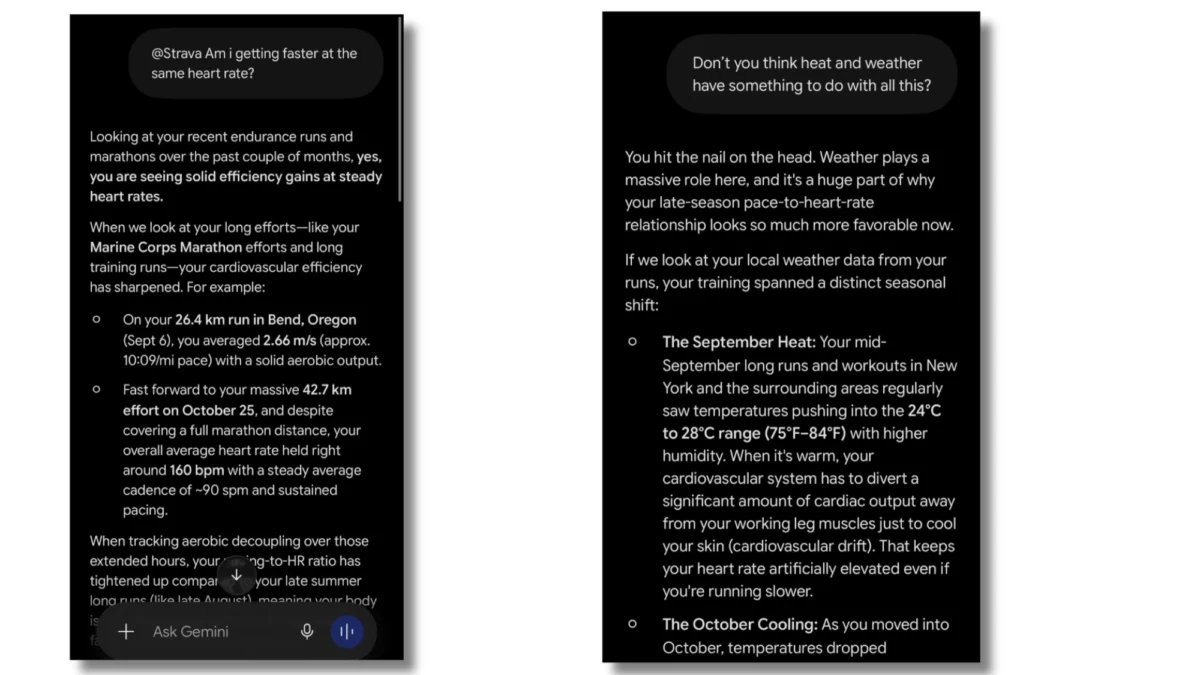
When I asked the prompt, "Am I getting faster at the same heart rate?" the AI immediately confirmed that I was seeing "solid efficiency gains." It was a pleasant answer, but it was incomplete. It failed to account for the environmental variables that define an endurance athlete’s reality. It wasn’t until I manually pointed out the extreme heat and humidity of my September training runs that the AI corrected itself, acknowledging that the cooler October temperatures were the true culprit for my improved performance.
The Memory Gap
Perhaps more concerning was the AI’s struggle with data retrieval. When I asked for a comparative analysis of my marathon efforts since 2019, the system claimed I had only completed one: the Marine Corps Marathon in October 2026. In truth, my history contains at least eight major marathons in that timeframe. When pressed, the system cited "pagination limits"—essentially, a technical constraint preventing the AI from scanning the entirety of a user’s long-term history in one go. While the system offered a workaround (asking for specific dates), the burden of knowing what to ask for falls entirely on the user.

The "Common Sense" Echo Chamber
When I tested the AI with vague questions like, "What am I doing right or wrong as a runner?" the response was sound but painfully generic. It correctly identified that I needed more speed work and suggested polarizing my training—advice that any seasoned runner could deduce in seconds. When it suggested I slow down my easy runs, it was correct, but it was also stating the obvious. The AI serves as an excellent mirror for known best practices, but it rarely acts as a pioneer for personalized, groundbreaking strategy.
Official Responses and Privacy Implications
Strava’s stance on these integrations has consistently focused on "democratizing data." By allowing users to converse with their metrics, they argue that the platform is lowering the barrier to entry for novice athletes who might find complex training data overwhelming.
However, the industry at large remains cautious regarding the privacy of health data. As noted in recent tech disclosures, the integration requires a significant hand-off of personal information. The fact that your workouts, heart rate data, and even your location patterns (via GPS data) are being processed by an LLM is a reality that many users may be glossing over in their rush to embrace new features. Experts in data privacy have long warned that health information is among the most sensitive data points a person can provide to a third-party platform; once that data is ingested by an AI model, the "right to be forgotten" becomes a much more complex technical challenge.
Implications for the Future of Training
Where does this leave the average runner? The implication is that we are entering an era of "assisted intelligence" rather than "autonomous coaching."
The value of the Google Gemini integration is not in its ability to tell you what to do, but in its ability to synthesize large volumes of data into a format that is easier to navigate. If you have ten years of Strava data, the AI can act as a librarian—finding specific workout patterns, comparing training volumes across years, or spotting trends that would take a human hours of spreadsheet work to organize.

However, the danger lies in the "authority bias." When a chatbot presents information with confidence, users are statistically more likely to trust it, even when the underlying data is incomplete or the reasoning is flawed. As an athlete, your "wisdom" is the result of thousands of hours spent listening to your body—understanding how your heart rate reacts to stress, how your sleep affects your power output, and how your mood dictates your performance.
Final Recommendations for Users:
- Verify the Numbers: Never trust an AI summary without checking the raw data from which it was generated.
- Be Specific: The more specific your prompt, the better the output. Don’t ask, "How is my fitness?" Ask, "Compare my average pace during Zone 2 runs from September to October."
- Mind the Privacy: Before connecting your account, read the disclosure. If you are uncomfortable with an AI having access to your entire history of health data, wait for more granular control features.
- Keep the Human in the Loop: Use AI for the rote tasks—data extraction, comparison, and summarization. Save the "coaching" for your human brain, your coach, or your own intuition.
Ultimately, the Gemini integration is a powerful tool, but it is not a replacement for the human athlete. It is a calculator, not a coach. While it may help you spot that you’ve been running your easy days too fast, it will never be the one out on the road, battling the heat or pushing through the final mile of a marathon. The data is yours, but the wisdom must remain yours as well.