You have packed the running shoes, the compression socks, and the specialized apparel. They return home as clean as the day they left. This is the archetypal cycle of the business traveler: the intention to maintain fitness is packed with meticulous care, yet the workout session never manifests. A four-night trip, intended to be a brief interlude in a rigorous training program, quietly becomes the death knell for a routine you have spent months building.
The failure is rarely a lack of willpower. It is a failure of design. At 6:40 a.m. in an unfamiliar city, navigating the cognitive fog of a shifted body clock, with a high-stakes client breakfast looming at 8:00 a.m., the human brain is not wired to architect a complex workout. When the environment is volatile, decisions must be made in advance. The key to surviving a trip—and returning home without having to "restart" your fitness journey—is to strip the session of all ambiguity.
The Myth of the "Gym Find" and the Logistics of Failure
The common strategy of "I’ll just find a gym when I get there" is a logistical fallacy. Upon arrival, the "hotel fitness center" typically reveals itself to be a depressing suite of two mismatched dumbbells, a treadmill with a flickering display, and a single bench occupied by a guest who has been there for forty minutes. If you venture off-site, the local gym requires a day pass, a fifteen-minute walk you did not budget for, and an enrollment process that consumes your limited morning window. By the time you navigate these hurdles, the window of opportunity has slammed shut.
What you reliably have, regardless of whether you are in Cleveland or Frankfurt, is a floor, a wall, a chair, a door, and a suitcase. This architectural constant is the only foundation worth building a session around. If you desire additional resistance, a simple resistance band weighs nothing and occupies less space than a spare pair of socks. The objective is to remove the "gym" from the equation, replacing it with a mobile, equipment-agnostic framework.
The Impact of Travel on Physiology
Beyond logistics, travel disrupts the biological substrate of performance: sleep. Research involving over 2,200 business-class travelers in Japan and the U.S. indicates that while jet lag is inevitable, those who maintain physical activity levels report milder symptoms and faster recovery. However, the travel environment—short sleep cycles, shifting time zones, and external scheduling pressures—is not the place to attempt personal records. The goal is maintenance, not expansion.
The Post-Trip Trap: Why "Monday" is the Real Enemy
A four-night trip costs you very little in terms of physiological decay. A brief hiatus is insufficient to erode months of disciplined training. The danger is not the skipped session in the hotel room; the danger is the "thread" of habit being broken.
In a study of resistance-trained men, researchers found that after two weeks of total inactivity, leg-press strength remained largely unchanged. The data suggests that a short trip is not the catastrophic event we fear. The true damage occurs upon returning home. You arrive with no sessions scheduled, a vague, irrational sense of "being behind," and the temptation to delay your restart until the following Monday.
Monday becomes the site of the actual collapse. The session you missed on Wednesday in a hotel room cost you almost nothing. The "reset" that Monday requires can cost you a month of momentum. The purpose of travel workouts is not to gain muscle; it is to ensure that when you land at your home airport, you are still "in-program."
The Two-Tiered Strategy: The 20-Minute Session and the 8-Minute Floor
To prevent the "restart" cycle, you must pack your decisions before you pack your bag. We propose two distinct sessions. The first is a 20-minute, three-round circuit for mornings when you have time. The second is an 8-minute, one-round "floor" session for mornings when you are pressed for time or sleep-deprived.
The Five Pillars of Travel Fitness
| Movement | Hotel-Room Execution | Full Session (3 Rounds) | Floor Session (1 Round) |
|---|---|---|---|
| Split Squat | Back foot on floor, hand on desk chair | 3 sets of 8–10/leg | 1 set of 8/leg |
| Hip Hinge | Single-leg deadlift (balance) | 3 sets of 8/leg | 1 set of 8/leg |
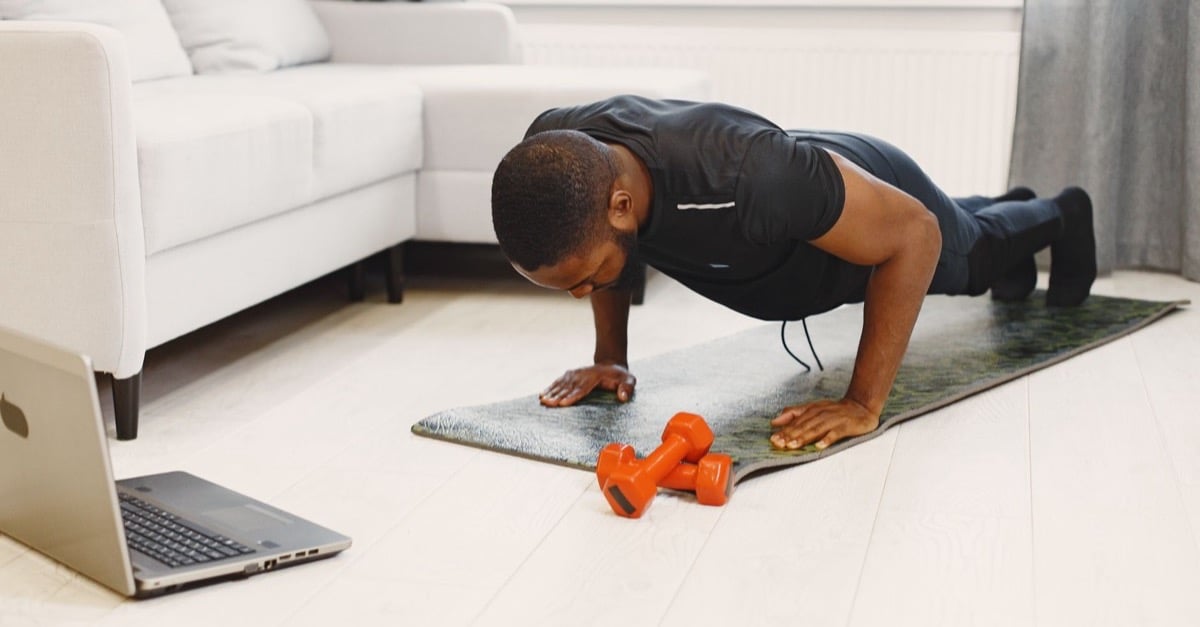
| Push-up | Hands on desk/bed/floor | 3 sets of 8–12 | 1 set of 8–12 |
| Row | Towel on door handle/Suitcase row | 3 sets of 10 | 1 set of 10 |
| Carry | Suitcase carry (corridor) | 3 sets of 30 steps/side | 1 set of 30 steps/side |
Safety Protocol: When using a door for rowing, ensure it opens away from you, so your body weight pushes the door into the frame rather than pulling it off the hinges. If the door does not latch securely, abandon the towel row and use your suitcase as a weight for a bent-over row instead.
Principles of Intensity Without Weights
A bodyweight session is not a "placeholder"; it is a legitimate training stimulus if you understand how to manipulate variables. When you lack external iron, you must focus on mechanical disadvantage:
- Change the Angle: Move from a desk-height push-up to a chair-height, then to the floor.
- Increase Time Under Tension: Use a three-count descent (eccentric) for every repetition.
- Add Pauses: Incorporate a two-second pause at the most difficult point of the movement (the bottom of a squat or the bottom of a push-up).
If a set is not difficult by the last two repetitions, do not simply add more repetitions. This turns training into endurance cardio. Instead, make the movement harder. Counting to 40 push-ups is an endurance activity; performing 8 push-ups with a three-second pause and a slow descent is a strength stimulus.
A Realistic Chronology: The Four-Night Trip
Consider a realistic four-night work trip:
- Monday: Arrival at 11:00 p.m. No session.
- Tuesday: Wake at 5:50 a.m. Session B (8 minutes). Done before the first email.
- Wednesday: First meeting at 10:00 a.m. Session A (20 minutes). Carried out while the hotel is quiet.
- Thursday: High-pressure conference day. Session B (6:45 a.m.). Followed by 11,000 steps of incidental walking.
- Friday: Early morning departure. No session.
This schedule is not "compromised"; it is a success. You have maintained your program through the week, and the 11,000 steps on Thursday provide cardiovascular benefits without overtaxing your recovery.
Implications for Longevity and Performance
The scientific consensus on maintenance training is clear: younger adults can retain strength and muscle size for as long as 32 weeks with a single session per week, provided the intensity remains high. The variable that travelers get backward is the volume of sets. You do not need to perform high-volume work to maintain your gains; you simply need to ensure that the effort exerted in the sets you do perform is sufficient to trigger a maintenance signal.
If you are away for more than one week, your only rule should be to ensure at least one "Session A" (the full 20-minute version) is completed to maintain your threshold of intensity.
Final Directives: The "Decision Note"
The most effective intervention is the simplest: open the notes app on your phone—the same one that holds your flight confirmation—and paste your two sessions there. Pick your "rung" (difficulty level) for the push-up and split squat before you leave home. When you wake up in the dark, the decision-making process has already been handled by your "past self."
The shoes are optional. The suitcase is your equipment. The note is the intervention. By removing the need to choose, you ensure the workout happens. Stop fearing the trip, and start viewing it as a period of maintenance, where the primary objective is to return home having never stopped being an athlete.