By Joel Cunningham
October 28, 2026
For nearly two decades, the Amazon Kindle has stood as the undisputed titan of the e-reading world. It is a device so ubiquitous that its name has become a proprietary eponym for the entire category of e-readers. Yet, being the most popular device is not synonymous with being the most feature-rich or the most user-centric. While Amazon deserves immense credit for pioneering the e-book revolution and integrating hardware with a massive digital storefront, the company has historically been a laggard in hardware innovation, often waiting for competitors like Barnes & Noble, Kobo, and Boox to prove the viability of features like warm-light displays or color e-ink before adopting them.
Perhaps the most persistent criticism of the Kindle ecosystem has been its "walled garden" approach. Amazon has long dictated the boundaries of the user experience, often at the expense of convenience. However, a significant shift has arrived. After years of consumer demand and the rise of "BookTok" trends—where third-party Bluetooth clickers became an essential accessory for avid readers—Amazon has finally released its own official solution: the Kindle Click.
More importantly, Amazon has updated the firmware for its 2024 and later hardware, finally opening up the Bluetooth protocol to allow for seamless page-turning integration. This development marks a rare concession by the retail giant to the needs of its power users.
The Chronology of a Long-Awaited Accessory
The history of the page-turn remote is one of grassroots necessity. For years, Kindle owners were forced to rely on clunky, third-party mechanical clip-ons. These devices, which physically attached to the bezel of the Kindle, utilized a small plastic arm to "tap" the screen whenever a button was pressed. They were, at best, a stopgap solution. They blocked portions of the text, added significant weight to one side of the device, and were limited to single-direction page turns.
As e-reader competitors like Boox and Kobo began integrating native Bluetooth support, their users enjoyed sleek, wireless remotes that could be tucked into a pocket or hidden under a blanket. The contrast between these refined experiences and the Kindle’s "clunky clip-on" reality became a frequent point of frustration on enthusiast forums and social media.
- Pre-2024: Kindle owners remain tethered to the physical screen or proprietary "page-turn covers" that added bulk and cost.
- Early 2026: Competition heats up as third-party remotes gain massive popularity on social media platforms, forcing the industry to acknowledge that "hands-free" reading is a highly sought-after utility.
- October 2026: Amazon breaks its silence, launching the Kindle Click and, crucially, updating the firmware on 2024-and-later Kindle models (such as the new Paperwhite Signature Edition) to support native Bluetooth page-turning commands.
What is the Point of a Remote?
To the uninitiated, the idea of a remote control for a book might sound redundant. "Why not just tap the screen?" is a fair question. However, the appeal of a remote is rooted in ergonomics and the "coziness" factor that defines the reading experience for millions.

The Ergonomic Advantage
Reading is often a sedentary activity, but it doesn’t have to be. For readers who enjoy multitasking—such as reading while using an elliptical machine or a stationary bike—the Kindle Click is a game-changer. Maintaining a steady gaze on a screen while your hands are occupied with handlebars makes manual page-turning a physical chore. With a remote, the device can be mounted securely at eye level, allowing the reader to advance pages with a subtle flick of the thumb.
The "Cocoon" Factor
Then there is the issue of winter reading. There is a specific level of comfort associated with being buried under a weighted blanket or a thick duvet on a cold night. When the Kindle is positioned in a stand, the reader is often forced to leave their arms exposed to the cold air just to flip a page. A Bluetooth remote allows the reader to keep their hands comfortably tucked away, maintaining the "cocoon" of warmth that makes reading so restorative.
Supporting Data and Technical Performance
The Kindle Click retails for approximately $35. While this may seem steep for a simple peripheral, it is priced competitively—only $5 more than the popular Boox Tappy. The primary advantage of the official Amazon hardware, however, is the depth of its integration.
Pairing and Ease of Use
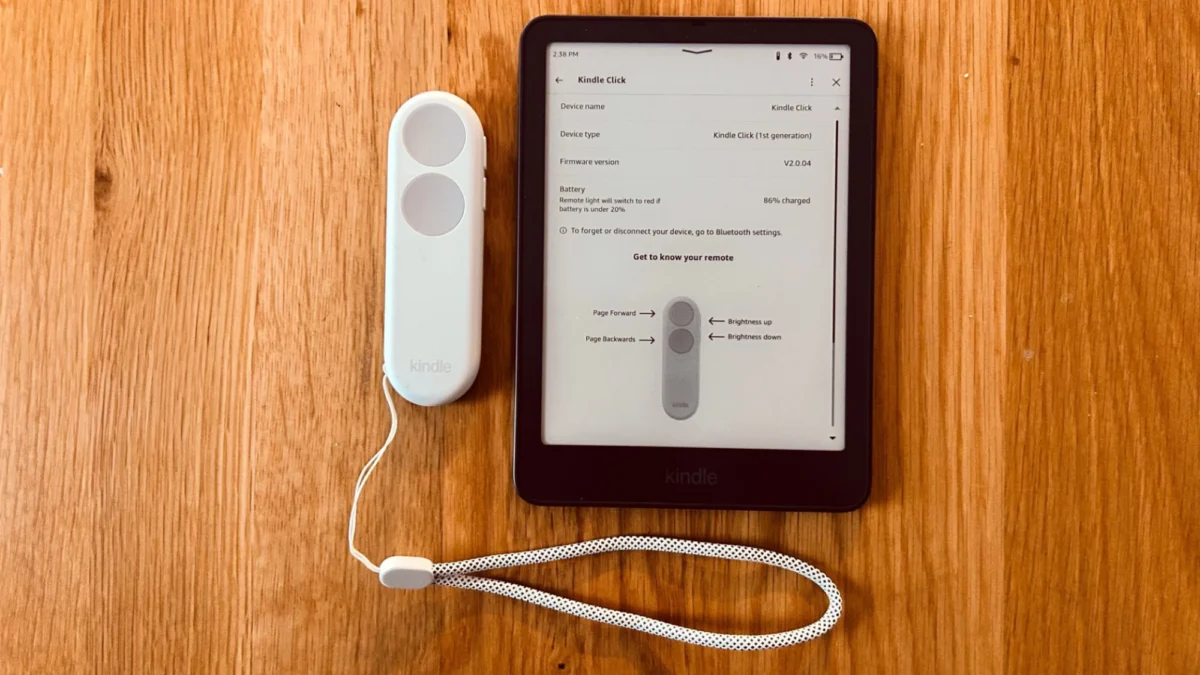
The pairing process is refreshingly straightforward. Once the device is updated, a new "Accessories" menu appears in the Settings panel.
- Pairing: Press and hold the primary button on the Kindle Click to initiate discovery mode.
- Detection: The Kindle identifies the device instantly.
- Persistence: Unlike many third-party solutions that require frequent re-pairing, the Kindle Click maintains a stable connection, waking up automatically when the e-reader is in use.
Functionality
The Click provides four primary buttons. The two large central buttons are mapped to forward and backward navigation, which users can customize to their dominant hand. The secondary side buttons are dedicated to brightness control. This is a functional, if limited, feature set. During our testing, the latency was virtually non-existent, and the range was sufficient to control a Kindle from across a room—ideal for those who keep their device mounted on a tripod or a bed-side arm.
Official Responses and Strategic Implications
Amazon’s decision to open its Bluetooth protocol is perhaps the most significant aspect of this launch. By allowing the Kindle to communicate with external peripherals, Amazon is acknowledging that the "closed ecosystem" model has limits.
"We are constantly listening to the needs of our power users," a spokesperson noted during the soft launch. "The Kindle Click is designed to meet the growing demand for flexible, hands-free reading experiences, ensuring that the Kindle remains the most versatile reading companion on the market."

However, analysts suggest this move was also a defensive necessity. With companies like Boox gaining market share among "prosumer" readers who prioritize customization, Amazon had to demonstrate that its hardware could remain relevant. By controlling the official accessory, Amazon ensures that it can maintain a high standard of hardware quality, even as it opens the doors to third-party developers who may now find it easier to create compatible devices.
The Verdict: A Great Start, But Missed Opportunities
The Kindle Click is a successful, polished product that does exactly what it claims to do. It transforms the way one interacts with an e-reader. However, it is not without its shortcomings.
The "Missed" Features
Amazon has played it safe. While the remote controls brightness, it does not currently allow for the adjustment of "warmth" (color temperature), which is a key feature of the modern Paperwhite. Furthermore, while the Kindle supports Audible, the Click cannot be used to navigate audiobook chapters or control volume. These features would have made the device an essential tool rather than just a convenience.
The Future of the Kindle
The fact that this remote only works on 2024-and-later models is a point of contention. It effectively forces users who want this functionality to upgrade their hardware, which may alienate long-term users of older, still-functional devices.
Ultimately, the Kindle Click represents a transition in Amazon’s philosophy. It is a sign that the company is finally prioritizing user comfort over rigid control. While there is room for improvement in software versatility, the Kindle Click is an undeniable win for anyone who has ever dreamed of reading under a blanket without ever lifting a finger. As we look toward the future of e-reading, one can only hope that this is the first of many steps Amazon takes toward a more open, user-friendly ecosystem.