In the modern small business landscape, the pursuit of efficiency is often synonymous with the adoption of new technology. When a project slips behind schedule—taking eleven days to complete tasks that theoretically require only two—the reflex is almost universal: purchase a new project management platform, implement a sophisticated board view, and double down on personal productivity. However, as business analysts and operational experts are increasingly discovering, this impulse is often the primary obstacle to true growth.
The central problem facing most small businesses is not a lack of personal speed, but a misunderstanding of what actually constitutes "work." To streamline operations effectively, entrepreneurs must stop obsessing over how fast they perform individual tasks and start measuring the invisible, costly intervals where work sits stagnant. By shifting focus from "touch time" to "wait time," business owners can unlock significant capacity without hiring new staff or investing in expensive software.
Main Facts: The Anatomy of a Stalled Workflow
At the heart of operational failure is a simple arithmetic error. When a job is delayed, business owners typically analyze the "touch time"—the minutes spent actively editing a document, writing code, or manufacturing a part. They assume that if they work faster, the total project duration will shrink accordingly.
In reality, the duration of a job is almost entirely determined by the "wait time"—the hours or days a task spends languishing in an inbox, waiting for a client’s signature, or sitting in a "pending" folder while the owner attends to other priorities. If a task requires ninety minutes of actual labor but takes eleven days to complete, speeding up those ninety minutes by 20% will yield a negligible improvement. The bottleneck is not the labor; it is the queue.
The "Efficiency Paradox" dictates that for most small businesses, the process is not merely a sequence of tasks, but a sequence of tasks separated by queues. True streamlining occurs only when these queues are eliminated or drastically shortened. Before purchasing a single piece of software, a business must map the journey of a task and identify where it stalls.
Chronology: The Lifecycle of a Failed Process Improvement
The typical trajectory of a failed process overhaul follows a predictable, disheartening path:
- The Trigger: A Tuesday arrives, and the business owner realizes they are three weeks behind schedule. Panic sets in, and the belief that "we just need better tools" takes hold.
- The Investment: The owner spends their Sunday night migrating data into a new, high-end project management suite, promising to maintain it religiously.
- The Illusion of Progress: The first week feels productive as the team populates the new boards and labels.
- The Reality Check: By the second or third project cycle, the "eleven-day" delay returns. The tool has not fixed the process; it has merely provided a high-tech dashboard to view the same old bottlenecks.
- The Burnout: The owner, sensing the failure of the software, tries to compensate by working late into the night. This provides a temporary, unsustainable boost that inevitably leads to decreased performance later in the week.
This cycle repeats because it targets the ninety minutes of hands-on effort while ignoring the 250+ hours of waiting.
Supporting Data: The Cost of Inaction
The disparity between touch time and lead time is often staggering. A landmark case study involving an axle beam manufacturing line revealed that only 408 minutes of total processing time occurred over a 4.6-day (6,624-minute) lead time. While this is a manufacturing example, the principle applies to service-based businesses as well.
In professional services, the waste is hidden behind the guise of "being busy." If a law firm or a bookkeeping agency has ten active projects but only finishes two per week, each project is doomed to spend weeks in the system. This is an application of Little’s Law: the average amount of work in progress (WIP) is directly proportional to the flow time. By capping the number of concurrent projects—essentially saying "not yet" to new work until existing work is cleared—businesses can significantly reduce the lead time for every client without actually working harder.
Furthermore, a 2024 analysis of a healthcare claims department demonstrated that by utilizing "lean" diagnostic tools—deleting non-value-added steps before applying automation—the team reduced processing time by 380 minutes, improving cycle efficiency from roughly 69% to 95%. This proves that sequence is everything: diagnosis must precede deletion, and deletion must precede automation.
Official Perspectives and Operational Theory
Industry leaders and operational theorists, such as those advocating for the Theory of Constraints, argue that the "loudest" process is rarely the most expensive one. Entrepreneurs often fixate on tasks that cause them the most irritation, rather than those that carry the highest financial cost or the longest delays.

According to the Theory of Constraints, any attempt to speed up a non-bottleneck step is a waste of resources. If a process has a inherent delay—such as waiting for a third-party approval—making the preparation of that approval faster only causes the document to sit in the recipient’s inbox longer. It does not shorten the project.
"Administrative load" is another area where perspective is critical. Research into small manufacturing firms found that nearly 50% of owners spend over an hour per week on mandatory compliance paperwork. This is a "fixed" delay that cannot be deleted, only managed. The goal here is not to eliminate the step, but to batch it. When a business owner treats every administrative task as a unique, urgent event, they incur a "switch cost" that depletes mental energy and destroys focus.
Implications: A Five-Step Framework for Success
To move away from toxic productivity and toward true efficiency, business owners should adopt the following five-step sequence:
1. Cost-Based Prioritization
Calculate the "true cost" of your processes. Multiply the frequency of the job by the minutes spent on it, and add a penalty for every time the job requires rework. Focus your improvement efforts on the jobs that have the highest frequency and the most significant delays, rather than those that simply annoy you the most.
2. Radical Measurement
Stop relying on memory. For one full cycle of a repeated task, keep a two-column log: Touch Time and Wait Time. Note the clock every time the work leaves your desk and every time it returns. This data will reveal exactly where the process "sits still."
3. Identify and Test the Bottleneck
Analyze the "Wait Time" column. The longest entry is your primary suspect. However, confirm if it is a true bottleneck by observing if work piles up there consistently. If a delay is a one-off (e.g., a client on vacation), it is a story. If it happens every time, it is a structural failure.
4. The Fix Ladder: Delete, Default, Batch, Hand Off, Automate
- Delete: Remove steps that exist only because of an outlier event from the past.
- Default: Create standing rules for decision-making (e.g., "Any invoice under $500 is auto-approved").
- Batch: Group similar tasks to minimize the mental toll of task-switching.
- Hand Off: Delegate with clear "Definitions of Done" to prevent the need for rework.
- Automate: Only after the process is lean and logical should you introduce software.
5. Cap Work-in-Progress (WIP)
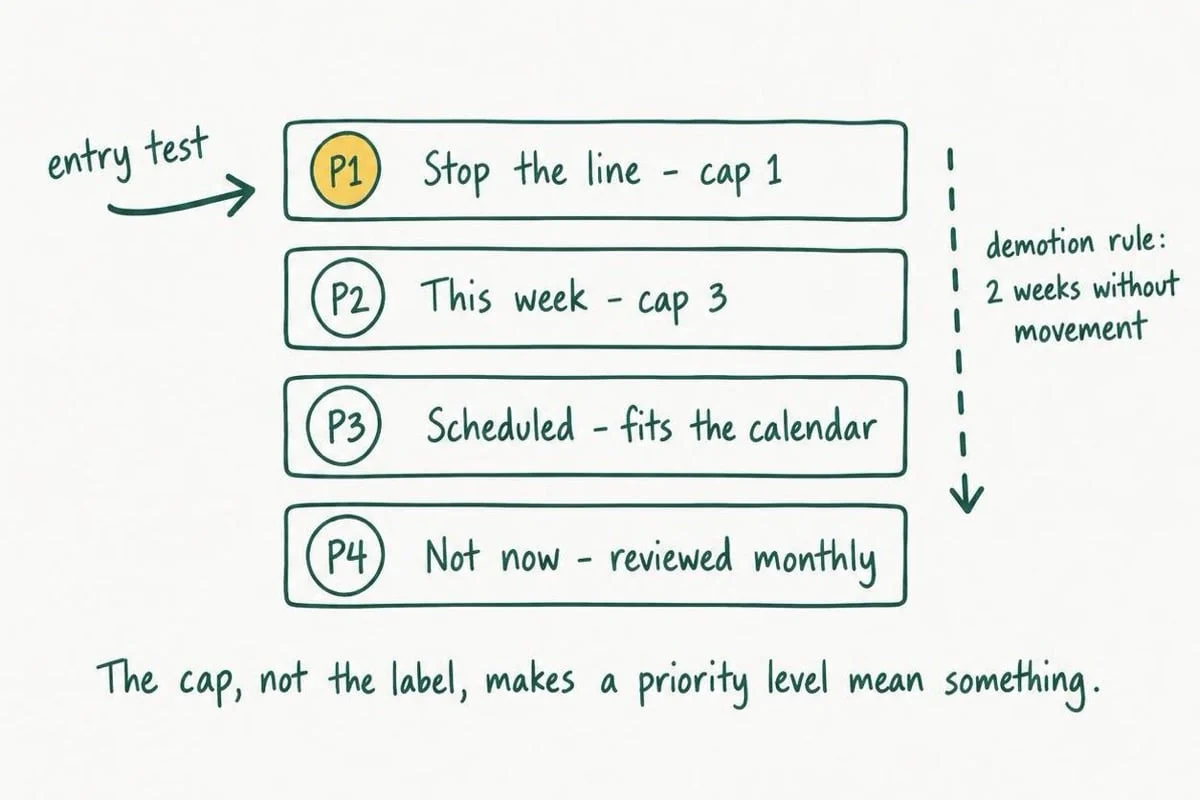
Limit the number of active jobs. By reducing the volume of work currently in the pipeline, you force each project to move through the system faster. This is the ultimate "time management" hack for entrepreneurs: the courage to limit active commitments.
Conclusion: The Path Forward
The path to a streamlined business is rarely found in the marketing materials of the latest software-as-a-service (SaaS) provider. It is found in the quiet, disciplined act of measuring one real-world job, identifying the pauses, and having the courage to delete the steps that serve no purpose.
As the examples of "Bridget" the bookkeeper and "Todd" the flooring installer demonstrate, significant gains are possible through simple, low-cost modifications. By replacing custom, on-the-fly decision-making with standardized rules and batching tasks that require similar mental energy, these entrepreneurs transformed their workflows without adding staff or overhead.
Streamlining is not a project to be scheduled for a "quiet week" in the future; it is a mindset to be applied to the very next job on your desk. By focusing on the gaps between the work rather than the speed of the work itself, you can reclaim your time, reduce your administrative burden, and grow your business with a fraction of the friction.