The morning routine often masquerades as a triumph of modern logistics. You successfully pack lunches, secure a misplaced shoe from the depths of the couch, and manage to sign a forgotten permission slip while simultaneously navigating a high-stakes work email from the drop-off lane. By the time you sit down for your first professional call, you are operating with the precision of a clockwork mechanism.
But the real story—the part you would never dare voice in a professional setting or to a friend—happens at 6:40 that evening. Your daughter sits beside you, animatedly recounting a playground dispute, and you realize with a jolt of cold clarity that you feel absolutely nothing. There is no impatience, no irritation, no active malice. There is simply a void. You nod, you offer the perfunctory phrases expected of a nurturing parent, and you wait, with bated breath, for the interaction to conclude so the house can return to silence.
If you are currently experiencing a moment of crisis or feel unable to keep yourself or your child safe, please prioritize your immediate well-being. In the United States, you can contact the 988 Suicide & Crisis Lifeline by calling or texting 988 to speak with a trained counselor.
The Anatomy of Parental Burnout: Moving Beyond "Tired"
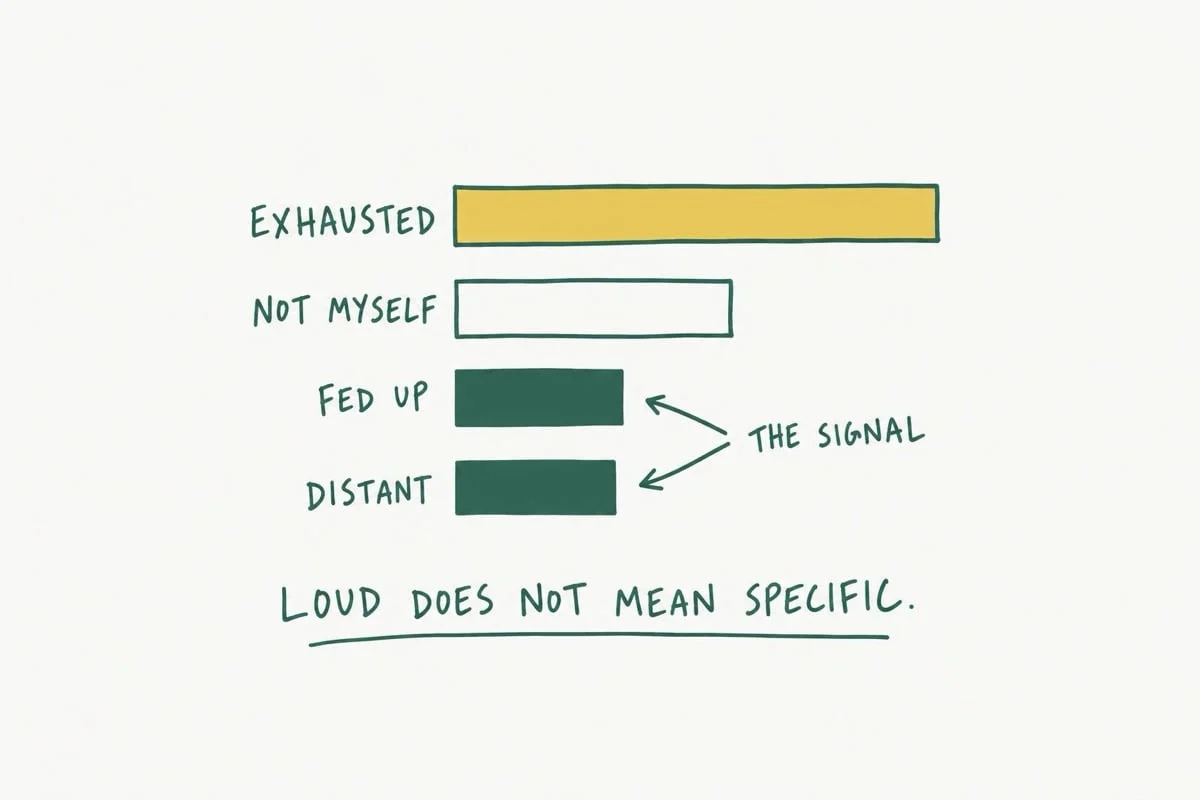
Society has a tendency to flatten the complex, multifaceted experience of parental burnout into a single, digestible word: exhaustion. While fatigue is certainly an ingredient, it is the least informative one. A long weekend or a solid block of sleep can alleviate physical depletion, but it rarely touches the structural rot of burnout.
Parental burnout is a specific psychological state measured by researchers across four distinct dimensions:
- Exhaustion in the parental role: Feeling drained by the act of parenting itself.
- Contrast with the past: A painful recognition of the gap between the parent you once were and the one you have become.
- Feeling fed up: A persistent sense of resentment toward the role of caregiver.
- Emotional distancing: The most critical symptom—a subconscious detachment from one’s own children.
Researchers established these pillars by analyzing the firsthand accounts of nearly a thousand parents. In the context of an ordinary week, these symptoms manifest as a crushing sense of dread before school pickup, the performance of bedtime routines on "autopilot," a hair-trigger temper over trivial matters, and the haunting, private sensation that you have fundamentally gone missing from your own life.
Chronology of a Crisis: Why It Doesn’t Lift
To understand whether you are simply "having a rough month" or if you are crossing the threshold into burnout, it is necessary to apply a temporal lens.
The Persistence Factor
Exhaustion is a byproduct of life’s demands—a newborn, a seasonal flu, or a "sprint" quarter at work will all deplete your batteries. However, general depletion typically follows a predictable curve. If you feel flat for a few weeks due to a house move, that is a reaction to a stressor. If you have felt a consistent, unshakable flatness for four months, you are looking at a pattern, not a phase.
The Sensitivity to Demand
The most telling diagnostic clue is whether your state of mind shifts when demands drop. If you feel energized after a quiet Saturday or a full night of sleep, your issue is likely situational depletion. If, however, the "Sunday Night Dread" descends regardless of how much rest you achieved over the weekend, the problem is not your energy levels—it is the load itself.
The Domain Specificity
Perhaps the most important question is: Is this everywhere, or is this specific to parenting? If your malaise is universal—if you feel hopeless at work, at home, and in your social life—that points toward a broader clinical issue, such as depression. If the fatigue is specifically tethered to the parental role, we are dealing with a distinct form of burnout that requires a specific strategy.
Emotional Distancing: The Unspoken Symptom
Emotional distancing is the symptom that parents almost never report. It carries a heavy stigma; admitting that you are waiting for your child to stop talking so you can finally be alone feels like a moral failing. Yet, in the research model, it is a primary indicator of burnout.

The danger of this symptom lies in its secrecy. Because parents are ashamed to disclose their detachment, they suffer in silence, which only accelerates the cycle. Data suggests that parental burnout is one of the strongest correlates to child maltreatment—not because the parents are inherently cruel, but because they are operating with a frayed, depleted nervous system that has lost its ability to regulate.
It is vital to treat this symptom as a "load signal." It is not a verdict on your character as a human being or your capacity as a parent. It is a biological warning light that your current environment has exceeded your internal resources. If you find yourself worried about your interactions with your child, the Childhelp National Child Abuse Hotline (800-422-4453) provides a confidential space to discuss these feelings before they escalate into harmful behaviors.
Distinguishing Burnout from Depression and Job Stress
One of the most common mistakes working parents make is misdiagnosing the source of their collapse.
- Parental Burnout vs. Job Burnout: If you negotiate a lighter workload, take more time off, and return to your desk only to find the same level of dread upon arriving home, you have misidentified the source. Conversely, if your "flatness" lifts the moment you leave your children and returns on Monday morning, your issue may be rooted in professional burnout.
- The Clinical Threshold: Parental burnout is not a clinical diagnosis in the DSM-5 sense; it is a conceptual framework. If you experience a persistent loss of interest in all areas of life, or if you feel a pervasive sense of hopelessness, you should seek a professional clinical evaluation. Burnout terminology should never be used as a substitute for medical or psychological care.
The Mathematical Imbalance: Risks vs. Resources
Burnout is best understood as a chronic imbalance between Parenting Risks (the stressors) and Parenting Resources (the buffers).
The Risk Accumulation: Risks often hide in plain sight. They are the "quiet" stressors: the new IEP meetings at school, a partner changing their work shift, a daily commute that has grown by fifteen minutes, or the self-imposed pressure of maintaining "Pinterest-worthy" family dinners. Individually, these are manageable. Collectively, they tip the scale.
The Resource Deficit: Resources are not abstract concepts like "mindfulness." They are concrete, countable assets: hours of childcare, a partner who takes over specific shifts, a friend who can be called in an emergency, or even a manager who allows for a flexible afternoon schedule. When you are burned out, your resource count is likely lower than your risk count. The solution is not to "try harder"—it is to mathematically adjust the columns.
A Practical 20-Minute Audit
To regain clarity, set aside 20 minutes with a notebook. Do not aim for a total overhaul; aim for a structural shift.
- List your risks: Write down everything that currently drains your capacity.
- List your resources: Be honest about what you actually have. Are there hours covered by another adult?
- The Intervention: Choose one risk to delete or delegate. If you cannot delegate it, you must find a way to remove the "standard" you are holding yourself to.
- The Recovery Block: Protect one, non-negotiable block of time where someone else is responsible for the children.
Use a case study approach: Look at the life of "Tessa," a parent who holds the entire mental load of the school calendar. Her exhaustion is loud, but her distancing is the real problem. By having her partner take over specific bedtimes and grocery runs—in writing—she creates a "resource" that actually changes the balance of her week.
Implications for the Future: Why "Try Harder" Fails
The most difficult pill to swallow for many high-achieving parents is that there is no "cure" for burnout that involves sheer willpower. The research is clear: parental burnout is largely environmental. In a 42-country study, prevalence rates varied significantly, suggesting that the pressure is tied to cultural and societal structures, particularly in societies that emphasize high levels of individualism.
If you are currently feeling the symptoms of burnout, recognize that this is a systemic signal. You are not a broken parent; you are a parent in a broken system of support. The way forward is unglamorous and slow: it is the tedious, repetitive work of negotiating boundaries, offloading tasks, and protecting your recovery time.
Do not redesign your entire life this week. Simply pick one thing you can hand off. Then, watch the indicator that actually matters: not whether you feel "energetic," but whether your interest and warmth toward your children begin to return. If they don’t, that is not a failure—it is valuable data. It is a sign that it is time to bring a professional into the conversation to help carry the load.