In an era where technology is increasingly worn on the face, the boundary between public interaction and private surveillance has become porous. As companies like Meta, Snap, and various boutique electronics manufacturers push smart glasses and augmented reality (AR) headsets into the mainstream, a new subculture of counter-surveillance has emerged. The latest entry into this digital arms race is "Antizuck," a $2.99 iOS application designed to detect the presence of smart devices in your immediate vicinity.
Developed by Albert Pariente Cohen, the app serves as a digital sentry, scanning for Bluetooth signals associated with wearable tech. While it offers a sense of agency to those concerned about being surreptitiously recorded, it also highlights a broader, more uncomfortable question: in a world of ambient computing, is privacy a right we can still enforce, or have we entered an era of perpetual, inescapable observation?
The Mechanics of Detection: How Antizuck Works
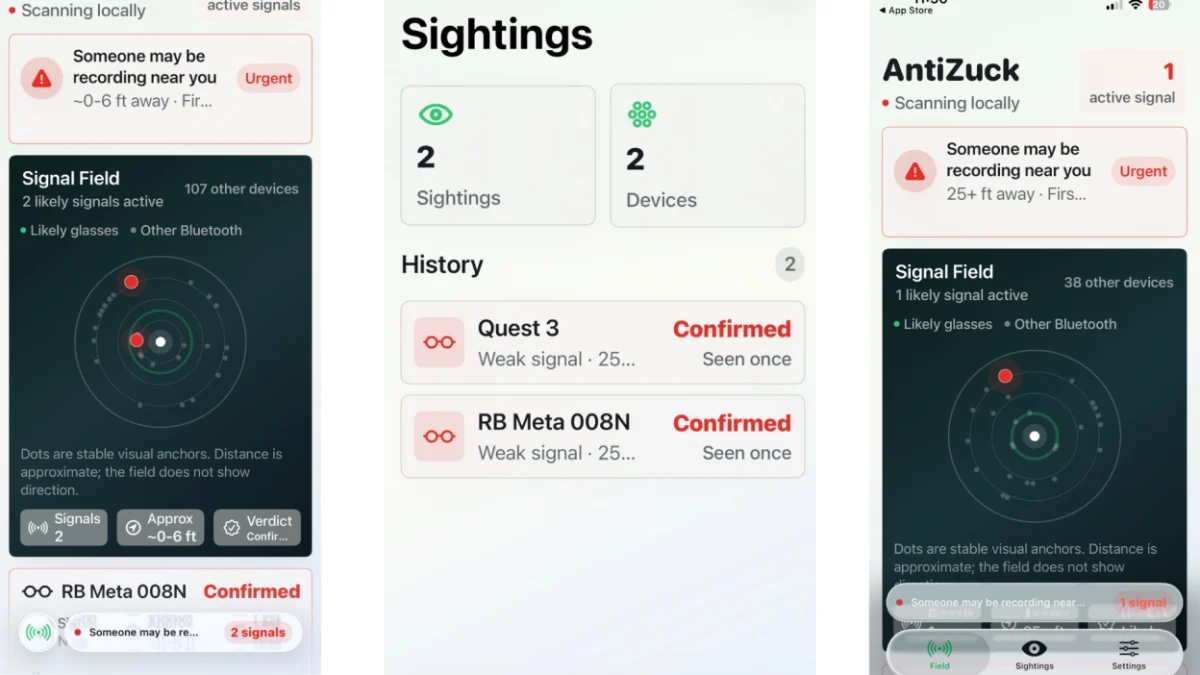
At its core, Antizuck operates on the principle of signal identification. Smart glasses and AR headsets, such as Meta’s Ray-Ban collection or the Meta Quest series, constantly broadcast Bluetooth Low Energy (BLE) signals to remain tethered to smartphones or peripheral controllers.
Antizuck functions by cataloging these specific hardware signatures. When the app is active, it maps the Bluetooth landscape around the user, identifying devices that match the profiles of known smart eyewear and headsets. According to early testing, the app is surprisingly proficient at identifying hardware, including the Meta Quest 3, even when the device is in a low-power "sleep" state.
However, the technology is not without its limitations. In practical application, detection is often sporadic. While the app can identify a headset from a distance, it frequently struggles to ping Meta smart glasses unless they are in an active state—such as during initial pairing, while charging, or during a boot cycle. Because the app does not "listen" for the act of recording itself, but rather for the presence of the device’s wireless handshake, it cannot confirm if a user is actively capturing audio or video. It simply alerts the user that a potentially recording-capable device is in the room.
A Brief History of the Smart Glasses Backlash
The friction surrounding smart glasses is not a new phenomenon, but it has accelerated in tandem with the improved design of such devices.
- 2013-2014: The Google Glass Era: The initial wave of skepticism began with Google Glass. Early adopters, dubbed "Glassholes," were barred from bars, movie theaters, and casinos. The backlash was rooted in the novelty of the camera—the public was not yet accustomed to the idea that a person could record them without lifting a phone.
- 2021-2023: The Normalization Phase: With the release of the first generation of Meta-Ray-Ban glasses, the hardware became indistinguishable from standard fashion eyewear. The "creep" factor increased because the camera became invisible to the casual observer.
- 2025-2026: The Regulatory Shift: Following sustained pressure from privacy advocates, legal institutions began to intervene. Notably, New York State courts implemented formal bans on smart glasses in judicial settings, citing the potential for unauthorized, high-quality audio and visual evidence collection.
- July 2026: The Antizuck Launch: The release of the Antizuck app marks the first time that consumer-grade counter-surveillance has been commoditized for the average smartphone user, signaling a move from public policy debate to personal defensive action.
Privacy vs. Functionality: The Dual Nature of Wearables
The controversy surrounding smart glasses is inherently polarized. Critics argue that the ubiquity of cameras on faces creates a "chilling effect" on public behavior, where individuals can no longer assume they are free from being documented. This is particularly concerning for vulnerable populations and those who value the sanctity of private conversations in public spaces.
Conversely, proponents of the technology highlight a wide range of positive use cases. For individuals with visual impairments, smart glasses provide real-time AI assistance, reading text aloud or identifying obstacles. For professionals, they offer hands-free utility for data management, documentation, and even artistic creation.

The developer of Antizuck, Albert Pariente Cohen, has positioned the app as a tool for transparency. By requiring no account, no email address, and ensuring no data leaves the device, the app attempts to maintain the very standard of privacy it seeks to protect. Yet, the existence of the app itself raises a philosophical dilemma: if you use an app to scan for someone’s device, are you not also engaging in a form of surveillance?
Implications for Public Space and Social Etiquette
The existence of an "Anti-Zuck" scanner suggests that we are heading toward a "digital cloak-and-dagger" reality. If the general public begins to view anyone wearing frames with a thick hinge as a potential threat, the social fabric of public interaction will inevitably change.
The Problem of False Positives
One of the major hurdles for the future of such scanning technology is accuracy. Because Bluetooth signatures are shared across millions of devices, distinguishing between a harmless pair of Bluetooth-enabled headphones and a camera-equipped smart frame is a technical challenge. If apps like Antizuck become widespread, users may find themselves being "flagged" by passersby simply for using modern, connected audio equipment.
The "Creep" Factor and Social Stigma
Lorde’s recent public dismissal of smart glasses as "not sexy" encapsulates the growing cultural consensus: technology should not override the social grace of a face-to-face interaction. The stigma attached to wearable cameras is unlikely to fade until manufacturers address the "indicator light" issue more transparently. Currently, many smart glasses use tiny, often imperceptible LEDs to indicate recording. In bright sunlight, these are effectively invisible, leaving the subject of the recording unaware of their status.
Legal and Ethical Considerations
The legal landscape remains in flux. While it is generally legal to record in public places in many jurisdictions, the method of recording—especially when it involves covert technology—is subject to intense scrutiny.
- The Expectation of Privacy: While the "expectation of privacy" is lower in public, courts are increasingly looking at whether the unobtrusiveness of new tech constitutes a violation of consent.
- The Burden of Proof: If an app notifies you that you are being recorded, does that constitute legal evidence? Currently, no. Antizuck is a diagnostic tool, not a forensic one. Its alerts are speculative and based on proximity, not intent.
- The Anti-Surveillance Market: We are likely to see a surge in "privacy-first" tech. From signal-jamming cases to RF-detecting phone cases, the demand for "digital silence" is a direct market reaction to the "digital noise" of modern wearables.
Conclusion: Living in the Age of Constant Connection
The Antizuck app is a symptom of a larger, systemic anxiety regarding the loss of privacy. As the lines between human perception and digital augmentation blur, the ability to "opt-out" of the digital record becomes increasingly difficult.
Whether one views smart glasses as a revolutionary tool for accessibility or as an invasive instrument of surveillance, the reality remains that the technology is here to stay. Applications like Antizuck provide a temporary salve for these anxieties, but they are unlikely to resolve the fundamental conflict. As we move forward, society must decide whether we value the convenience of hands-free, AI-assisted living more than the anonymity of the crowd.
For now, the battle is being fought in the Bluetooth spectrum, one ping at a time. Whether you choose to download the app or simply accept the presence of these devices, the conversation regarding our digital autonomy has only just begun. The question is not whether the technology can detect us, but how we choose to navigate a world that is always watching.