In the turquoise waters off the Florida coast, a silent, relentless pandemic has been sweeping through the Caribbean’s architectural foundation. Stony Coral Tissue Loss Disease (SCTLD), a virulent and lethal contagion, has decimated coral populations with frightening speed since its discovery in 2014. However, a new frontier in marine conservation—the use of beneficial bacterial probiotics—is offering a glimmer of hope.
A landmark study published in the journal Frontiers in Marine Science has revealed that a specific probiotic strain, MCH1-7, significantly mitigates the devastation caused by SCTLD in great star coral (Montastraea cavernosa). By utilizing a novel “whole-colony bagging” technique, researchers have demonstrated that this microbial intervention can stabilize coral health for years, marking a pivotal shift in how scientists approach reef restoration.
The Menace of SCTLD: A Brief History
To understand the significance of the MCH1-7 discovery, one must first grasp the scale of the crisis. SCTLD is characterized by rapid tissue loss, where the coral’s living flesh sloughs off, leaving behind a stark, white skeleton. Unlike bleaching events caused by rising water temperatures, SCTLD is infectious and persistent, spreading through direct contact or waterborne transmission.
Since its emergence near Miami, the disease has spread throughout the Caribbean, affecting more than 20 species of reef-building corals. Its impact is not merely aesthetic; corals are the cornerstone of marine biodiversity, providing habitat for roughly 25% of all marine life and protecting coastal communities from storm surges. The rapid decline of these reefs poses an existential threat to the economic and ecological stability of the region.
The Discovery of MCH1-7: Nature’s Own Defense
The story of the MCH1-7 probiotic began in 2018. Scientists from the Smithsonian Marine Station were surveying reefs in Florida when they encountered a remarkable phenomenon: a coral colony that appeared to be naturally resisting the onslaught of SCTLD, despite being surrounded by diseased neighbors.
Upon closer inspection, researchers identified a specific strain of bacteria living within the coral’s microbiome that acted as a biological shield. This bacterium, labeled MCH1-7, produces a unique compound known as tetrabromopyrrole (TBP).
TBP is a secondary metabolite that serves a dual purpose in the marine environment. Beyond its antimicrobial properties, it acts as a chemical “settlement cue” for coral larvae. Jennifer Sneed, a biologist at the Smithsonian Marine Station, notes the evolutionary elegance of this relationship: “If TBP is a natural settlement cue, and if bacteria that also produce this compound protect corals from disease, it makes sense that larvae would settle where those compounds are being produced. More of them would survive to be able to recognize the compound.” This discovery suggests that the probiotic is not just a treatment, but a foundational component of healthy reef recruitment.
Methodology: Putting Probiotics to the Test
The study, led by Kelly Pitts of the Smithsonian Marine Station, sought to determine the most effective delivery mechanism for this probiotic. The research team focused on Montastraea cavernosa, a prominent species in Florida’s reef tracts. They compared two primary application methods:
- Topical Paste: A probiotic-infused paste applied directly to the lesion sites.
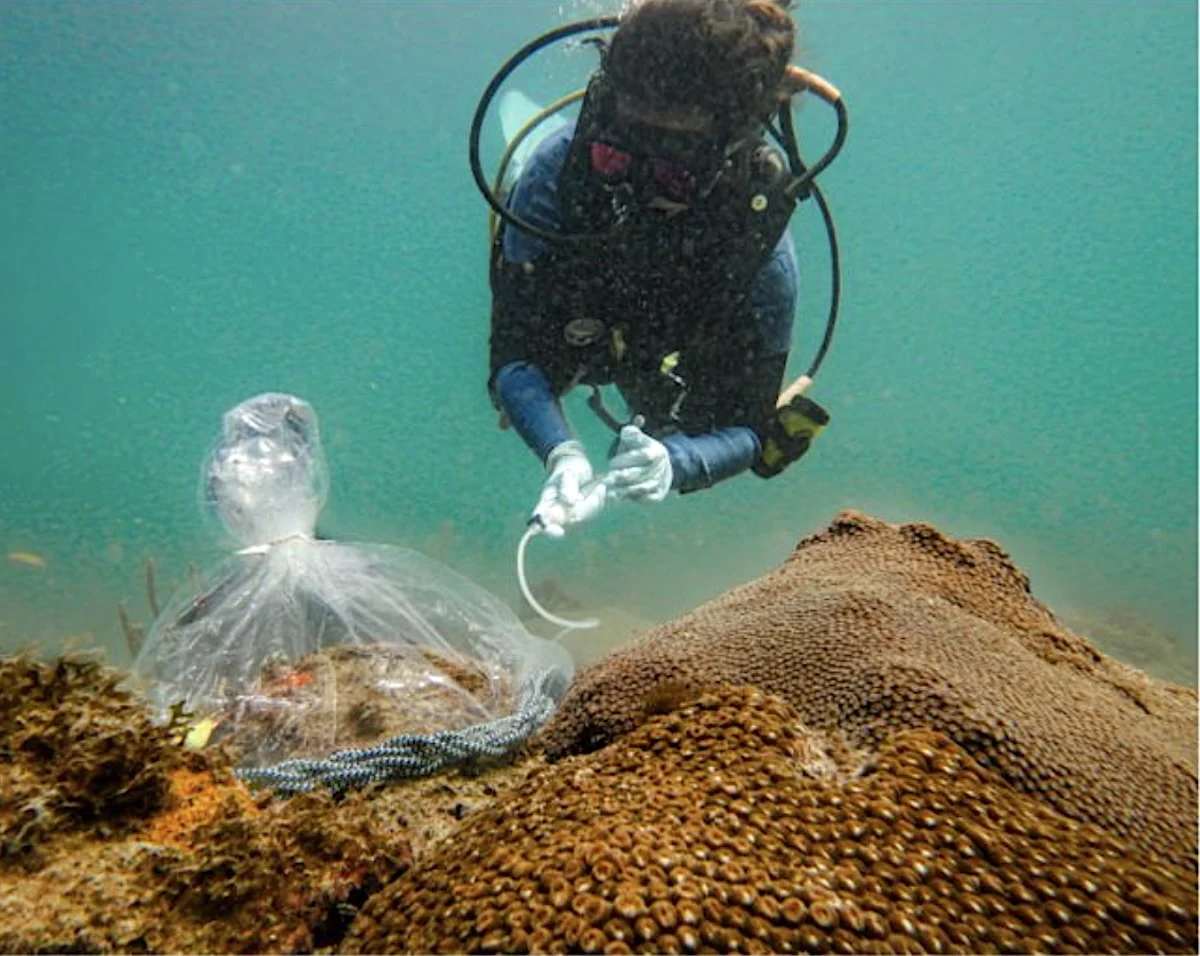
- Whole-Colony Bagging: An innovative, albeit labor-intensive, technique involving placing a weighted bag around the entire coral colony and injecting the probiotic directly into the enclosed seawater.
The goal of the bagging method was to provide a sustained, high-concentration exposure to the probiotic, allowing the beneficial bacteria to colonize the entire surface of the coral rather than just the active lesion. The researchers monitored the treated corals for an impressive 2.5-year duration, providing long-term data on the efficacy and stability of the treatment.
Supporting Data: The Power of Whole-Colony Treatment
The results of the study were striking. Corals treated using the whole-colony bagging method showed a dramatic reduction in disease progression. While untreated control colonies lost an average of 35% of their tissue to the disease, those treated with the bagging method lost only 7%.
Perhaps more importantly, these gains were not fleeting. The protective effects of the MCH1-7 treatment persisted for the full 2.5-year observation period. This longevity is crucial; previous coral restoration efforts have often been stymied by the “re-emergence” of disease shortly after initial treatment.
Conversely, the study found that the paste application was significantly less effective. The researchers hypothesize that the paste may be washed away by currents or fail to penetrate the deeper layers of the coral microbiome, reinforcing the need for the more intensive, whole-colony approach.
Official Perspectives: Navigating the Challenges
The research team is careful to temper their success with scientific caution. While the results are promising, they do not constitute a "magic bullet."

“It’s important to understand that this is the very beginning,” says lead author Kelly Pitts. “This is definitely not a cure-all, but we’re definitely moving in the right direction.”
The logistical hurdles are significant. The bagging method requires scuba divers to carry specialized equipment to the reef, deploy bags, manage the injection process, and later retrieve the materials. It is a time-consuming and labor-intensive process compared to the simple application of a paste. However, the study’s authors argue that the long-term benefits—namely, the survival of the colony and the potential for long-term resistance—outweigh these operational costs.
Furthermore, the team confirmed that the application method does not adversely affect other healthy coral species in the Caribbean, an essential finding for ensuring that restoration efforts do not inadvertently cause ecological imbalances.
Implications for Future Marine Conservation
The success of MCH1-7 represents a fundamental shift in coral restoration strategy: moving away from reactive "band-aid" treatments toward systemic microbiome management. By understanding how probiotics interact with coral physiology, scientists are beginning to treat the "patient" (the coral) rather than just the "symptom" (the lesion).
Several key implications emerge from this research:
1. Scaling the Science
The challenge now lies in scalability. While effective on individual colonies, protecting entire reef tracts requires more efficient delivery systems. Researchers are currently looking at ways to automate or simplify the bagging process to allow for larger-scale interventions.
2. A Model for Other Species
The success of the MCH1-7 probiotic suggests that similar microbial solutions may exist for other coral species affected by SCTLD. This "probiotic cataloging" could become a standard practice in the global effort to save endangered reefs.
3. Integration with Broader Restoration Efforts
This probiotic treatment is likely to work best when integrated with other restoration techniques, such as coral gardening and assisted evolution. By ensuring that outplanted, laboratory-raised corals are treated with beneficial probiotics before they are introduced to the wild, scientists may be able to give these vulnerable colonies a head start against the disease.
4. Climate Resilience
While SCTLD is the current focus, the broader goal is to build reefs that are resilient to multiple stressors, including climate change and ocean acidification. Probiotics that can help corals survive disease may also prove to be valuable allies in helping corals withstand the physiological stress caused by rising sea temperatures.
Conclusion: A Long Road Ahead
The findings from the Smithsonian Marine Station provide a critical piece of the puzzle in the fight to save Florida’s coral reefs. By leveraging the natural defensive capabilities of beneficial bacteria, scientists have established a viable, long-term strategy for slowing the spread of one of the most destructive diseases in marine history.
However, the authors of the study emphasize that this is only one piece of a much larger puzzle. Addressing the root causes of coral decline—including water quality degradation, overfishing, and global climate change—remains essential. The MCH1-7 probiotic is a powerful tool in the shed, but it is not a replacement for comprehensive environmental stewardship.
As the scientific community continues to refine these methods, the hope is that these "microbial guardians" will become a standard part of the toolkit for reef managers across the globe. For now, the successful protection of the great star coral serves as a testament to the power of scientific innovation, proving that even in the face of a marine pandemic, it is possible to turn the tide. The path forward is difficult and demands sustained funding and international cooperation, but for the first time in a long time, the outlook for Florida’s reefs feels slightly less dire.