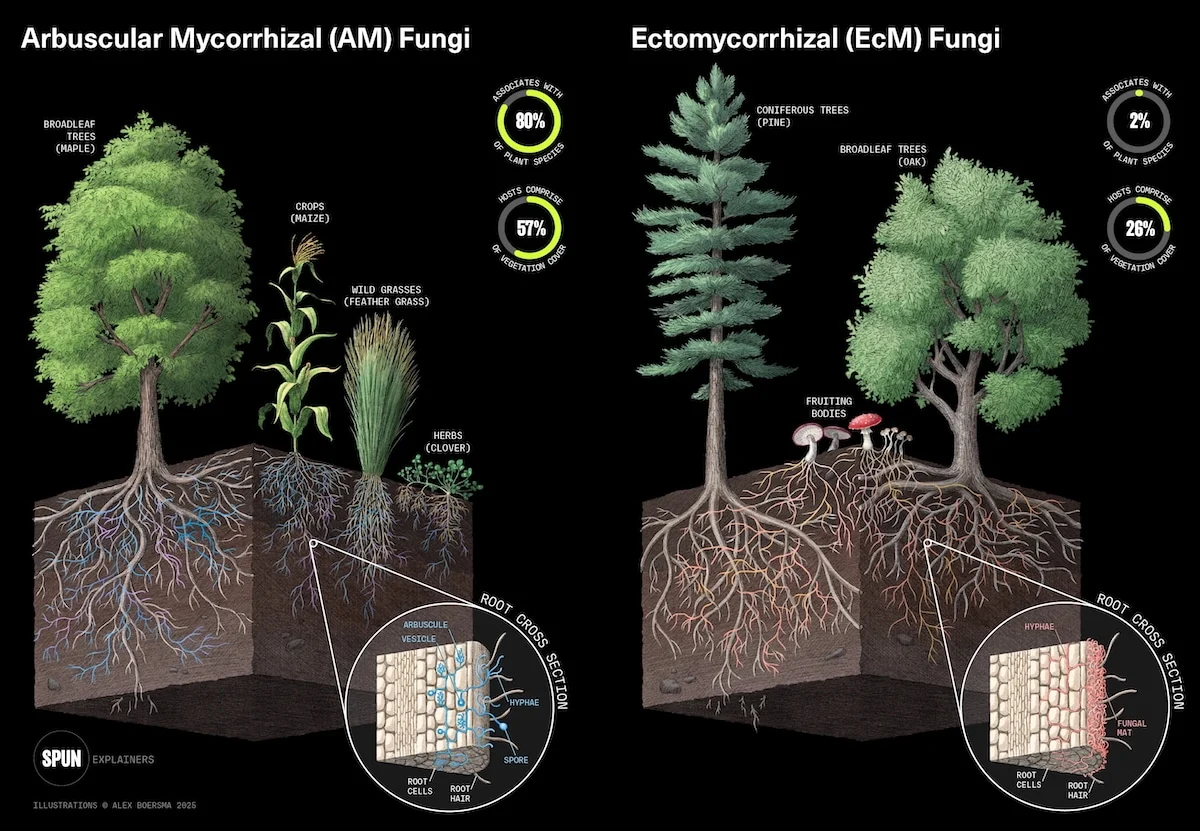
For millions of years, a vast, silent, and invisible engine has been driving the vitality of life on Earth. Beneath our feet, complex webs of mycorrhizal fungi act as the planet’s circulatory system, shuttling nutrients, storing carbon, and fortifying plants against environmental stressors. Yet, despite their foundational role in global ecology, these "ecosystem engineers" have remained largely ignored by policy-makers and conservationists.
New research published in the journal Nature by the Society for the Protection of Underground Networks (SPUN) has shattered this state of "fungus blindness." By mapping the biodiversity of these subterranean networks, scientists have revealed a startling reality: the vast majority of the world’s most critical fungal hotspots exist outside of protected areas, leaving them vulnerable to degradation and destruction.
Main Facts: The Architects of Life
Mycorrhizal fungi exist in a symbiotic relationship with the vast majority of terrestrial plants. They extend their microscopic threads—known as hyphae—into the soil, creating a massive, interconnected network that facilitates the exchange of resources. Plants provide the fungi with sugars produced through photosynthesis, while the fungi, in return, scavenge the soil for phosphorus, nitrogen, and water, delivering them directly to plant roots.
The implications of this relationship extend far beyond the individual plant. These networks are carbon sequestration powerhouses, drawing an estimated 13 billion tons of carbon annually into the soil—a figure roughly equivalent to one-third of global fossil fuel emissions. When these networks are disrupted by intensive agriculture, deforestation, or urban development, the soil loses its ability to store carbon, and plant health begins a precipitous decline.
"When we disrupt these critical ecosystem engineers, forest regeneration slows, crops fail, and biodiversity above ground begins to unravel," explains Dr. Toby Kiers, Executive Director of SPUN. "450 million years ago, there were no plants on Earth, and it was because of these mycorrhizal fungal networks that plants colonized the planet and began supporting human life."
A Chronology of Discovery and Mapping
The path to identifying these hotspots has been a monumental scientific undertaking. For centuries, cartographers and biologists focused their efforts on the "charismatic" megafauna and flora above the surface—mountains, forests, and ocean ecosystems—while the fungal world remained shrouded in mystery.
The current study marks a significant milestone in SPUN’s 2021 initiative to create the "Underground Atlas." By aggregating over 2.8 billion fungal sequences collected from 130 countries, researchers were finally able to visualize the global distribution of these communities.

- 2021: The launch of the world mapping initiative by SPUN, aiming to quantify underground biodiversity for the first time on a large scale.
- 2022-2024: An international effort involving 96 "Underground Explorers" and over 400 scientists commenced. Teams were deployed to some of the most remote and challenging environments on the planet, including regions in Bhutan, Mongolia, Ukraine, and Pakistan, to gather soil samples.
- July 2025: The findings are officially published in Nature, titled "Global hotspots of mycorrhizal fungal richness are poorly protected." The study provides the first high-resolution, predictive biodiversity maps of the planet’s mycorrhizal communities, confirming that only 9.5 percent of these vital hotspots fall within existing protected areas.
Supporting Data: The Scale of the Invisible
The dataset supporting this research is unprecedented in its scope. Despite having sampled only 0.001 percent of the planet’s surface, the project has already cataloged more than 40,000 specimens representing 95,000 distinct mycorrhizal fungal taxa.
The data reveals that fungal diversity is not evenly distributed. Regions such as the Guinean forests of West Africa, the temperate rainforests of Tasmania, and the Cerrado savanna of Brazil emerged as high-density hubs of unique, endemic fungal communities. The maps provide a granular look at where biodiversity is highest, utilizing bright colors to indicate areas of high richness.
The urgency of this data cannot be overstated. As global climate patterns become increasingly erratic, the resilience of these underground systems is being tested. Without protection, the loss of these networks threatens to diminish global crop productivity and significantly weaken the ability of ecosystems to recover from extreme weather events.
Official Responses and Expert Insights
The scientific community and prominent conservation advocates have lauded the report as a turning point in environmental science. The study features advisors including legendary conservationist Jane Goodall, authors Paul Hawken and Michael Pollan, and Fungi Foundation founder Giuliana Furci.
Dr. Merlin Sheldrake, Impact Director at SPUN, noted that the maps are an essential tool for curing "fungus blindness." By providing a visual framework, the research allows policy-makers to move beyond the traditional focus on surface-level conservation.
"These maps are more than scientific tools—they can help guide the future of conservation," says lead author Dr. Michael Van Nuland. "Food security, water cycles, and climate resilience all depend on safeguarding these underground ecosystems."
From the perspective of restoration ecology, the impact is equally profound. Dr. Alex Wegmann of The Nature Conservancy highlights that restoration efforts have historically been "dangerously incomplete." By providing quantitative targets, these maps allow land managers to understand what a healthy, diverse fungal community should look like in a given region, facilitating more effective, science-based restoration projects.

The Implications: A New Era for Conservation Policy
The implications of the SPUN report reach deep into the corridors of environmental policy, law, and climate strategy. For too long, the "underground" has been an afterthought in global climate accords, despite its role as a planetary circulatory system.
1. Reimagining Protected Areas
The fact that 90.5 percent of fungal biodiversity hotspots are currently unprotected suggests that current conservation strategies are misaligned with biological reality. Policymakers are now being urged to use the Underground Atlas to identify these zones and prioritize them for legal protection, potentially establishing "underground conservation corridors" that bridge the gap between fragmented surface habitats.
2. Integrating Fungi into Climate Strategies
With 13 billion tons of carbon sequestered annually by these networks, they are a primary asset in the fight against climate change. Integrating fungal protection into carbon credit markets and national climate action plans could provide the necessary funding to safeguard these regions.
3. Food Security and Agriculture
As the global population grows and climate change threatens crop stability, the health of mycorrhizal networks becomes a matter of food security. By protecting the natural fungal communities that aid in nutrient uptake and pathogen defense, agricultural systems can become more self-sustaining and less reliant on synthetic fertilizers, which are known to degrade these very networks.
4. A Data-Driven Future
The ultimate goal of SPUN is to ensure that underground biodiversity becomes as fundamental to environmental decision-making as satellite imagery. As Jason Cremerius, SPUN’s Chief Strategy Officer, notes, the integration of these maps into standard planning tools will allow for a more holistic approach to land management—one that recognizes that the health of the tree is entirely dependent on the health of the soil.
Conclusion: The Path Forward
The message from the research is clear: we are failing to protect the very infrastructure that sustains life on land. The discovery of these hotspots provides a map for action, but the speed at which we implement this knowledge will determine the stability of our future ecosystems.
As the international network of "Underground Explorers" continues to sample the furthest reaches of the globe, the dataset will only grow more precise. We are standing at a threshold where we can choose to either continue overlooking the "dark" world beneath our feet or embrace it as a vital partner in global conservation. By safeguarding the underground, we are not just protecting fungi; we are securing the water cycles, the food supplies, and the carbon-capturing capacity of the planet for generations to come. The era of ignoring the underground is over; the era of protecting it has begun.