BINGHAMTON, N.Y. — For millions of daily players, the morning routine is a familiar ritual of cognitive suspense. Over coffee and commutes, puzzle enthusiasts open The New York Times app to confront a blank slate of 30 squares arranged in a six-by-five grid. With no initial clues, the objective seems deceptively simple: guess a valid five-letter English word in six tries or fewer.
Yet, as any seasoned player knows, the path from a blank board to the coveted row of glowing green tiles is fraught with anxiety. A single misplaced vowel or an unfortunate early guess can send a player spiraling into a desperate, last-ditch scramble to salvage their streak.
Now, a team of researchers at Binghamton University, State University of New York, has brought the weight of advanced mathematics to the daily puzzle. Utilizing the principles of information theory, the research team has developed a computational method that cracks the Wordle code with an astonishing 99% success rate.
Published in the Northeast Journal of Complex Systems, the breakthrough shifts the paradigm of word games, proving that when it comes to solving complex systems under uncertainty, trying to be "right" too early is often the worst strategy a player can take.
Main Facts: The Science Behind the Grid
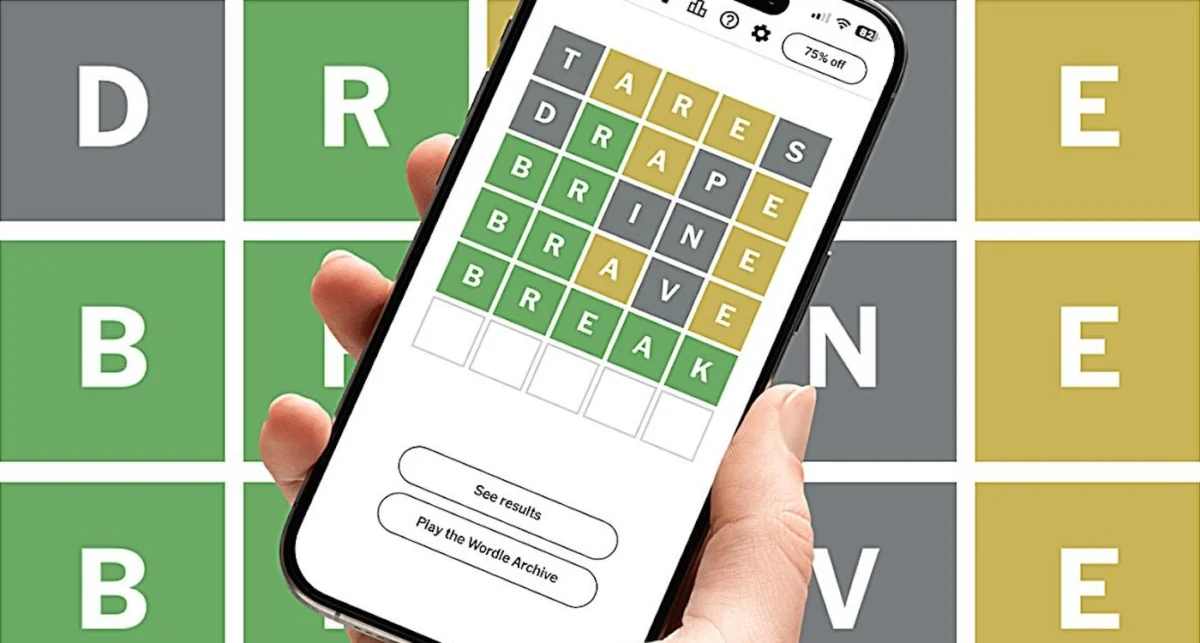
At its core, Wordle is a game of deduction constrained by feedback. When a player inputs a word—such as “BRAVE”—the game responds by color-coding the letters:
- Green indicates the letter is correct and in the right position.
- Yellow signifies the letter is in the target word but currently in the wrong position.
- Gray reveals the letter does not appear in the word at all.
Traditional strategies usually rely on frequency analysis: players open with words packed with common vowels and consonants (like “AUDIO” or “STARE”) to quickly identify which letters are present. While intuitive, this approach is fundamentally static. It prioritizes the probability of a direct hit over the systemic elimination of possibilities.
Enter the Binghamton research team, led by Assistant Professor Congyu “Peter” Wu and doctoral student Donald Stephens. Rather than asking, "What is the most likely word to be the answer right now?" the team applied Shannon entropy—a foundational mathematical measure of uncertainty and information content originally developed by mathematician Claude Shannon in 1948.
By treating the game through the lens of information theory, the researchers optimized for a different objective: maximizing the expected reduction in uncertainty with every single guess.
"By applying Shannon entropy, the objective shifts to maximizing the expected reduction in uncertainty rather than the probability of being right," explained Stephens. "In practice, this approach can lead to solving the puzzle in fewer guesses."
In rigorous computer simulations, the Binghamton method outperformed traditional letter-frequency strategies by a wide margin. While standard methods achieved a commendable 90% success rate across the dataset, the entropy-driven approach successfully solved 99% of Wordle puzzles.
Chronology: From Classroom Concept to Computational Breakthrough
The genesis of this research lies at the intersection of academic engineering theory and modern digital culture. Complex systems and information theory are standard subjects in advanced university curricula, but bridging abstract mathematical formulas with a viral web-based pastime required a unique creative spark.
Phase 1: Identifying the Bottleneck
The project began as an exploration into how human intuition fails when navigating combinatorial search spaces. The research team noted that human players are psychologically drawn to words that feel close to potential answers. If a player suspects the word ends in “IGHT” (such as LIGHT, MIGHT, NIGHT, or RIGHT), they will often waste crucial guesses trying individual words rather than systematically eliminating entire subsets of the alphabet.
Phase 2: Translating Shannon Entropy
Professor Wu and his team realized that Shannon entropy could be mapped directly onto the mechanics of Wordle’s feedback loop. Every guess generates a specific pattern of green, yellow, and gray tiles. Each distinct pattern acts as a filter, cutting down the pool of remaining valid dictionary words.
The team engineered a computational model that calculates the mathematical "information value" of every possible valid word at any given state of the game.
Phase 3: Dynamic Simulation and Testing
To validate their hypothesis, the researchers ran exhaustive simulations comparing traditional heuristic approaches against their entropy-maximizing algorithm. The results demonstrated not only a higher overall win rate, but a lower average number of guesses required to clear the board.
Following successful simulations, the team published their comprehensive findings, complete with mathematical proofs and data charts, in the Northeast Journal of Complex Systems.
Supporting Data: Why Counter-Intuitive Guesses Win
To the casual observer, the Binghamton strategy can look counter-intuitive, or even "random."
Under a traditional mindset, if a player discovers that the letters S, T, and A are present, they will immediately try to assemble them into a likely candidate like “STAND” or “SMART.”
However, the information theory approach might recommend guessing a completely different word—one that contains none of the user’s favorite letters, or places known letters in unfamiliar positions—simply because that specific word cuts the remaining dictionary possibilities cleanly in half.
"A subtle but important insight from the paper is that a guess doesn’t have to be the most likely answer; it simply has to be informative," Stephens noted.
Head-to-Head Simulation Results
- Traditional Frequency Method (e.g., focusing on high-frequency letters like E, A, R):
- Success Rate: 90%
- Vulnerability: Prone to getting trapped in "letter-trap" scenarios (e.g., words ending in -IGHT or -OUND where multiple options remain with few guesses left).
- Binghamton Shannon Entropy Method:
- Success Rate: 99%
- Advantage: Consistently preserves flexibility, eliminating semantic blind alleys by forcing maximum data yield per turn.
"What is especially creative and valuable about the team’s intellectual contribution," said Professor Wu, "is that it transformed a static measurement in a scientific domain into a dynamic solution that helps accomplish a popular task better, which showcases the team’s deep understanding of class material and their talent as engineers."
Official Responses: How Players Can Use the Method
Implementing a complex information-theory algorithm on the fly is beyond the mental arithmetic of the average human player. Solving Shannon entropy calculations in real time requires processing thousands of potential permutations against the official Wordle dictionary.
Recognizing this, the research team outlined how enthusiasts can deploy the strategy interactively.
"To use the method in real time, a player would need to run a script or program on the side," the team explained. "The player would enter the color-coded feedback that the game provides, and the program would spit out the next best guess to attempt to provide more information."
While purists might view running an algorithmic script as skirting the spirit of the game, puzzle theorists argue that using computational aids shifts Wordle from a test of vocabulary into an engaging masterclass in applied data science. It reframes the daily puzzle not merely as a test of what you know, but as an exercise in how you learn.
Implications: Beyond the Five-Letter Grid
While the immediate beneficiaries of this research are Wordle enthusiasts looking to protect their long-standing win streaks, the broader implications extend far beyond a smartphone screen.
The methodology demonstrated by Binghamton University highlights a profound engineering principle: the value of information optimization under uncertainty.
In professional fields ranging from medical diagnostics and cybersecurity to supply chain logistics and artificial intelligence, decision-makers are constantly forced to choose between acting on high-probability assumptions versus gathering data to eliminate catastrophic risks.
By taking a rigid, theoretical framework like Shannon entropy and applying it to a playful, low-stakes consumer environment, the Binghamton researchers have illustrated how abstract mathematics governs everyday problem-solving.
As word games continue to captivate global audiences—following in the footsteps of related linguistic phenomenons like Scrabble and Spelling Bee—the boundary between human intuition and machine intelligence continues to blur. Whether players choose to deploy Python scripts alongside their morning coffee or simply adopt the mindset of prioritizing information over impulse, one thing is certain: the green and yellow tiles will never look quite the same again.