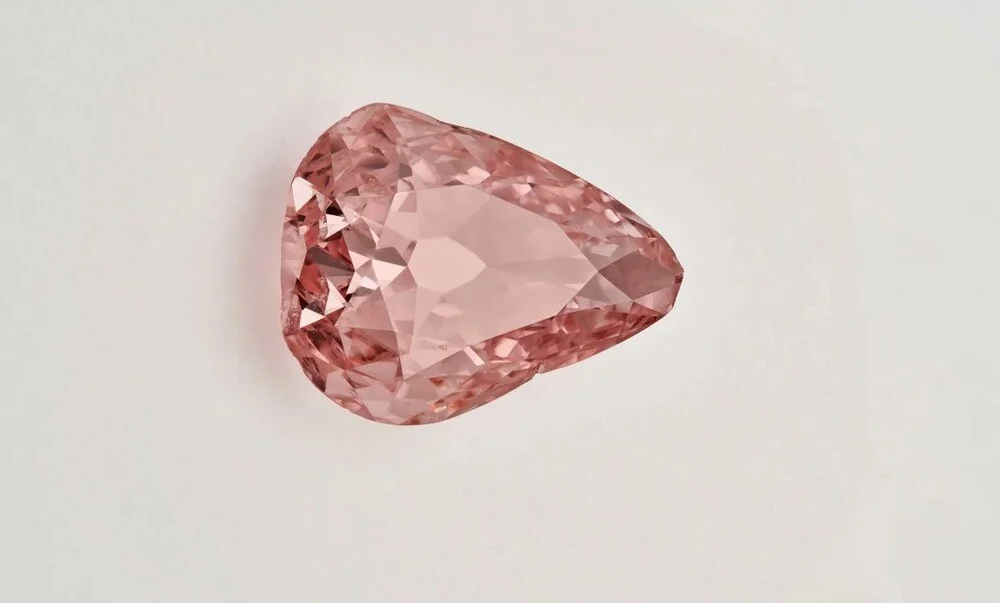
CHANTILLY, FRANCE — Nearly a century after its dramatic recovery from the center of a snack-time snack, the legendary Grand Condé diamond is stepping back into the public eye. The Musée Condé and the historic Château de Chantilly, located roughly 30 miles north of Paris, are preparing a landmark autumn exhibition celebrating not only the breathtaking beauty of this rare pink gemstone, but also the bizarre, almost cinematic chapter of history that nearly erased it from public view.
Marking the centenary of one of France’s most eccentric criminal episodes, the upcoming exhibition—running from October 17th to January 3rd—will display the stone for the first time in as many years. Yet, beyond the allure of its exquisite pink hue and centuries-old royal provenance, the exhibition serves as a window into a remarkable true story: the time a hungry Parisian hotel maid solved a high-profile heist with a single bite of a stolen apple.
Main Facts: A Rare Gem and an Unlikely Recovery
At the heart of the upcoming exhibition is the Grand Condé, a historic pink diamond of Indian origin valued at a staggering $3 million during the 1920s—a grand fortune equivalent to tens of millions of dollars today. Pink diamonds are among the rarest and most coveted colored gemstones on Earth, making the Grand Condé a target of immense criminal ambition.
In late 1925, the Château de Chantilly was targeted by amateur burglars who made off with the diamond alongside 74 other pieces of priceless jewelry, utilizing little more than a simple ladder and sheer audacity. However, the thieves quickly discovered that possessing world-famous royal loot was far easier than liquidating it. Unable to find a fence willing to touch items with such glaring, recognizable provenance, the criminals sat on a fortune they could not spend.
The standoff came to an abrupt, comical halt in 1926, thanks to Suzanne Schiltz, a Parisian chambermaid. Exhausted from scrubbing rooms in the bustling capital, Schiltz gave in to a momentary temptation while tidying a guest’s quarters: she swiped an apple from a gentleman’s suitcase.
Taking a firm bite, her teeth collided with something unyielding, nearly shattering her jaw. Peering down into the fruit in utter disbelief, Schiltz discovered a pink gemstone the size of a lima bean safely nestled inside the core. Her inadvertent discovery cracked the high-profile theft wide open, returning the legendary diamond to its rightful home and giving police one of the most memorable punchlines in criminal history.
Chronology: From Royal Courts to a Fruit Core
To truly appreciate the journey of the Grand Condé, one must trace its path across centuries of European history, political intrigue, and modern serendipity.
- The 17th Century (Origins): Believed to have been mined in India—the historical cradle of the world’s most famous diamonds—the stone eventually made its way to Europe. It was presented to Louis II de Bourbon, Prince of Condé (commonly known as Le Grand Condé), as a reward for his military service during the Thirty Years’ War.
- The Revolutionary Era: The diamond transitioned through various private collections before eventually becoming state property during the turbulence of the French Revolution, later returning to the hands of the nobility.
- Late 1925 (The Audacious Heist): Two amateur thieves scale the Château de Chantilly using a ladder, executing a daring raid that nets the Grand Condé and 74 other priceless jewels.
- Early 1926 (The Apple Incident): Struggling to fence the hot merchandise, the thieves hide the precious pink diamond inside an ordinary piece of fruit. Meanwhile, Parisian chambermaid Suzanne Schiltz, looking for a quick snack while cleaning hotel rooms, takes a bite out of the wrong apple and hits the diamond jackpot.
- 1926 (The Interrogation): Upon arresting one of the dumbfounded burglars, police reportedly asked the classic question: "Do you like apples?" When the confused thief asked why, the officer replied, "You have one with queer seeds in your case."
- October 17, 2026 – January 3, 2027 (The Centenary Exhibition): Marking 100 years since its recovery, the Musée Condé and the Château de Chantilly partner with Paris’s School of Jewelry Arts to put the diamond back on public display, accompanied by state-of-the-art forensic documentation.
Supporting Data: The Anatomy of a Pink Diamond
The upcoming exhibition is not merely a nostalgic look backward; it is also a scientific milestone. Mathieu Deldicque, chief heritage curator and director of the Musée Condé, invited expert gemologists from the prestigious School of Jewelry Arts in Paris to conduct exhaustive scientific analyses on the Grand Condé.
Researchers utilized advanced spectroscopy and microscopic imaging to assess the stone’s chemical composition, clarity, density, and structural rarity. According to historical and geological data compiled for the exhibition, pink diamonds owe their mesmerizing color not to chemical impurities like nitrogen or boron (which color yellow and blue diamonds, respectively), but to a rare distortion in the crystal lattice that occurs during the diamond’s formation deep within the Earth’s mantle under immense tectonic stress.
| Feature | Detail |
|---|---|
| Gemstone Type | Natural Pink Diamond |
| Geographic Origin | India |
| Historical Recipient | Louis II de Bourbon, Prince of Condé |
| 1920s Valuation | Approximately $3,000,000 USD |
| Recovery Method | Accidental discovery inside an apple (1926) |
| Exhibition Dates | October 17, 2026 – January 3, 2027 |
| Collaborating Institution | School of Jewelry Arts (École des Arts Joailliers), Paris |
Furthermore, the scientific team established a modern "identity card" for the stone. In an era where museum security faces sophisticated challenges, creating a comprehensive digital and chemical profile ensures that even if the diamond were somehow stolen, recut, or reshaped, its unique atomic fingerprint would instantly alert international auctioneers, gemologists, and law enforcement to its true origins.
Official Responses and Curatorial Insights
The decision to bring the Grand Condé out of the vault after a century of seclusion was not taken lightly, particularly given recent high-profile museum heists across Europe that have forced cultural institutions to reevaluate their physical and digital security protocols.
Director Mathieu Deldicque emphasizes that the exhibition aims to address both the historical security failures of the past and the advanced methodologies required to protect cultural artifacts today. However, beyond security and history, Deldicque stresses the irreplaceable sensory experience of viewing high-grade gemstones in person.
"Diamonds are quite particular," Deldicque noted in statements shared with cultural press. "You can’t enjoy them through pictures, videos, photographs, and so on. Their color, their light, their presence are actually so strong that you have to see them in real life."
Deldicque also describes gemstones not merely as symbols of wealth or instruments of royal power, but as genuine "works of art and works of nature." By collaborating with the School of Jewelry Arts, the museum bridges the gap between historical narrative and modern gemological science, offering visitors a holistic understanding of how nature creates such enduring wonders.
Implications: A New Era for Museum Exhibitions and Artifact Security
The return of the Grand Condé diamond holds profound implications for how museums handle historical artifacts of immense monetary and cultural value.
- Redefining Provenance and Security: By establishing a complete chemical and structural profile ("identity card"), the Château de Chantilly is setting a new gold standard for high-value jewelry exhibition. The inability of the 1926 thieves to fence the diamond proved that notoriety protects a gem; today, advanced science ensures that anonymity on the black market is virtually impossible.
- Public Engagement Through Storytelling: Cultural institutions are increasingly recognizing that historical exhibits succeed when they blend high scholarship with compelling human narratives. The tale of Suzanne Schiltz—an ordinary working-class woman whose hunger inadvertently altered the course of criminal history—provides an accessible, highly engaging entry point for younger and more diverse audiences.
- The Renaissance of In-Person Viewing: In an increasingly digital world dominated by virtual galleries and social media imagery, exhibitions featuring tactile, light-refracting masterpieces like the Grand Condé reinforce the irreplaceable value of physical museum visits.
As the doors of the Château de Chantilly swing open for this landmark centennial exhibition, visitors will not only gaze upon a rare geological marvel born millions of years ago in the depths of the Earth; they will also celebrate a delightful piece of human history—reminding us all that sometimes, the greatest mysteries are solved by the most unexpected twists of fate, and perhaps, a stolen piece of fruit.