In the rapidly evolving landscape of personal audio, a distinct schism has emerged. On one side, the budget and mid-range markets are undergoing a long-overdue revolution, driven by the 2012 Harman audio research, which suggests that most listeners gravitate toward a "neutral" sound signature. On the other side sits the high-end audiophile market—a realm of bold, subjective, and often polarizing engineering that refuses to adhere to the industry’s newfound obsession with clinical accuracy.
At the center of this debate stands the HiFiMan HE1000 Stealth, an iteration of a design that has defined the brand since 2015. With a price tag of $949, it remains a "statement" piece of hardware. But in an era where cheaper, balanced, and neutral-sounding gear is becoming the norm, does the HE1000’s specialized, artistic approach to sound still hold its value?
The Evolution of the "House Sound"
To understand the HE1000, one must first understand the "HiFiMan house sound." For years, the brand has been a champion of the open-back planar magnetic design, famous for creating a soundstage that feels expansive, airy, and deeply immersive.

The secret to this signature lies in a calculated acoustic decision: a deliberate recession in the upper midrange frequencies, specifically between 1.25kHz and 2.5kHz. By "scooping" this area, HiFiMan psychoacoustically pushes vocals and lead instruments further back in the mix. While this can occasionally result in a loss of intimacy or a slightly hollow timbre compared to strictly neutral studio monitors, it succeeds in providing a sense of space that is rarely matched by competitors.
Chronology of a High-End Icon
The journey of the HE1000 began in 2015, with the original model debuting at a staggering $3,000. It set a benchmark for planar magnetic technology, utilizing a nanometer-thickness diaphragm to achieve lightning-fast transient response.
Over the years, HiFiMan has iterated on this foundation, refining the driver technology and the physical housing. The 2023 "Stealth" iteration—the focus of our testing—represents the culmination of this lineage. It utilizes "Stealth Magnet" technology, which aims to reduce wave diffraction turbulence, thereby cleaning up the signal path. Despite these internal advancements, the core philosophy remains unchanged: this is not a headphone designed to measure flat on a graph; it is a headphone designed to create an "event" out of a listening session.

Technical Specifications and Build Quality
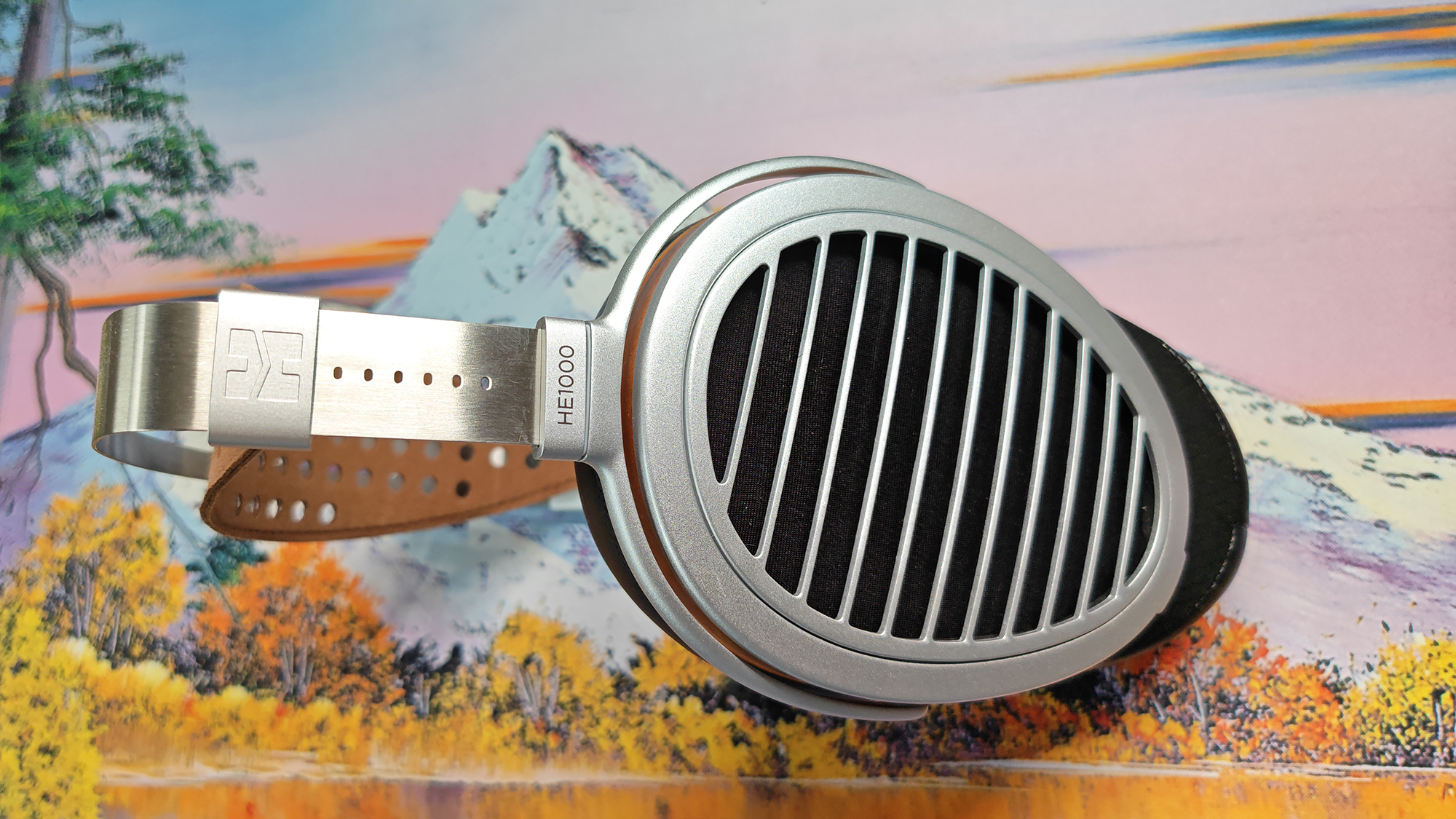
The HE1000 is as much a piece of industrial design as it is an audio tool. Its specs reflect a premium, uncompromising build:
- Price: $949
- Driver: 100mm planar magnetic
- Housing: Open-back with CNC-machined aluminium frame
- Trim: Wood-printed vinyl veneer (a point of contention at this price point)
- Headband: Real leather with a suede lining
- Impedance: 32Ω
- Sensitivity: 93dB/mW
- Weight: 458g
While the use of wood-printed vinyl veneer on a nearly $1,000 product is a curious choice, it is redeemed by the actual ergonomics. The massive earcups ensure that no part of the anatomy touches the internal drivers, and the weight distribution is managed well by the wide, comfortable headband.
Supporting Data: The Sound Profile
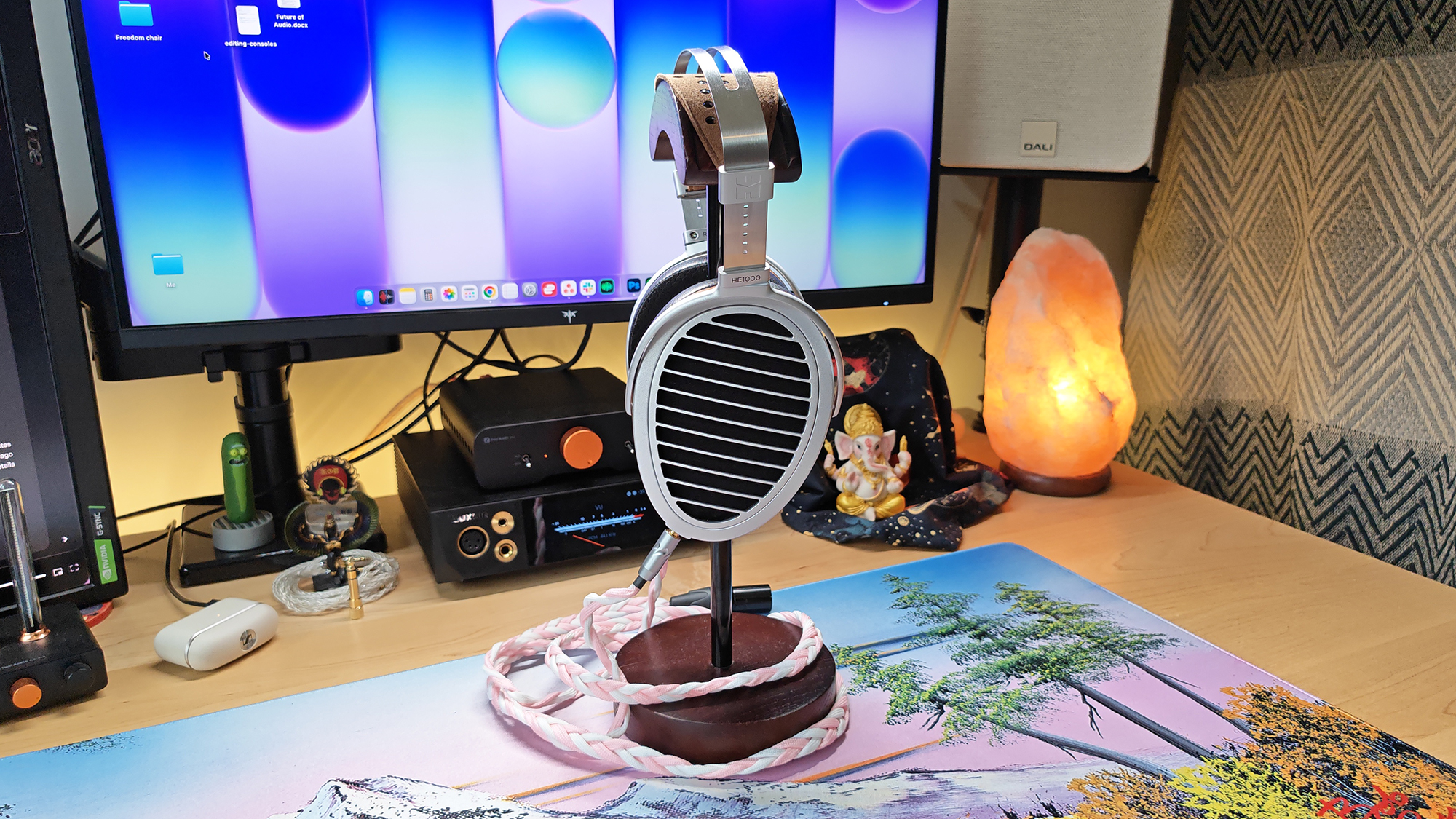
Our testing was conducted using a Luxsin X8 DAC/Amp, paired with high-end, low-capacitance balanced litz cabling. Streaming via lossless sources revealed a consistent sonic signature.
Bass Performance
The planar magnetic drivers deliver a linear, refined bass response. Unlike dynamic drivers that might offer a more aggressive "thump," the HE1000 provides a textured, sub-bass extension that feels controlled rather than bloomy. While it doesn’t offer the mid-bass slam found in some closed-back monitors like the Sony MDR-MV1, its clarity in the low end is exceptional.
Midrange and Treble
The "scooped" midrange mentioned earlier gives the music room to breathe. Complex orchestral arrangements and dense electronic soundscapes gain a level of separation that is truly impressive. However, this is not without consequence. Listeners who prefer vocal-forward, intimate presentations may find the midrange "too distant."
Furthermore, the treble region is marked by a series of peaks—notably between 6.5kHz and 7.3kHz, and a significant spike at 9kHz. For the vast majority of tracks, this adds a shimmering, detailed quality to percussion and high-frequency effects. Occasionally, however, it can lean into "spice," where sharp, sibilant sounds (like high-hats) become fatiguing.
Official Manufacturer Stance
HiFiMan has consistently defended its design choices as a pursuit of "musicality" over "measurement." By prioritizing soundstage and transient speed, the company positions its headphones as tools for the enthusiast who values the experience of music. They argue that "neutrality" is often a synonym for "boring," and that their specialized tunings are necessary to showcase the full capabilities of high-end planar drivers.
Implications for the Modern Audiophile
The existence of the HE1000 in 2024 poses a fundamental question: Should you buy specialized, high-end gear when "neutral" alternatives are cheaper?
The implications of this trend are clear: the divide between "studio-grade" equipment and "audiophile" equipment is widening.

- The Case for Neutrality: For creators, editors, and purists, the trend toward neutral tuning (as seen in the Sennheiser HD 480 Pro Plus) is a victory. It ensures that the source material is reproduced as accurately as possible.
- The Case for the HE1000: For the listener who views audio as a hobby and an escape, the HE1000 offers something that a perfectly flat graph cannot: personality.
The HE1000 is an invitation to revisit your library. It makes music sound "grand." It creates a stage. If you are an enthusiast who has already sampled the neutral world and found it lacking in "spark," the HE1000 is likely the end-game you are searching for.
Final Verdict
Is the HiFiMan HE1000 Stealth worth $949?
If you are a professional looking for a reference tool to mix tracks, the answer is no; you should look toward more neutral, balanced options. However, if you are a collector or a listener who wants to hear their music presented with an expansive, airy, and textured signature, the HE1000 remains one of the most compelling options on the market.

It is a reminder that in an industry increasingly governed by data-driven, neutral targets, there is still a place for the "modern art" of audio—the bold, the risky, and the unabashedly colored. It is not for everyone, but for the right listener, it is nothing short of a masterpiece.
Recommendations for Prospective Buyers
- Audition before buying: Given the specific, non-neutral nature of the frequency response, it is imperative to test these with your own music library.
- Consider the source: These headphones thrive on a quality DAC/Amp pairing. Do not pair them with low-power mobile devices.
- Look for alternatives: If the HE1000’s "scooped" mids sound unappealing, consider the HEDD D1 for a more neutral, balanced alternative.
Ultimately, the HiFiMan HE1000 proves that even as the audio world moves toward a standardized "ideal," there is immense value in the daring, the subjective, and the beautifully colored.