
In the heart of Connecticut, two 34-year-old professionals, Michael and Brian, find themselves at a common yet stressful crossroads of modern adulthood. Despite having stable careers—Michael as a project coordinator for a state behavioral health agency and an advocate for disability leadership, and Brian as a quality assurance manager for a state-run hospital—the couple feels that the elusive "next level" of financial security remains just out of reach.
Together since 2013 and approaching their 10-year anniversary this November, the pair is looking to move beyond the cycle of debt and towards the stability of homeownership and long-term wealth. Their story, featured as a "Reader Case Study" on the personal finance platform Frugalwoods, provides a granular look at the intersection of middle-class income, rising costs of living, and the psychological burden of financial uncertainty.

A Chronology of Transition and Financial Strain
The past year has been a period of significant upheaval for the couple. Previously living in a compact 600-square-foot studio apartment, Michael and Brian enjoyed a modest rent of $945 per month. However, the volatile 2022–2023 housing market forced a move that upended their living situation.
The transition to a more spacious, industrial-style apartment in a refurbished mill brought an increase in overhead, now costing $2,000 per month. This move, coupled with unexpected veterinary expenses for their two new kittens, created a "perfect storm" that derailed their previous goal of re-entering the housing market.

Brian’s career trajectory has been positive, marked by a move from the private sector to state employment, which secured him a pension and better benefits. However, his financial history—including the successful payoff of $58,000 in student loans—is currently overshadowed by significant consumer debt and a lack of liquid savings. Michael, meanwhile, continues to balance his primary employment with advocacy work, yet both men report feeling a sense of shame regarding their current debt-to-savings ratio.
Supporting Data: The Financial Snapshot
To understand their dilemma, one must look at the raw numbers. The couple earns a combined annual net income of approximately $109,455. Their current annual expenditures, including debt service and living costs, total $96,414.

The Debt Portfolio
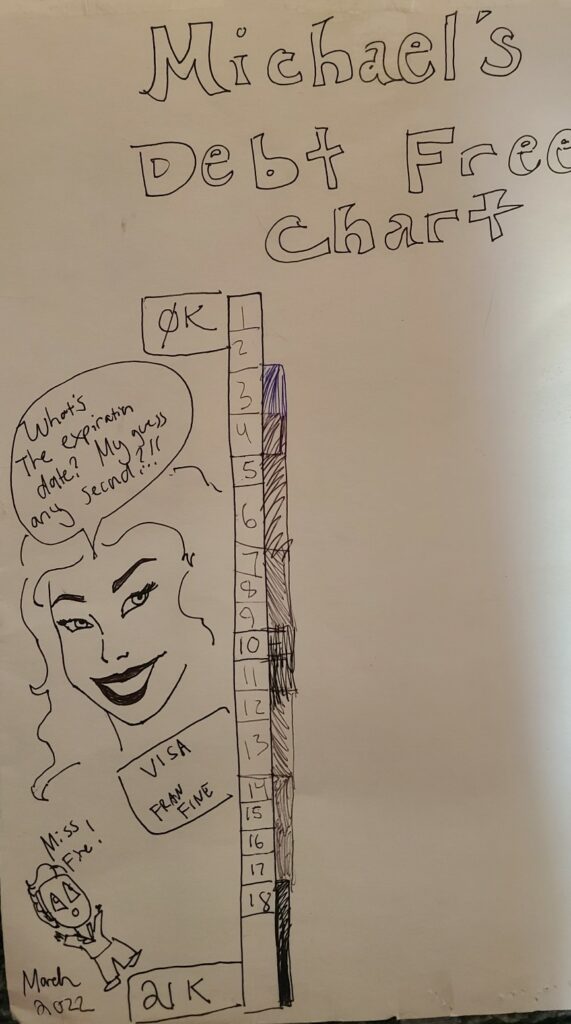
The couple carries a total consumer debt load of $28,259. This includes:
- Brian’s Visa (SCU): $16,057 at 0% (transitioning to 17.99% in November).
- Michael’s Visa Platinum: $9,700 at 10.99%.
- Brian’s Visa Platinum (Navy Federal): $2,503 at 0.99% (transitioning to 17.74% in November).
Assets and Investments
Despite the debt, the couple has accumulated $91,250 in total assets, largely comprised of retirement accounts including 401(k)s, a pension fund, and Health Savings Accounts (HSAs). Their current emergency fund sits at $7,000, which, while helpful, represents less than two months of their current $8,035 monthly burn rate.

Expert Analysis and Official Recommendations
Liz Frugalwoods, the moderator of these case studies, offers a perspective that balances empathy with rigorous fiscal discipline. Her primary assertion is that Brian and Michael are not in a "catastrophic" situation, but rather one that requires a shift in mindset and a more aggressive approach to expense tracking.
The "Expense Detox" Strategy
Frugalwoods advocates for an immediate, rigorous tracking of every dollar. She points out that with an annual surplus of roughly $13,000, the couple has the capacity to pay down their debt rapidly if they choose to enact a "spending detox."
By categorizing expenses into "Fixed," "Reduceable," and "Discretionary," Frugalwoods proposed a new budget that would cut their monthly spending from $8,035 to $6,665. This move would allow them to funnel $4,456 per month toward their debts, effectively clearing their consumer liabilities in approximately 6.5 months.
The Hierarchy of Financial Priorities
In response to the couple’s questions regarding the economic climate, Frugalwoods established a clear hierarchy for their financial goals:

- Debt Repayment: High-interest debt is the immediate priority to stop the "bleeding" of interest payments.
- Emergency Fund: Building this to cover 3–6 months of expenses is the only way to prevent future "boomerangs" into debt.
- Retirement: Maxing out tax-advantaged accounts like the 403b, 457, and Roth IRAs takes precedence over a home down payment.
- Home Ownership: This is relegated to a long-term goal, secondary to the security of a fully funded retirement and a debt-free balance sheet.
The Implications: Is a Master’s Degree Worth It?
One of the most debated points in the couple’s plan is Brian’s interest in pursuing a graduate-level degree. Frugalwoods provides a cautionary warning: unless the degree is tied to an "iron-clad" and significant increase in salary, it should be viewed as an unhelpful detour. In the current economic climate, where the couple is already struggling with liquidity, investing time and money into a degree that does not offer a direct return on investment could permanently delay their goal of homeownership.
Conclusion: Redefining Adulthood
The case of Michael and Brian highlights the modern struggle to achieve traditional milestones like homeownership in an era of high interest rates and inflation. Their feeling of being "behind" is a common sentiment among their generation, yet their situation—backed by a state-level pension and a substantial $91,000 in existing retirement assets—suggests they are far more secure than they perceive.

The path forward for the couple involves a transition from a "feast or famine" spending cycle to one of calculated, long-term sustainability. By prioritizing debt elimination, building a robust emergency buffer, and resisting the urge to take on further educational debt, they are well-positioned to unlock the "next level" of adulting they so deeply desire. Their story serves as a reminder that while money does not solve every life challenge, a disciplined approach to one’s finances is the most effective tool for creating the freedom to pursue the life one truly wants.