The smart ring market has evolved from a niche category of experimental fitness gadgets into a legitimate pillar of the wearable technology industry. As the Ultrahuman Ring Pro makes its highly anticipated official entry into the U.S. market, consumers are faced with a pivotal choice: stick with the established industry leader, the Oura Ring 5, or embrace the biohacking-centric promise of the newcomer.
After extensive testing and daily use of both devices, the verdict is clear. While the Ultrahuman Ring Pro introduces innovative, data-heavy features that cater to the hardcore "quantified self" enthusiast, the Oura Ring 5 remains the superior choice for the average user. It balances technical precision with a level of comfort, design, and user-friendly software that its competitor has yet to fully replicate.
Main Facts: The Battle of the Wearables
At their core, both the Oura Ring 5 and the Ultrahuman Ring Pro aim to do the same thing: track your biometric data—specifically heart rate, heart rate variability (HRV), body temperature, and movement—to provide actionable insights into your sleep quality, recovery status, and physical readiness.
However, their philosophies differ significantly:
- The Oura Ring 5 focuses on accessibility, long-term health trends, and intuitive, clean data presentation. It treats your body as a system to be balanced, prioritizing recovery and stress management.
- The Ultrahuman Ring Pro leans into "biohacking." Its app is designed to provide granular control, with features like "PowerPlugs" that allow users to customize their data feeds to monitor everything from caffeine intake to circadian rhythm adjustments.
While both devices are highly capable, the Oura Ring 5 excels in the physical metrics that matter most: comfort, form factor, and the reliability of its data presentation.
Chronology: The Evolution of the Smart Ring Race
The wearable landscape has shifted rapidly over the past few years. Oura has spent nearly a decade refining its hardware, moving from the clunky, prototype-like designs of its early iterations to the sleek, titanium-finished masterpiece that is the Ring 5.

Ultrahuman, by contrast, entered the scene later, bringing a disruptive energy. Their strategy focused on rapid software iteration and a "modular" app approach. When the Ring Pro was first teased, it promised to challenge Oura’s monopoly by offering a subscription-free model. However, as the product has matured and launched in the U.S., that "subscription-free" narrative has become more complex. Ultrahuman has pivoted toward a "PowerPlug" ecosystem, where certain advanced metrics are gated behind either individual micro-payments or a bundled "Max" subscription, fundamentally changing how consumers perceive the long-term value of the ring.
Supporting Data: The Cost-Benefit Analysis
One of the most persistent arguments for switching to Ultrahuman has been the promise of lower costs. However, a deep dive into the actual expenditure reveals that the financial gap is not as wide as it appears, and in some cases, Ultrahuman can prove more expensive.
The Oura Investment
The Oura Ring 5 retails starting at $399. To access the data that makes the device useful, a subscription of $5.99 per month (or $69.99 annually) is required. Over three years, this brings the total cost of ownership to roughly $600. It is a predictable, all-inclusive cost that provides a polished, holistic health experience.
The Ultrahuman Reality
The Ultrahuman Ring Pro carries a higher upfront price of $479. While it is marketed as "subscription-free," the reality is a tiered system. If a user wants to unlock the full suite of "PowerPlugs"—ranging from advanced respiratory health metrics to specialized cycle tracking—they must either pay per feature or subscribe to the "Ultrahuman Max" plan for $99.99 per year. If a user opts for the full suite of features, the three-year cost of ownership exceeds $750, significantly outpacing the Oura model.
Hardware Comparison
- Comfort: The Oura Ring 5 is objectively thinner and lighter. Its internal sensors are flush, and the ring’s geometry is better suited for the varying thickness of human fingers.
- Battery Life: The Ultrahuman Ring Pro offers superior raw battery life, lasting 8 to 10 days on a single charge compared to Oura’s 6 to 9 days. However, Oura offers a premium, portable charging case that is far more travel-friendly than the bulky, heavy case provided by Ultrahuman.
Implications for the User Experience
The primary differentiator between these two devices lies in the software ecosystem.
Oura’s Philosophy: Holistic Insight
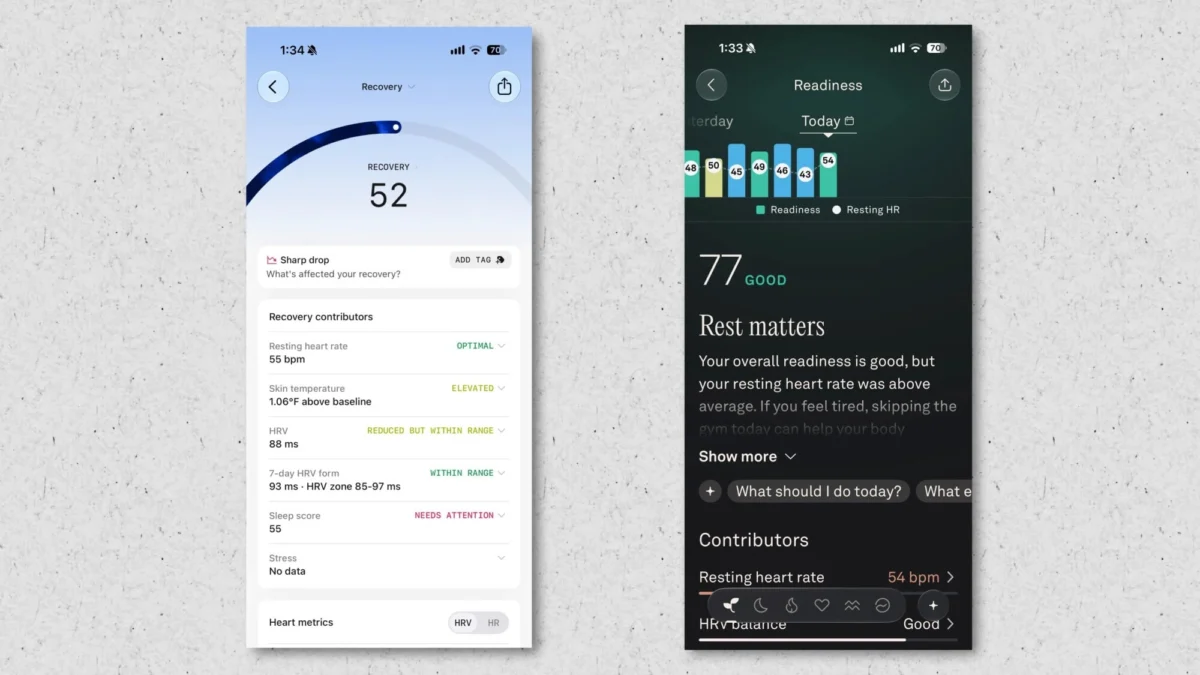
Oura’s interface is designed to reduce "data fatigue." It presents you with a "Readiness Score" that is synthesized from your sleep, activity, and stress levels. It doesn’t just show you raw numbers; it tells you what those numbers mean in plain English. For example, if your HRV is low and your body temperature is slightly elevated, Oura will suggest a rest day. It is an app that seeks to simplify your health.

Ultrahuman’s Philosophy: The Biohacker’s Toolkit
Ultrahuman’s approach is additive. It provides a constant stream of "next best actions" that attempt to optimize your life in real-time. Whether it is prompting you to stop consuming caffeine at a specific hour or analyzing your circadian alignment, the app is designed for users who want to be active participants in their biological optimization.
The implication here is one of lifestyle fit. If you want a device that works quietly in the background to provide a summary of your health, Oura is the superior choice. If you enjoy the process of adjusting your habits based on minute-by-minute data, Ultrahuman’s "PowerPlugs" provide a level of depth that Oura lacks.
Official Responses and Industry Outlook
Representatives from both companies have maintained that their platforms are not just trackers, but wellness partners. Oura’s recent messaging emphasizes "resilience," focusing on the long-term impact of stress and sleep on cardiovascular health. Ultrahuman has focused its marketing on "longevity," introducing metrics that aim to predict physical decline or improvement over decades, rather than just days.
The current market trend suggests that consumers are beginning to tire of subscription models, yet they are simultaneously demanding higher-quality, more reliable data. Oura has managed to maintain its dominance by ensuring that its hardware is nearly invisible on the finger, whereas Ultrahuman is finding its niche by catering to the segment of the population that finds joy in the complexity of health metrics.
Final Verdict
The Ultrahuman Ring Pro is a commendable piece of hardware, and for a specific type of user—the "biohacker" who wants to control every aspect of their health data—it is a fantastic tool. The modularity of the app is innovative, and the battery life is undeniably impressive.
However, for the vast majority of users, the Oura Ring 5 remains the gold standard. Its design is more comfortable, its app is more intuitive, and its long-term cost is more transparent and predictable. In the world of wearables, we aren’t just buying sensors; we are buying a companion for our daily routines. Oura’s ability to present that data without overwhelming the user is what keeps it at the top of the category. When you choose the Oura Ring 5, you are choosing a mature, reliable, and expertly crafted ecosystem that prioritizes your health over the endless accumulation of data points.