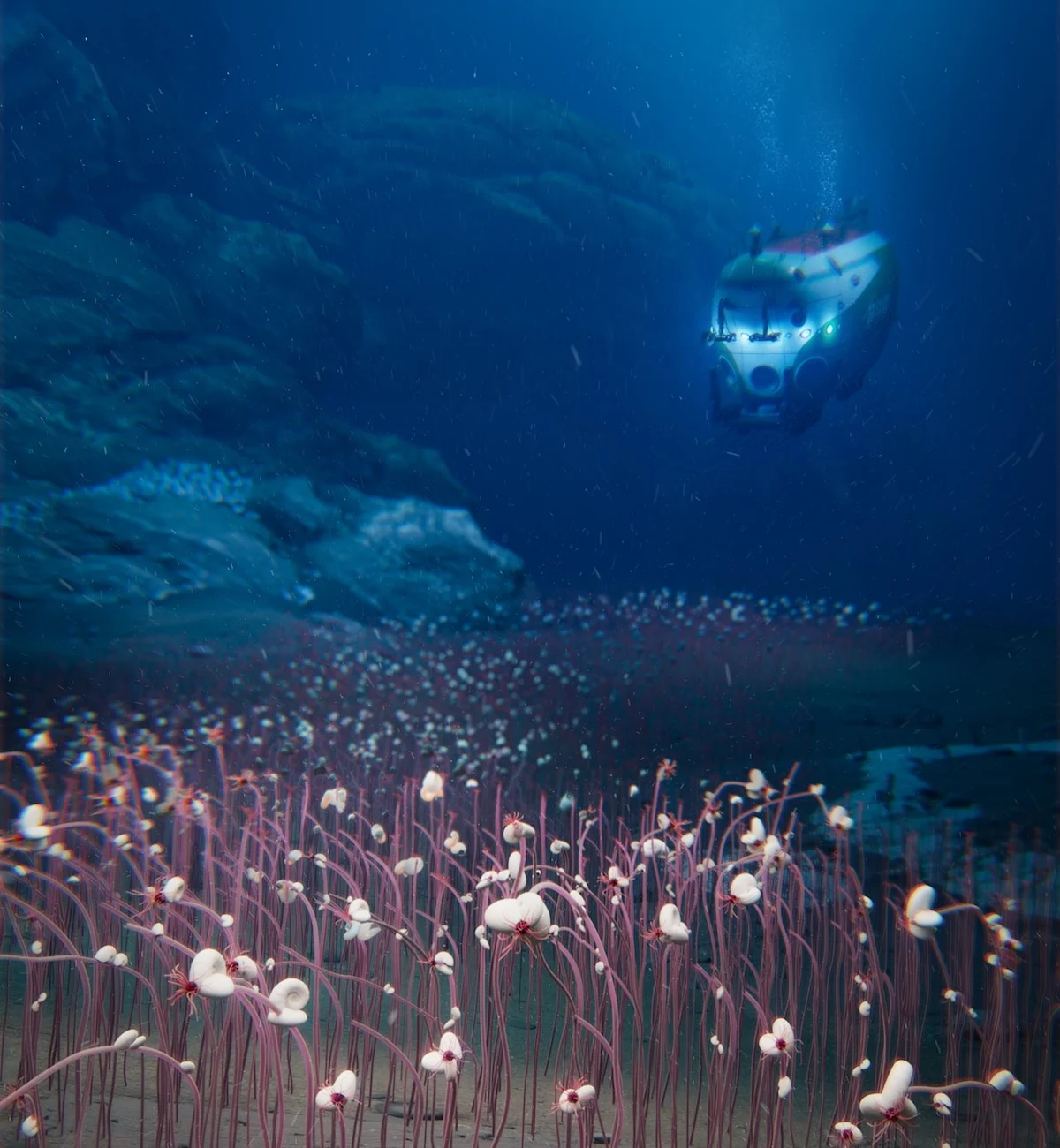
In a groundbreaking discovery that challenges our fundamental understanding of biological limits, researchers have identified the deepest-known animal colonies on Earth. Utilizing the Chinese manned submersible Fendouzhe, an international team of scientists explored the dark, crushing pressures of the Mariana Trench—the deepest point on our planet—and uncovered a vibrant ecosystem thriving nearly six miles below the ocean’s surface.
For decades, the “hadal zone”—the deepest region of the ocean—was largely considered a biological desert. Yet, the findings published in the journal Nature suggest that these underwater canyons are far from barren. Instead, they appear to host extensive, chemosynthesis-based communities that rely not on sunlight, but on the chemical energy seeping from the Earth’s crust.
Main Facts: A Discovery Beyond Expectations
The expedition, led by researchers from the Institute of Deep-sea Science and Engineering at the Chinese Academy of Sciences, conducted 23 dives into the Mariana Trench over the course of last year. What they found shattered existing models of deep-sea carbon cycling.
The team documented thousands of mollusks, siboglinid polychaetes (tubeworms), and various invertebrates flourishing at depths ranging from 3.6 to 5.92 miles. To put this into perspective, if one were to place Mount Everest at the bottom of the Mariana Trench, its peak would still be submerged under more than a mile of water.
Unlike surface-dwelling creatures that depend on photosynthesis, these organisms survive through chemosynthesis. They thrive in an environment fueled by hydrogen sulfide and methane-rich fluids that traverse deep sediment layers via tectonic faults. This chemical cocktail allows life to persist in a realm where no sunlight can penetrate and temperatures hover just above freezing.
A Chronological Perspective: From Desolation to Discovery
The history of deep-sea exploration has been defined by a transition from skepticism to awe.
- 1960: The first humans, Jacques Piccard and Don Walsh, reached the bottom of the Challenger Deep in the Trieste. They reported seeing little life, cementing the image of the deep trench as a desolate, alien environment.
- 2012: Filmmaker and explorer James Cameron performed a solo dive to the bottom of the Mariana Trench. While he documented geological formations, he described the area as profoundly empty, reinforcing the belief that high-pressure environments could support only the most microscopic of life forms.
- 2024–2025: The Fendouzhe expedition conducted a series of systematic dives, utilizing advanced high-definition imaging and robotic sampling. The resulting footage, released alongside the study, revealed fields of tubeworms reaching up to a foot in length and vast, clustered mats of bivalves, signaling a level of biological density that had never been documented at these depths.
The progression from the brief, singular encounters of the 20th century to the systematic, sustained observation provided by the Fendouzhe has turned the tide on our understanding of Earth’s final frontier.
Supporting Data: The Mechanics of Survival
The study, titled "Flourishing chemosynthetic life at the greatest depths of hadal trenches," provides detailed isotopic analysis to explain how these colonies sustain themselves.
The Chemosynthetic Engine
The researchers found compelling evidence that the methane utilized by these organisms is produced microbially from organic matter deposited in the trench sediments. These methane-rich fluids are then transported upward along fault lines, creating a “vibrant oasis” for specialized marine life.
Biodiversity in the Dark
The survey covered a massive stretch of the ocean floor, spanning approximately 1,553.4 miles across the Kuril-Kamchatka and western Aleutian Trenches. The inventory of species discovered includes:
- Siboglinid Polychaeta: Deep-sea tubeworms that cluster around microbial mats.
- Bivalvia: Large mounds of clams and mollusks.
- Invertebrates: Including spiky crustaceans, sea lilies, and sea cucumbers.
The sheer abundance of these organisms suggests that the "biological desert" theory of the hadal zone is fundamentally flawed. Instead, these trenches may act as critical nodes in the global carbon cycle, sequestering and processing organic matter on a scale previously ignored by oceanographers.

Official Responses and Scientific Context
Lead author Xiatong Peng and co-author Mengran Du have been vocal about the significance of the findings. "Given the geological similarities with other hadal trenches, such chemosynthesis-based communities might be more widespread than previously anticipated," Peng noted.
Mengran Du, a marine geochemist, emphasized the emotional and scientific weight of the mission. "What makes our discovery groundbreaking is not just its greater depth—it’s the astonishing abundance and diversity of chemosynthetic life we observed. Unlike isolated pockets of organisms, this community thrives like a vibrant oasis in the vast desert of the deep sea."
The international scientific community has largely hailed the report as a turning point. By proving that complex, multicellular life can thrive under such extreme barometric pressure, the study forces a recalibration of where we expect to find life—not just on Earth, but potentially on icy moons like Europa or Enceladus, where similar chemical-rich, lightless environments may exist.
Implications: A Fragile Frontier at Risk
The discovery of such a complex, thriving ecosystem comes at a precarious time for global ocean policy. As the demand for rare earth minerals grows, the deep sea has become a primary target for mining corporations seeking to harvest polymetallic nodules from the seafloor.
The Looming Threat of Deep-Sea Mining
Environmentalists and marine biologists are sounding the alarm. The International Seabed Authority (ISA) is currently embroiled in debates regarding the regulation of deep-sea mining. Critics argue that we are rushing to exploit an environment we have barely begun to map.
"Mining the little-explored ocean floor could destroy fragile marine ecosystems in one of the last wild zones on the planet," warn experts. Because these deep-sea colonies are often slow-growing and specialized to specific chemical seeps, the disturbance caused by heavy machinery could lead to irreversible biodiversity loss before we even fully comprehend the roles these creatures play in our planetary health.
Rethinking Carbon Cycles
Beyond the environmental stakes, the findings challenge current models of deep-ocean carbon sequestration. If these trenches are more biologically active than previously assumed, they are likely playing a more significant role in how the ocean stores carbon. Understanding this process is vital as the world faces the mounting crisis of ocean acidification and climate change.
The Future of Exploration
The Fendouzhe mission proves that we are entering a new era of deep-sea discovery. However, the mystery remains vast. With only a handful of humans having ever descended into the deepest parts of the Mariana Trench, we are essentially looking at a pinhole view of a gargantuan, hidden world.
As researchers prepare for future expeditions, the focus will shift toward mapping the extent of these "oases" and determining how these species interact with the broader ocean environment. For now, the message from the abyss is clear: life is far more resilient, and far more abundant, than we ever dared to imagine. The deep ocean is not merely a graveyard of sunken debris or a void of crushing pressure; it is a living, breathing, and complex ecosystem that holds the secrets to life’s origins and its potential future.
As we stand on the precipice of potentially opening the deep sea to industrial exploitation, the discovery by the Chinese Academy of Sciences serves as both a scientific triumph and a stark warning: we must understand what we are protecting before we lose it forever.