BRASÍLIA, BRAZIL — In a landmark move for South American conservation, Brazilian environmental authorities have officially expanded the Pantanal Matogrossense National Park, increasing its geographic footprint by more than 25 percent. The decision adds 185 square miles (approximately 480 square kilometers) to the existing 523-square-mile protected area.
To contextualize the scale of this addition, the newly protected terrain is roughly equivalent to adding the entirety of the United States’ Redwood National Park to the existing reserve. Administered by the Chico Mendes Institute for Biodiversity Conservation (ICMBio)—a federal agency linked to Brazil’s Ministry of the Environment—the expansion represents a critical victory for scientists, Indigenous advocates, and conservationists who have spent decades lobbying for enhanced legislative safeguards across the imperiled Pantanal biome.
This strategic enlargement is designed to shield one of the planet’s most ecologically sensitive and biologically diverse environments from encroaching industrial, agricultural, and climatic threats. By securing critical breeding grounds and vital biological corridors, the Brazilian government aims to safeguard populations of iconic megafauna, including the highest concentration of jaguars found anywhere on Earth.
Chronology of a Conservation Milestone: From Ramsar Recognition to Modern Expansion
The path toward securing the expanded boundaries of the Pantanal Matogrossense National Park spans decades of international recognition, scientific assessment, and mounting environmental urgency.
The Foundation (1990s–2000s)
The global significance of the region was formally underlined more than three decades ago when the Pantanal Matogrossense was designated as a wetland of international importance under the United Nations’ Ramsar Convention. Established in 1971 in Ramsar, Iran, the convention provides the framework for national action and international cooperation for the conservation and wise use of wetlands and their resources. For years, the park served as a cornerstone of Brazil’s protected area network within Mato Grosso do Sul, yet conservationists continually noted that the park’s rigid historical boundaries failed to encompass the dynamic, seasonal migration patterns of its resident wildlife.
The Growing Pressures (2010s–2020s)
Over the past two decades, the ecological integrity of the greater Pantanal faced unprecedented stressors. Severe, prolonged droughts exacerbated by global climate shifts transformed parts of the normally waterlogged landscape into tinderboxes. Catastrophic wildfires swept through the region in 2020 and subsequent years, destroying millions of acres of vegetation and killing countless animals. These crises galvanized local and international pressure on federal authorities to rethink static conservation models and adopt dynamic, landscape-scale protections.
The Institutional Push
(Recent Years)
According to reports from the Brazilian outlet Fato Paulista, the recent expansion directly answers a long-standing demand from ecological experts who emphasized the urgent need to secure critical breeding areas. ICMBio initiated comprehensive field studies to map out how animals traversed the borders of the park. By identifying vital biological corridors—pathways utilized by wildlife to move fluidly between the park and surrounding private or state lands—authorities laid the groundwork for the structural enlargement realized today.
Supporting Data: The Biological Wealth of the Pantanal
To understand the profound significance of adding 185 square miles to the Pantanal Matogrossense National Park, one must examine the staggering density of life harbored within the world’s largest tropical wetland and flooded grassland system.
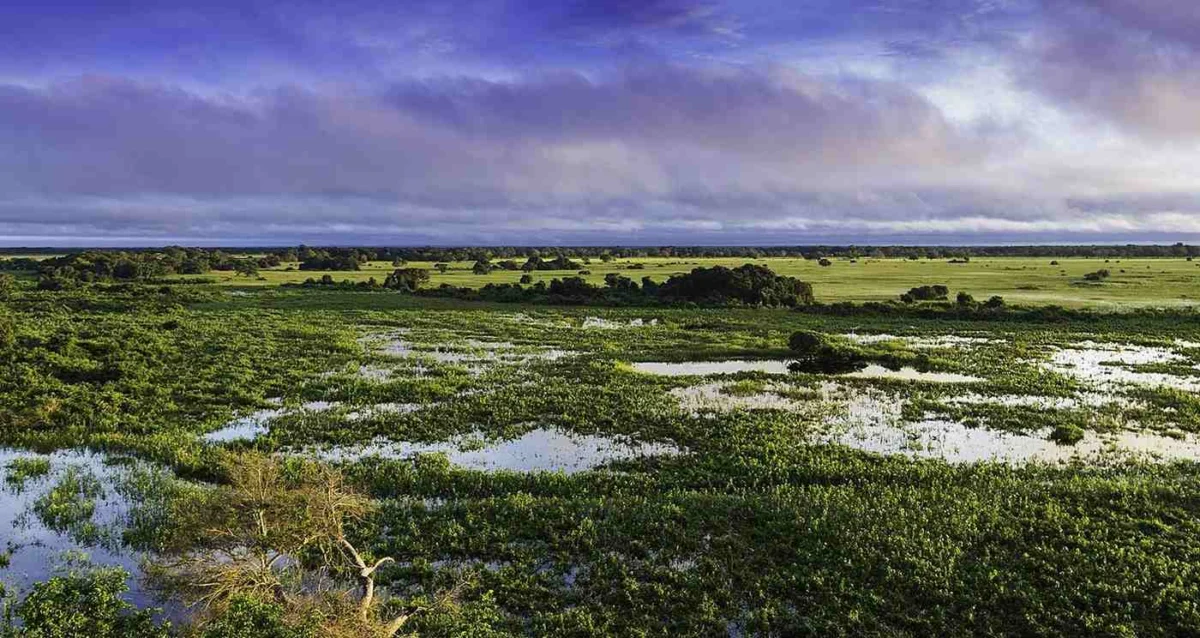
Unlike the Amazon rainforest, which is defined by dense canopy cover, the Pantanal is a vast, open mosaic of seasonally flooded savannas, gallery forests, meandering rivers, and permanent lakes. This hydrological pulsing creates a remarkably productive ecosystem that supports rich biodiversity across multiple taxonomic groups:
- Avian Life: The park and its surrounding wetlands provide sanctuary for an astonishing 463 species of birds. This includes vibrant populations of the endangered hyacinth macaw, jabiru storks, toucans, and numerous species of herons, egrets, and kingfishers.
- Aquatic Biodiversity: Beneath the surface of the region’s intricate river networks swim 269 species of fish, ranging from the massive pirarucu and dorado to countless smaller species that form the base of the aquatic food web.
- Herpetofauna: More than 100 species of reptiles and amphibians—including caimans, anacondas, yellow-spotted river turtles, and diverse tree frogs—thrive in the humid microclimates of the wetlands.
- Mammalian Megafauna: Over 236 species of mammals inhabit the biome. The Pantanal is globally renowned for hosting the highest density of jaguars (Panthera onca) on Earth. In addition to these apex predators, the expanded park protects vital habitats for several charismatic and evolutionarily distinct species:
- Lowland Tapirs: The largest native terrestrial mammals in South America, acting as crucial seed dispersers.
- Giant Otters: Highly social, aquatic carnivores that patrol the rivers and oxbow lakes.
- Giant Armadillos: Secretive, burrowing edentates that create subterranean micro-habitats utilized by numerous other species.
- Giant Anteaters: Specialized insectivores playing a vital role in regulating termite and ant populations.
Crucially, the newly incorporated acreage encompasses essential zones where these species mate, give birth, and rear their young away from human disturbance.
Official Responses and Stakeholder Perspectives
The expansion of the Pantanal Matogrossense National Park has drawn widespread praise from environmental organizations, government officials, and local stakeholders alike, though experts emphasize that legislation on paper must be matched by active, collaborative management on the ground.
Representatives from ICMBio have underscored that the success of the new boundaries hinges on cooperation with local landowners. Because wildlife does not recognize legal property lines, maintaining the integrity of biological corridors requires working hand-in-hand with ranchers, farmers, and private property owners adjacent to the park. Sustainable land-use practices, private reserve agreements, and incentivized conservation programs are being integrated into the management strategy to ensure human economic activities can coexist with ecological preservation.
International conservation bodies have also lauded the decision. By reinforcing the protections around the Pantanal, Brazil is actively fulfilling its commitments under global biodiversity frameworks and the Ramsar Convention. Environmental analysts point out that protecting this landscape contributes significantly to regional climate regulation, carbon sequestration, and freshwater security across the La Plata basin.
Furthermore, regional advocates note that safeguarding the Pantanal bolsters eco-tourism potential. Responsible wildlife viewing—particularly jaguar tracking and birdwatching—provides sustainable economic alternatives for local communities, proving that a preserved ecosystem can yield high economic value without requiring industrial conversion.
Ecological Implications: Resilience Against Fires, Droughts, and Climate Change
The expansion of the Pantanal Matogrossense National Park is not merely a quantitative increase in protected square mileage; it represents a strategic intervention aimed at bolstering ecological resilience in an era of rapid environmental change.
Preserving the "Spongy" Landscape
The defining characteristic of the Pantanal is its hydrology. During the wet season, swollen rivers overflow their banks, inundating vast stretches of land. During the dry season, this water slowly drains back into the river systems. This natural "sponge" effect regulates downstream water flow, mitigates catastrophic flooding, and maintains soil moisture during dry spells.
However, human alterations—such as upstream dam construction, deforestation in the surrounding Cerrado savannah, and channelization of rivers—have disrupted this delicate hydrological pulse. By incorporating key river basins and buffer zones into the national park, authorities can better regulate land use and prevent activities that compromise the land’s natural sponge-like properties.
Combating Fires and Drought
In recent years, prolonged droughts driven by regional deforestation patterns and global climate anomalies have turned parts of the Pantanal into a tinderbox. Uncontrolled fires have devastated ancient gallery forests and killed thousands of animals incapable of escaping fast-moving flames.
Expanding the park provides federal environmental agencies with enhanced legal tools, financial resources, and logistical access to deploy firefighting infrastructure, execute controlled burns, and monitor vulnerable ecosystems more effectively. Keeping the rivers and wetlands that feed the Pantanal free from industrial degradation ensures that the landscape retains higher baseline moisture levels, naturally resisting the spread of catastrophic wildfires.
Securing Genetic Diversity
Genetic isolation is one of the greatest threats facing wildlife populations confined to fragmented natural areas. By explicitly targeting biological corridors in the park’s expansion, ICMBio has ensured that animals can travel safely between different tracts of wilderness. This mobility is essential for maintaining robust genetic diversity among endangered species, preventing inbreeding depression, and allowing populations to adapt to shifting climatic conditions.
A Beacon of Hope for Brazilian Biodiversity
This recent expansion follows other major regional initiatives, such as flagship restoration projects in the neighboring Cerrado savannah aimed at restoring millions of acres of degraded land. Together, these coordinated conservation efforts signal a vital shift in regional environmental policy toward holistic, landscape-scale management.
As the 185 newly protected square miles are officially integrated into the operational framework of the Pantanal Matogrossense National Park, conservationists look to the future with renewed optimism. By anchoring these vital wetlands in permanent federal protection, Brazil has taken a monumental step toward ensuring that the roaring jaguars, wading jabirus, and endless flooded grasslands of the Pantanal will endure for generations to come.