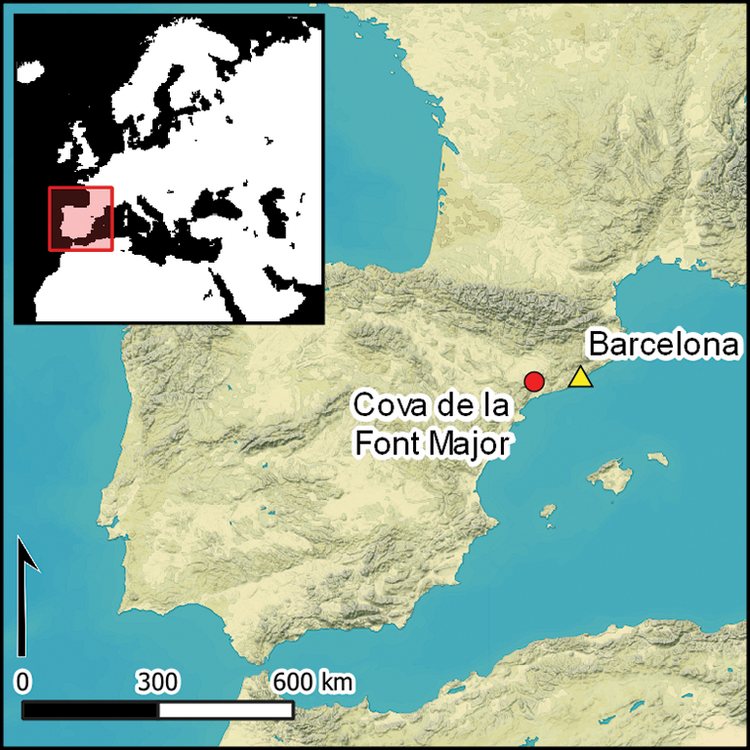
BARCELONA, SPAIN — In the realm of archaeological discoveries, few narratives rival the poetry of the overlooked. For more than six decades, hundreds of thousands of tourists, spelunkers, and amateur treasure hunters walked right past one of the most significant archaeological finds in modern European history. Wandering just 250 yards into the subterranean depths of the Cova de la Font Major in Catalonia, Spain, visitors regularly brushed shoulders with walls harboring secrets tens of thousands of years old. Some visitors even inadvertently inscribed their own modern names and dates directly over the faint, ancient grooves etched into the stone, completely oblivious to the Paleolithic masterpieces resting beneath their fingertips.
This staggering oversight has now been brought to light through groundbreaking research published in the prestigious journal Antiquity. Led by archaeologist Josep Maria Vergès and an international team of researchers, the formal documentation of the Cova de la Font Major’s rock art has upended long-held assumptions about prehistoric distribution in the Iberian Peninsula. Housing the third-largest collection of Ice Age-era engravings ever discovered on Spain’s Mediterranean coast, the cave has transformed from a popular local tourist attraction into a focal point of global archaeological significance.
Main Facts: A Subterranean Treasure Trove
The sheer scale of the discovery at Cova de la Font Major defies regional norms. While the Iberian Peninsula famously contains more than 50% of all documented Upper Paleolithic cave art in Europe, its geographic distribution has long puzzled scholars. The vast majority of these treasures are heavily concentrated in northern Spain—specifically within the Cantabrian region—and across the border into southern France. By stark contrast, the expansive northeastern region of Catalonia had yielded a meager total of only two recognized Paleolithic art representations across its entire landscape prior to this finding.
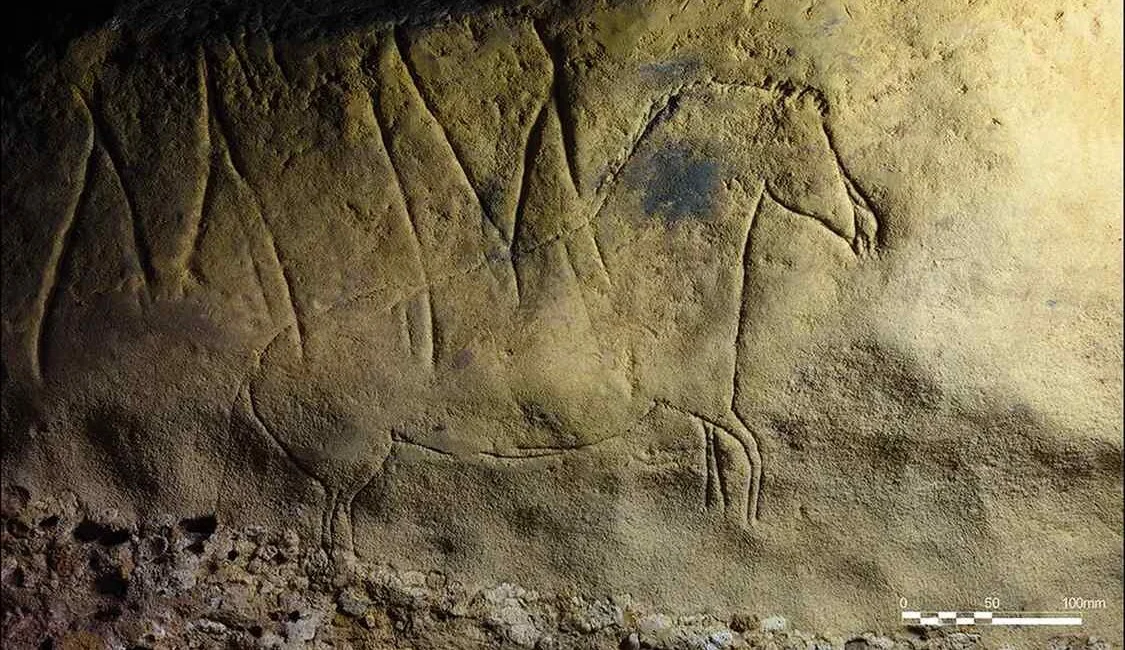
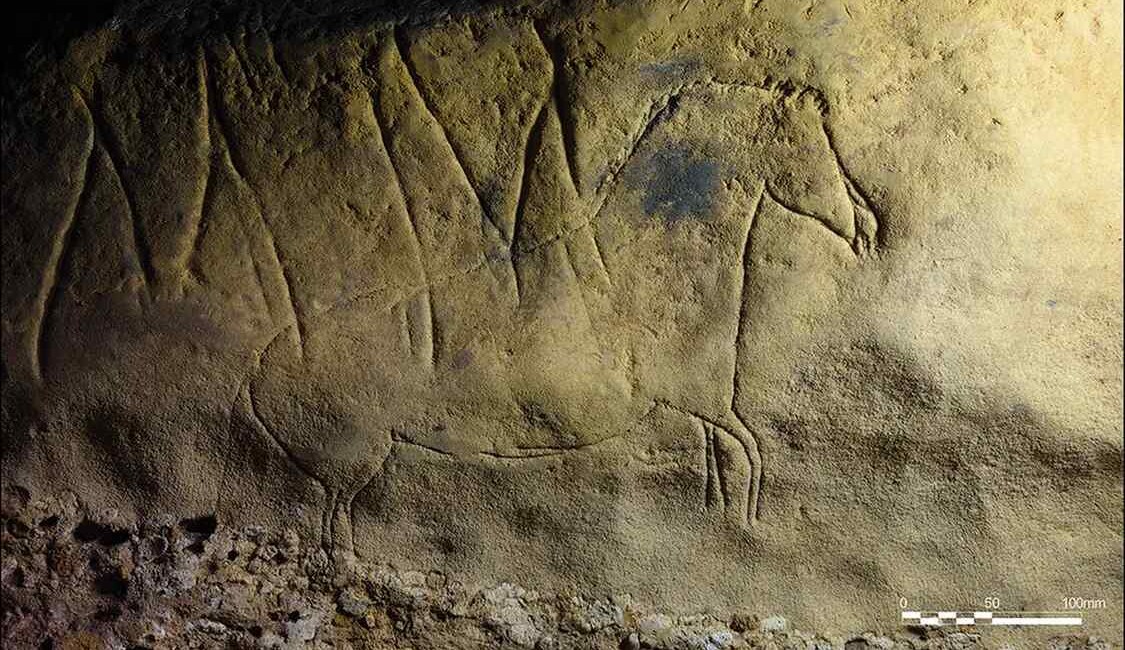
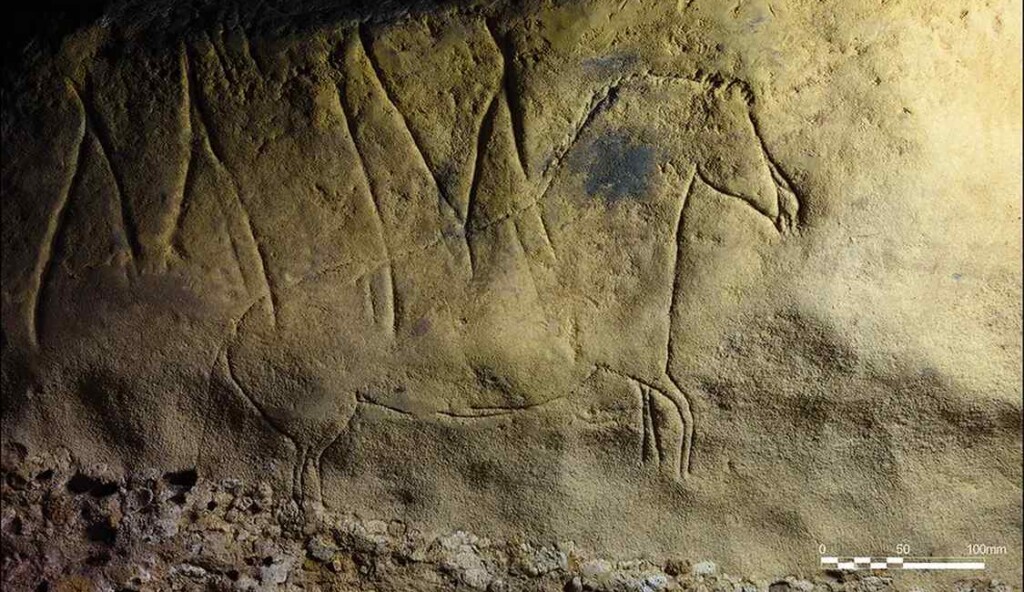
Cova de la Font Major shatters this geographic anomaly. The cave houses an astonishing 280 distinct engravings, catapulting it to the status of the third-largest Ice Age engraving collection on the Spanish Mediterranean side. Among these carvings are 55 meticulously documented animal representations, capturing the fauna of a bygone Pleistocene epoch. Horses, wild oxen, bears, goats, and deer emerge from the limestone canvas, offering a vivid window into the biodiversity and symbolic life of Ice Age Europeans.
Furthermore, the art showcases sophisticated techniques that demonstrate a profound interaction between the ancient artists and their subterranean medium. In one striking example highlighted by the researchers, a natural contour of the cave floor was deliberately utilized to represent the ground beneath a deeply etched horse—a masterclass in three-dimensional prehistoric perspective.
Chronology: From Pleistocene Hunters to Modern Tourists
The timeline of Cova de la Font Major spans tens of thousands of years, tracing a continuous thread from deep prehistory through the modern era. Radiocarbon dating of organic materials recovered from the cave floor and walls indicates that human presence within the labyrinthine passages dates back as far as 40,000 BCE, right around the time modern humans were first expanding across Europe. Use of the cave continued intermittently and intensely through successive eras, persisting through the Magdalenian period, the Neolithic, and right up into the Bronze Age.
Despite this rich history of human footfall, the art remained invisible to modern science for generations. The chronology of its modern rediscovery unfolds as follows:
- 12th Century CE: Earliest historical records indicate human visitation to the outer and middle chambers of the cave system.
- 1957: The cave begins to see heavy, systematic visitation by spelunkers, speleological clubs, and local adventurers following new explorations of its vast subterranean river networks.
- 1993: Recognizing its geological and cultural potential, authorities officially convert portions of the Cova de la Font Major into a commercial tourist attraction, complete with an interpretive museum. Over the next thirty years, hundreds of thousands of casual visitors walk the well-lit paths.
- Present Day: Josep Maria Vergès and his colleagues publish their comprehensive study in Antiquity, formally identifying and cataloging the Paleolithic engravings that had sat unnoticed beneath layers of dust, modern graffiti, and historical neglect.
The reasons for this prolonged oversight are primarily geological and psychological. For decades, academic consensus held that the Cova de la Font Major was fundamentally unsuited for prehistoric art. The cave’s walls are characterized by irregular shapes, wildly varying mineral colors, and heavily textured, undulating limestone surfaces. Traditional archaeological surveys focused their efforts on smoother, whiter panels commonly found in classic Franco-Cantabrian caves, entirely bypassing the rugged, chaotic stone canvases of Catalonia.
Supporting Data: Bypassing Statistical Norms
To understand just how statistically improbable the Font Major discovery is, one must examine the baseline data of Spanish rock art. Archaeological surveys conducted from the Pyrenees down to the Strait of Gibraltar reveal clear patterns in site composition:
- Scarcity of Large Sites: Approximately 75% of all known Spanish cave art sites contain five or fewer individual depictions.
- The 20-Mark Threshold: Over 90% of these sites contain 20 or fewer total artistic representations.
- The Font Major Outlier: With 280 distinct engravings, Font Major sits comfortably in the extreme top tier of site density, redefining what archaeologists can expect to find outside of traditional core zones.
The collection is not limited to animal representations. A significant portion of the catalog consists of non-figurative, abstract motifs. These include complex series of parallel lines and hundreds of loop-shaped engravings. Some of these loops appear isolated, while others form vast, interconnected webs.
Interestingly, not all of these abstract markings belong to the Ice Age. Scientific analysis of charcoal fragments lodged directly within some of the loop-shaped engravings revealed medieval dates. This indicates that later visitors—perhaps medieval shepherds or explorers carrying torches—also left their mark on the cave walls, interacting with the ancient stone in their own enigmatic ways.
Official Responses and Expert Analysis
The academic community has received the publication of the Antiquity study with a mixture of awe and professional humility. The realization that hundreds of thousands of tourists and dozens of professional geologists and historians walked past a major Paleolithic gallery without batting an eye has sparked robust discussions regarding archaeological survey methodologies.
In their official statements accompanying the study, the authors emphasized the psychological barrier of expectation. "For more than six decades, thousands of visitors passed directly in front of the engraved surfaces, and in some cases inscribed names and dates over them, without the Paleolithic origin of the figures being recognized," remarked Josep Maria Vergès.
The researchers noted that the discovery fundamentally challenges the notion that Catalonia was a cultural desert during the Upper Paleolithic. Instead, it suggests that rock art may have been far more widespread in the region than previously documented, rendered invisible simply because contemporary science was not looking in the right places or evaluating irregular geological formations with the correct analytical framework.
Independent specialists in European prehistoric art have echoed these sentiments, pointing out that the discovery validates theories that ancient humans actively sought out challenging, textured surfaces to imbue their art with naturalistic depth and spiritual resonance.
Implications: A Catalyst for Re-evaluating Global Prehistory
The repercussions of the Cova de la Font Major discovery extend far beyond the borders of Catalonia. By proving that major Paleolithic art collections can hide in heavily visited, commercialized caves dismissed as unsuitable, the findings have triggered an immediate wave of re-evaluations across international archaeology.
Inspired by the methodologies used in the Font Major study, researchers have begun launching retrospective surveys of other caves previously written off as barren. These renewed investigations are already yielding fruit. A recent targeted survey of Cova Simanya, another Catalan site, successfully uncovered non-representational rock art remarkably similar to the abstract motifs found at Font Major, proving that Font Major is not an isolated fluke, but potentially the tip of a much larger archaeological iceberg.
Furthermore, the discovery serves as a cautionary tale and a call to action for heritage management. As millions of tourists visit subterranean attractions worldwide, the integration of advanced digital imaging—such as 3D laser scanning, photogrammetry, and multispectral photography—is becoming mandatory. These technologies can detect micro-reliefs, faint tool marks, and organic residues that the human eye, dulled by shadows and tourist lighting, routinely misses.
Ultimately, the horses, wild oxen, and abstract loops of Cova de la Font Major remind modern humanity of the profound continuity of human expression. Tens of thousands of years ago, an artist stood in the damp, echoing dark of a Catalan cave, carving the outline of a horse to mirror the solid ground beneath its feet. Today, that enduring link across the millennia calls out to us from plain sight, demanding that we look closer at the world around us.