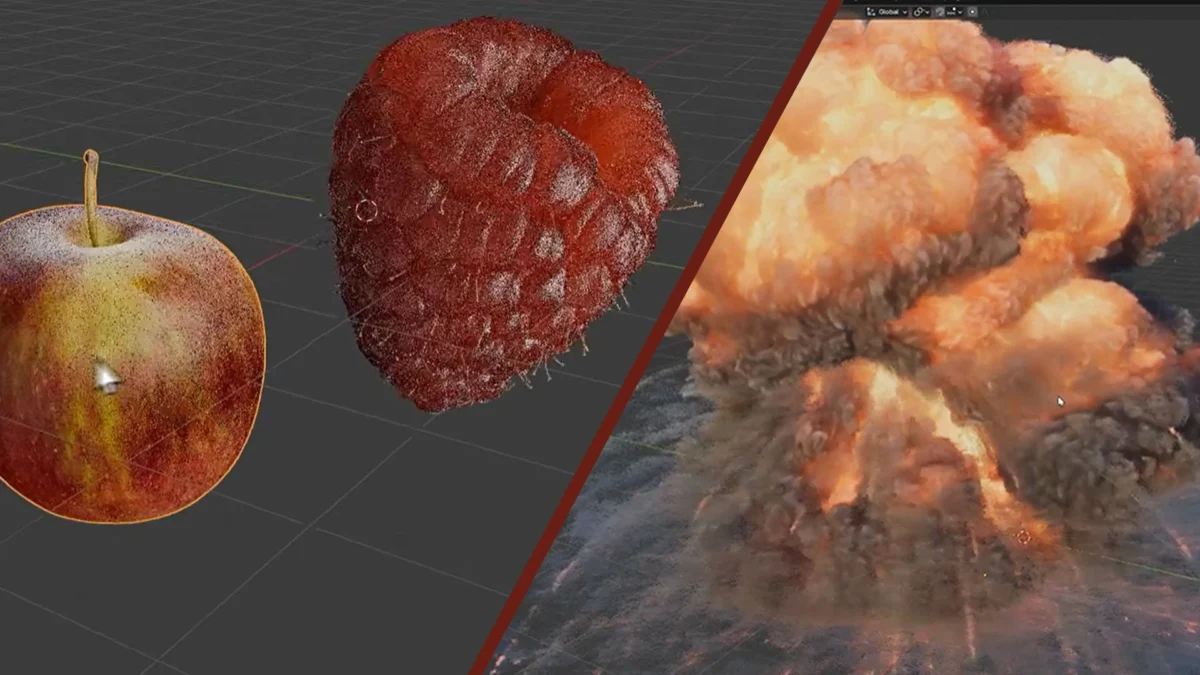
The landscape of 3D modeling and animation is on the cusp of a significant transformation. Blender, the industry-standard, open-source suite for 3D creation, is set to receive a major upgrade in its upcoming 5.3 release. While the software has long been hailed as the premier free tool for both 2D and 3D animation, the latest iteration promises to bridge the gap between photogrammetry and traditional computer graphics by introducing native support for 3D Gaussian Splatting.
Currently in its alpha phase, Blender 5.3 is slated for a full public release in November. As the creative community eagerly anticipates the stable build, the inclusion of Gaussian Splatting stands out as the most disruptive feature, signaling a new era of how artists integrate real-world captures into digital environments.
The Core Innovation: What Are Gaussian Splats?
To understand the magnitude of this update, one must first understand the shift in 3D reconstruction technology. Historically, capturing a real-world object and translating it into a 3D digital asset required complex photogrammetry—a process that creates rigid meshes composed of triangles and polygons. While powerful, this method is often computationally expensive and struggles with complex geometries like hair, glass, or fine textures.
Gaussian Splatting represents a radical departure from this paradigm. Instead of creating a solid, polygon-based surface, a Gaussian Splat is comprised of millions of tiny, overlapping, colored blobs. Each "splat" functions as a data point storing specific information regarding its 3D position, size, shape, color, and transparency. Because these points are semi-transparent and layered with high precision, they produce results that are remarkably photorealistic, capturing the nuances of light and depth that traditional meshes often fail to replicate.
By allowing users to import these scenes directly into Blender, the software is effectively democratizing a technology that was previously reserved for high-end research labs and specialized VFX studios.
Chronology: From Experimental Add-ons to Native Integration
The journey to native Gaussian Splat support has been a rapid one, characterized by the community-driven innovation that defines the Blender ecosystem.
- The Early Adoption Phase: Following the emergence of 3D Gaussian Splatting as a viable alternative to NeRFs (Neural Radiance Fields), independent developers began creating bridges. Tools such as Brush and COLMAP became the primary gateways for artists. Users would process their photo or video datasets in these external applications and then laboriously convert the output into
.plyfiles to be imported into Blender via third-party add-ons. - The Community Pressure: As Gaussian Splatting gained traction on social media platforms like X (formerly Twitter) and YouTube, the Blender community began lobbying for a more streamlined, "out-of-the-box" experience. The friction of constant format conversion and reliance on unstable, third-party codebases served as a bottleneck for professional adoption.
- The Development Sprint: Blender’s development team recognized this demand and began integrating support directly into the core engine. By mid-2024, experimental branches began to appear, allowing for the direct import of
.plyand.spzfiles. - The Current Alpha State: As of now, Blender 5.3 is in its alpha phase. This version allows users to bring in external splat data and, crucially, render it directly using Blender’s native engines—Workbench, EEVEE, and Cycles—without the need for external post-processing.
Technical Implications: Performance and Workflow
The integration of Gaussian Splats into Blender 5.3 is not merely a feature addition; it is a fundamental shift in the rendering pipeline. By supporting native rendering, Blender allows artists to treat these splats as interactive elements within their scenes.
However, the technology is still in its infancy within the software. The official release notes have highlighted several critical limitations that early adopters must navigate:
1. Hardware and Software Performance
While the rendering capabilities are impressive, they are not yet fully optimized. Users should anticipate a steep learning curve regarding hardware requirements. For those looking to capitalize on these new capabilities, high-performance workstations—particularly those equipped with top-tier GPUs—will be essential to maintain fluid viewport performance when working with high-density splat files.
2. Color Space and Lighting Hurdles
One of the primary challenges identified in the current alpha is the handling of color spaces. The pipeline currently assumes an sRGB color space, which can lead to inaccuracies when interacting with Cycles and EEVEE, as these engines operate in a linear color space. Furthermore, areas characterized by low opacity or high radiance may produce artifacts or rendering errors, requiring artists to develop manual workarounds until the internal shading models are further refined.
3. Transform Limitations
"Apply Transform" functionality is currently incomplete for Gaussian objects. Because the underlying data structure of a splat relies on complex attributes like spherical harmonics, scale, and rotation, Blender’s traditional transform tools do not yet interact with them with the same ease as they do with a standard polygon mesh. This means that scaling or rotating a splat post-import can yield unpredictable results.
The Broader Industry Impact
The introduction of Gaussian Splatting in Blender is part of a larger trend of "reality capture" becoming accessible to the average creator. While companies like Chaos have already begun tackling the issue of relighting Gaussian Splats—a notoriously difficult task due to the baked-in lighting of the original source photos—Blender’s move to support the base format ensures that it will remain the central hub for this work.
Democratizing VFX
For independent filmmakers and solo developers, this update is a game changer. Previously, if a director wanted to include a photorealistic, real-world environment in a scene, they would either need an massive budget for LIDAR scanning or hours of manual modeling. Now, an artist can walk through a location with a smartphone, record a video, convert it to a splat, and have a high-fidelity 3D environment ready for rendering in a matter of hours.
The Future of Archival and Digital Twins
The implications for digital preservation are immense. Museums, architects, and historians can now capture delicate artifacts or heritage sites with a level of visual fidelity that far exceeds traditional 3D scanning. By utilizing Blender as the primary viewing and rendering platform, these assets can be integrated into educational tools, VR experiences, and historical documentaries with unprecedented ease.
Official Stance and Future Roadmap
Blender’s commitment to this feature demonstrates a clear focus on the future of generative and captured 3D content. While the current limitations in version 5.3 are notable, the roadmap suggests that these are merely temporary hurdles.
As the developer community continues to refine the integration, we can expect to see improvements in:
- Relighting Capabilities: Better integration with Blender’s light sources, allowing splats to exist naturally within artificial environments.
- Export Functionality: While currently limited to import, future updates will likely enable the export of manipulated splats, further cementing Blender’s role as a creative powerhouse.
- Optimization: Ongoing updates to the viewport and rendering engines to ensure that even massive splat datasets can be handled in real-time.
Conclusion: A New Frontier for Digital Artists
Blender 5.3 is shaping up to be a landmark release. By embracing Gaussian Splatting, the Blender Foundation is not just keeping pace with the industry—they are helping to define the next generation of 3D workflows.
While the software is currently in alpha and carries the expected quirks and performance trade-offs, the ability to import and render these photorealistic scenes is a massive leap forward. For artists, architects, and VFX professionals, the transition to version 5.3 will provide a powerful new toolset for blending the physical and digital worlds. As we approach the November launch, the creative potential of this technology is limited only by the imagination of the users who will soon have it at their fingertips.
Whether you are a veteran 3D artist or a newcomer looking to experiment with the latest trends in computer graphics, the inclusion of Gaussian Splatting in Blender 5.3 is an update worth watching. The barrier between "capturing reality" and "creating art" has never been thinner.